Greetings Readers and History-Lovers!
When it comes to the world of Ancient Greece, the subjects we find most interesting are religious festivals and sacred athletic competitions such as the Olympic Games. These events, in a way, portray the ancient world in microcosm. ‘War minus the shooting’, as George Orwell famously said of ancient sport.
When it came to ancient Athens, the greatest event on the Attic calendar was, no doubt, the Panathenaic Festival in honour of the city’s patron goddess, Athena. To read all about the Panathenaic Festival, CLICK HERE.
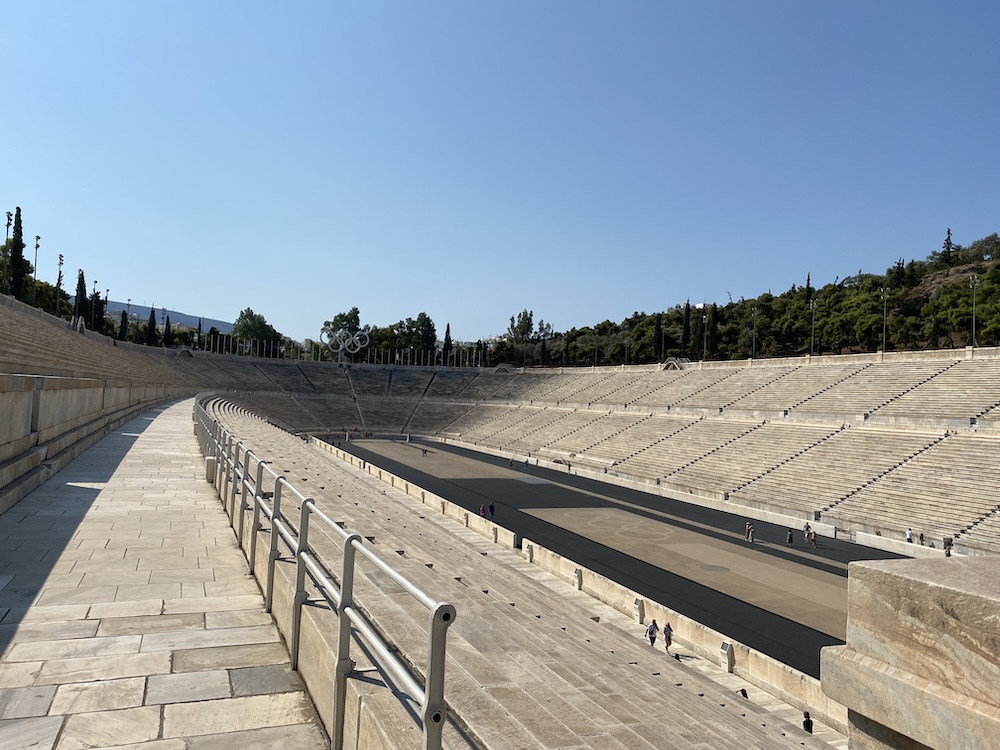
The celebrations that took place during the Great Panathenaea of Athens took place all over the city at different venues, and the venue where the athletic competitions took place was the Panathenaic Stadium, or ‘Kallimarmaro’ as it is also known, ‘Nice Marble’.
In this article, we’re going to take a brief look at the history of the stadium and, at the end, take a full video walking tour of the site.
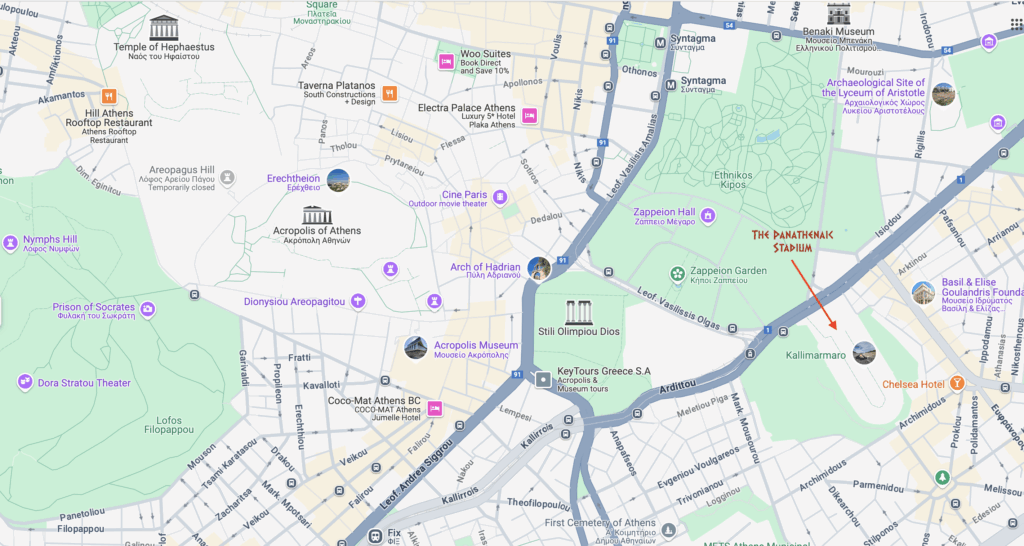
This magnificent stadium in the heart of Athens, on the edge of the modern neighbourhood of Pangrati, is located in what was a small valley between the sacred hills of Agras and Ardittos where there were also temples to the Goddess Tyche, and to Artemis Agrotera.
Originally, this was the site of a horse racing course from the 6th century B.C., but during the archonship of Lykourgos in the 4th century B.C. a new stadium was constructed as part of a string of public works projects carried out at that time.
The new stadium, which had earthen embankments where spectators sat to watch the games, was used for the first time during the celebration of the Greater Panathenaea of 330/329 B.C.

Panathenaic amphora depicting a synoris, or two-horse chariot
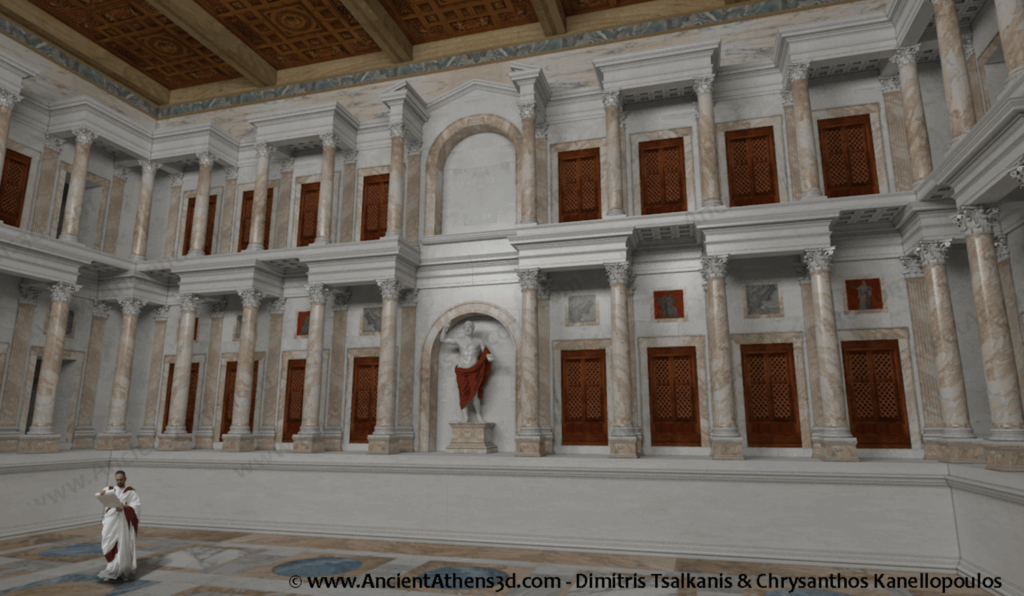
A few hundred years later, during the reign of the Roman Emperor Hadrian (A.D. 117-138), who was a great philhellene, the orator and philanthropist, Herodes Atticus, sponsored the renovation and redesign of the stadium. It was at that time that the stadium was completely rebuilt in white, Pentelic marble from the quarries outside the city.
A vaulted passage through which athletes entered the stadium was also built at this time, and the entire stadium was adorned with statuary.
This renovated, permanent Panathenaic Stadium could seat well over 50,000 spectators. It was unrivalled in the ancient world.
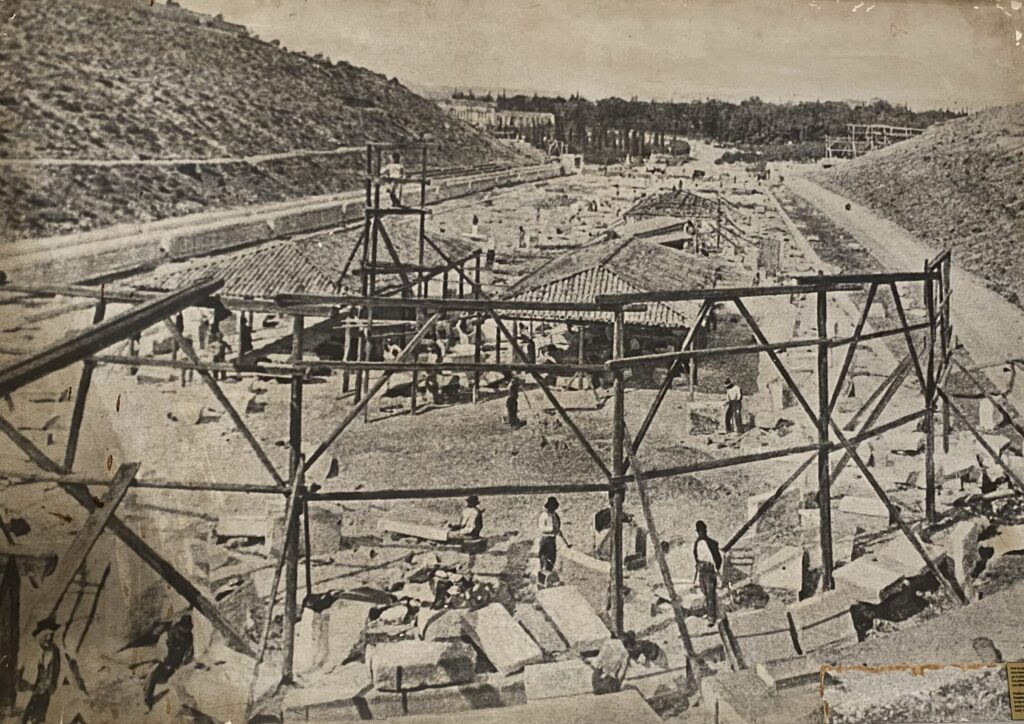
Reconstruction work on the ancient stadium in 1895
Sadly, when the Christian Roman emperors banned all pagan festivals, including the Panathenaea, the stadium fell into a state of disrepair that worsened during the Ottoman occupation of Greece from 1456 to 1821.
Thankfully, in the 1870s, a movement began to revive the idea of the Olympic Games and events were organized in the ruins of the Panathenaic Stadium. In 1896, two years after Pierre de Coubertin’s International Olympic Conference in Paris, the first modern Olympic Games were held in the newly reconstructed Panathenaic Stadium in Athens.
The Olympic Games were back, and new life was pumped into the long-dormant stadium.

First day of the modern Olympic Games held in 1896 in Athens at the Panathenaic Stadium
Since then, the Panathenaic Stadium has hosted numerous musical and athletic events and served as a venue for the marathon (the finish line) and archery events in the highly successful 2004 Athens Olympic Games.
Today, this magnificent stadium is one of the most recognizable and beloved monuments of Ancient Greece and the city of Athens.

In the summer of 2024, on a scorching day in July when the temperatures soared to 45 degrees Celsius, we took our cameras back to the Panathenaic Stadium one morning to film a walking tour of the site.
We’re thrilled to be able to present this video to you here.
We hope that you enjoy walking around the Panathenaic Stadium with us.
Thank you for reading, and thank you for watching.
The Great Panathenaea of Athens is the central event in An Altar of Indignities, Book II in our multi award-winning series, The Etrurian Players.
For more information about archaeological sites, ancient history, and Greek Mythology, be sure to visit the Article Archive.
If you are interested in visiting Athens, Greece, and are looking for discounts on airfare, accommodation, and personal tours of the archaeological sites, be sure to visit our Ancient World Travel page at the link below to take advantage of the deals we have curated for our followers:
https://eaglesanddragonspublishing.com/ancient-world-travel/
To get discounted tickets (just for our subscribers!) to archaeological sites like the Panathenaic Stadium, museums and other amazing tours and experiences in Athens, click the links below:
Tiquets: https://tiqets.tpx.lt/XRbEqVpu
Viator: https://viator.tpx.lt/jem8HgE4
Lastly, if you are a fan of Ancient Greece, Greek Mythology, or the history of the Roman Empire, be sure to check out Eagles and Dragons Publishing’s range of unique clothing, art, housewares and more in the AGORA on Amazon. CLICK HERE to shop now.