Welcome back to The World of The Hearts of Heroes!
We hope that you’ve enjoyed this blog series so far. If you missed Part II on the Romano British civitas of Viroconium Cornoviorum, you can read that by CLICKING HERE.
In Part III, we’re going to take a look at the seasonal celebrations of one the most important, fascinating, and culturally rich groups in ancient Europe and the British Isles: the Celts.
As we shall see, many pagan Celtic traditions survived the coming of Rome and the subsequent conversion to Christianity. We’ll discuss classical writers’ views of the Celts, explore Celtic myth, and look at the four great festivals that continue to be celebrated to this day.

Artist impression of Celtic peoples of Europe and Britain – by Albert Kretschmer, painters and costumer to the Royal Court Theatre, Berin, and Dr. Carl Rohrbach. – Costumes of All Nations (1882)
The history and archaeology of the cultural group we call the ‘Celts’ has always been fascinating to me, not least because of its wonderful mythology, but also because of the role it plays in Arthurian legend and literature. As the Eagles and Dragons series has progressed, many fans have noted the breadcrumbs of Celtic and Arthurian images and themes emerging in the world of the Roman Empire that has dominated the series to this point.
In The Hearts of Heroes, Greco-Roman and Celtic religious beliefs have always played a large role in the story and, in this latest novel, some of the key moments take place during the important festivals of Beltane and Samhain.
There were, in fact, four major seasonal festivals celebrated by the ancient Celts, especially in the British Isles. These were Imbolc, Beltane, Lughnasadh, and Samhain.
What were these ancient festivals? What did the Celts do at that time of year, and how did they celebrate? We’ll take brief look at each of them in turn.
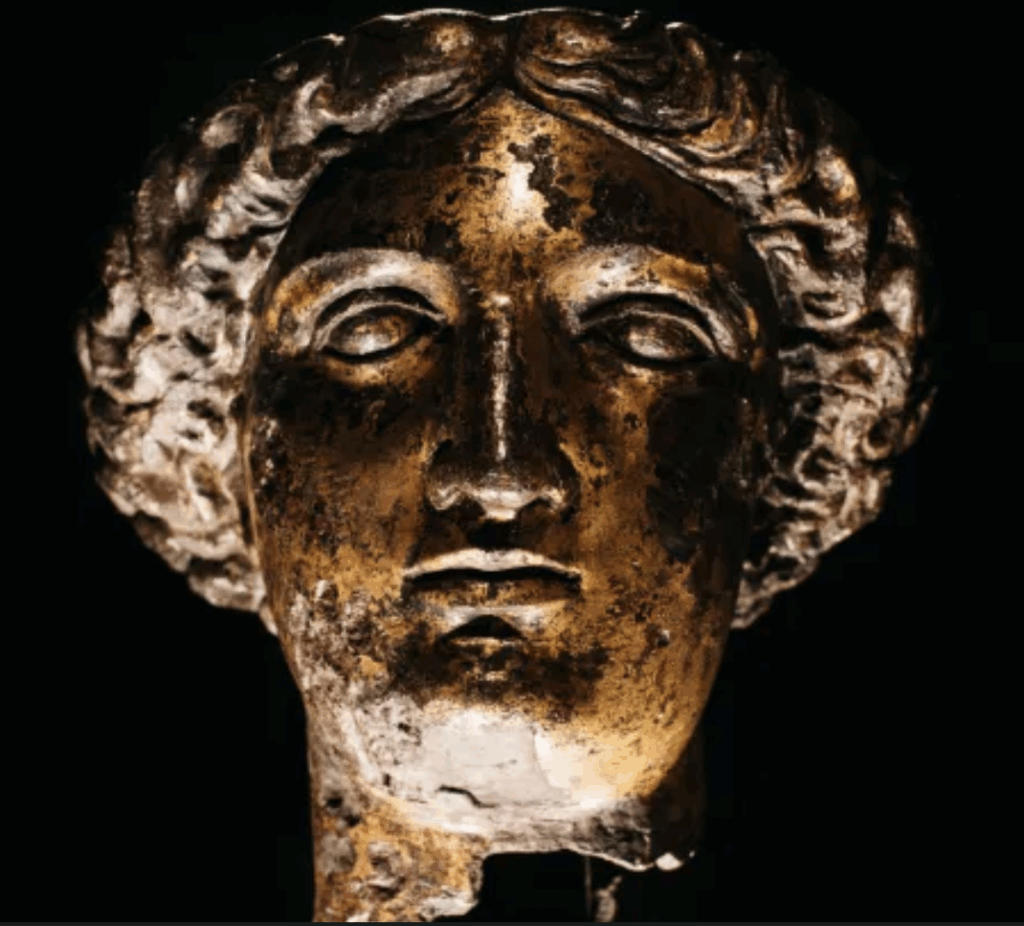
Gilt bronze head of Sulis Minerva from Bath. The Romano-British Goddess that combined Minerva with Sulis, Celtic Goddess of Wisdom and Decisions
Before we dive into the specifics of the festivals themselves, let’s discuss the ‘Celts’. Who were they? What set them apart, and how did so much of their culture survive?
‘Celts’, very simply put, is actually a broad term given to the ancient peoples of pagan beliefs in Europe and the British Isles from about 700 B.C. to A.D. 400. They thrived in much of Europe north of the Alps, but also moved south to the Mediterranean, sacking Rome in 387 B.C. and plundering the sanctuary of Delphi in 279 B.C. As Rome pushed back against the migrating Celts, defeating them heavily in Gaul, the last strongholds for these peoples became what we know today as Wales, Scotland, and Ireland, as well as Cornwall and Brittany.
As Rome’s legions conquered Britannia, however, Celtic culture and religion were not completely snuffed out. In fact, a unique Romano-British culture emerged that was an amalgam of the two sides, and it thrived once the Pax Romana had settled over Britannia.
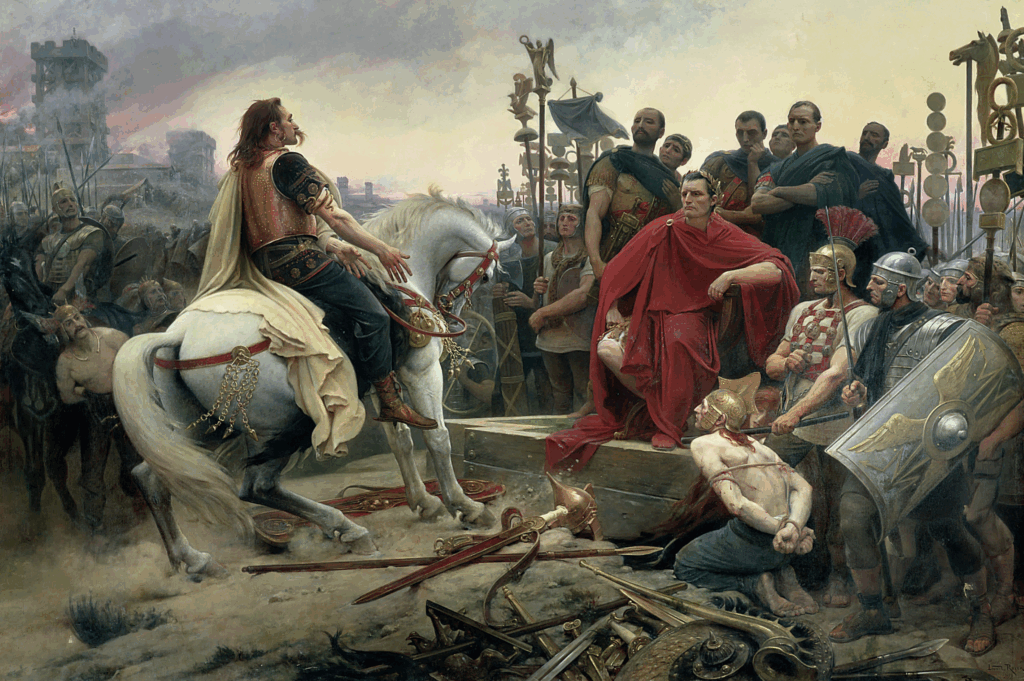
Vercingetorix Throws Down his Arms at the Feet of Julius Caesar (Lionel Royer 1899)
The nation of all the Gauls is extremely devoted to superstitious rites; and on that account they who are troubled with unusually severe diseases, and they who are engaged in battles and dangers, either sacrifice men as victims, or vow that they will sacrifice them, and employ the Druids as the performers of those sacrifices; because they think that unless the life of a man be offered for the life of a man, the mind of the immortal gods can not be rendered propitious, and they have sacrifices of that kind ordained for national purposes. Others have figures of vast size, the limbs of which formed of osiers they fill with living men, which being set on fire, the men perish enveloped in the flames. They consider that the oblation of such as have been taken in theft, or in robbery, or any other offence, is more acceptable to the immortal gods; but when a supply of that class is wanting, they have recourse to the oblation of even the innocent.
(Gaius Julius Caesar, The Gallic War, Book VI, 16)
Much of what we know about the Celts comes from classical writers such as Julius Caesar (above), or references by such ancient Greek authors as Herodotus and Hecataeus of Miletus, or later Roman authors like Strabo, Diodorus Siculus, Lucan, and Cassius Dio. Some of these authors wrote about the customs and religion of the ancient Celts, but admittedly, it was more often from their point of view as a more ‘civilized’ society. Though there is still much to be gleaned from these texts, it is important to keep in mind that, as in the case of Caesar’s memoir of the conquest of Gaul, he may have sensationalized the Celtic people, the Druids, and their barbarian rituals to enhance his own actions and achievements.
History is often written by the victors, after all.
That said, classical authors are not our only source for knowledge about the Celts, not even remotely. Archaeology and material culture have been a wealth of knowledge for us, as have the rich linguistic legacies Celtic language and literature. It is the literature of early Medieval Wales and Ireland that is, perhaps, one of the greatest sources of our knowledge about the Celts, their society, religion, and mythology.
The combination of all of these sources help to point a rather vivid picture of the Celts and their beliefs, including shared themes of water rituals, head-hunting, otherworldly feasting, the religious significance of cauldrons, the sanctity of the number ‘3’ and more.
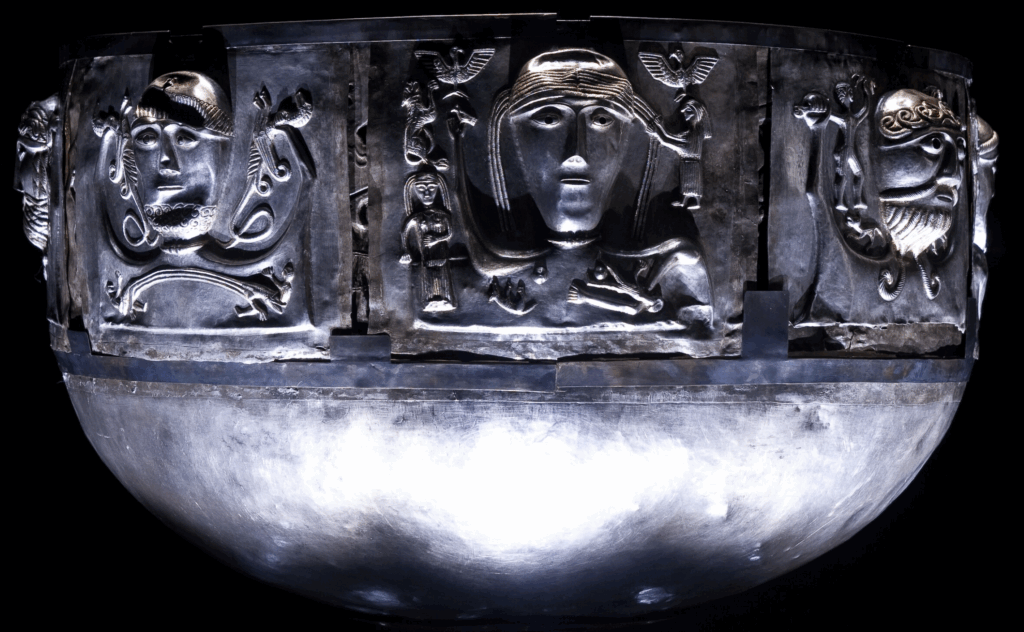
The Gundestrup cauldron is a silver vessel dated from between 200 BC and 300 AD. it’s the largest known example of European Iron Age silver work. Now in the National Museum of Denmark in Copenhagen.
When it came to religious beliefs, one might think that Christianity would have wiped out all traces of pagan Celtic beliefs.
But that is not so.
While Celtic beliefs seem to have melded nicely, post-conquest, with those of their Roman conquerors (the Goddess Epona is a perfect example of this), the subsequent Christianization of the Celts appears to have also been something of a smooth transition with Celtic monks copying and Christianizing ancient pagan tales such as the Táin Bó Cúailnge and four branches of The Mabinogi. Celtic gods also survived by donning the robes of Christian Saints.
The religion of the pagan Celtic world survived not only in the literature that was passed on, but also in the seasonal festivals of the Celts that continue to be celebrated to this day. It is through these seasonal festivals that we can glimpse the beliefs and rituals of an ancient pagan, Celtic past.
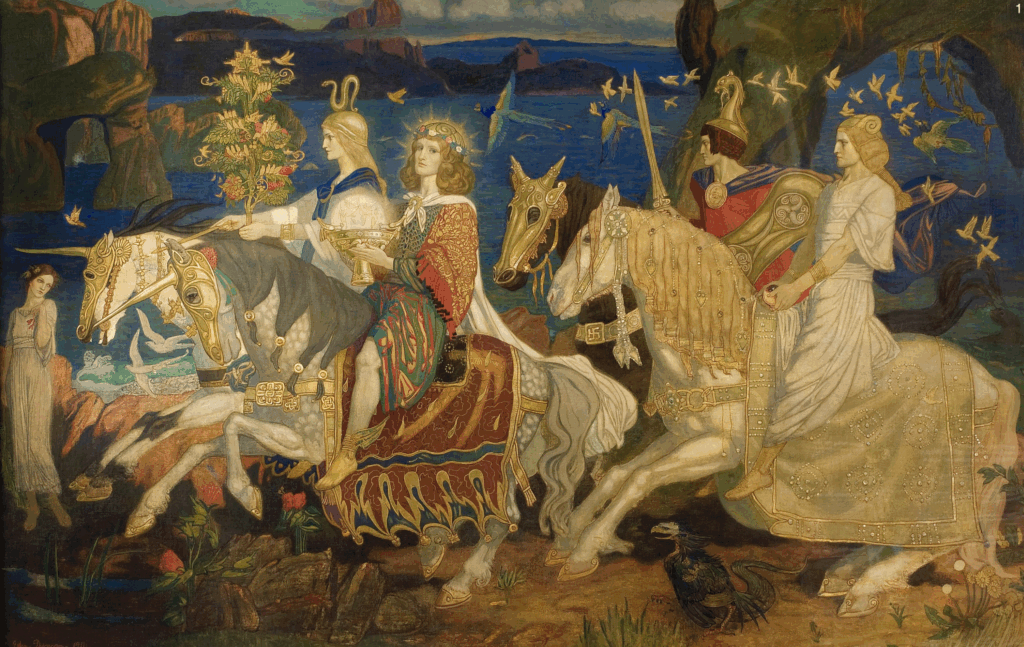
The Tuatha Dé Danann as depicted in John Duncan’s Riders of the Sidhe (1911)
All over Europe the peasants have been accustomed from time immemorial to kindle bonfires or certain days of the year, and to dance round or leap over them. Customs of this kind can be traced back on historical evidence to the Middle Ages, and their analogy to similar customs observed in antiquity goes with strong internal evidence to prove that their origin must be sought in a period long before the spread of Christianity…
…The seasons of the year when these bonfires are most commonly lit are spring and midsummer; but in some places they are kindled also at the end of autumn or during the course of the winter…
(Sir James Frazer, The Golden Bough, LXII)
Water and fire were both important aspects of the seasonal festivals of the Celts. Sir James Frazer was correct in highlighting the importance of fire in festivals. Fire was equated with the sun and was its terrestrial element symbolizing warmth and illumination, venerated for its purifying and cleansing qualities.
Like the Greeks and Romans, there were many festivals throughout the year for the Celts. The difference however was that Celtic religion, though honouring the gods, also honoured nature and the cycles of nature, perhaps in a more fulsome way that the Greeks and Romans.
The four main seasonal festivals of the Celts (Imbolc, Beltane, Lughnasadh, and Samhain), what we know about them, and how they are celebrated to this day, illustrate this…
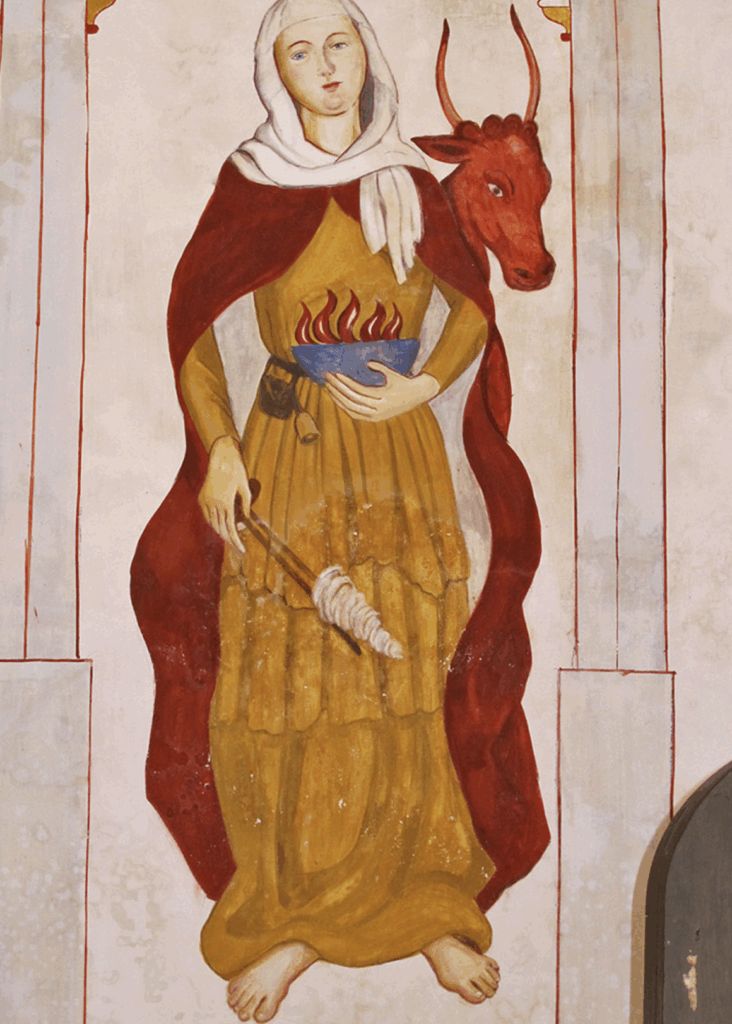
Painting of Saint Brigid with a bowl of fire, a spindle, and a cow in St. Patrick’s Chapel, Glastonbury Abbey.
IMBOLC
The ancient festival of Imbolc was held on February 1st of ever year. It marked the beginning of Spring and was associated with the lambing season.
After a long winter during which food stores were depleted, the lambing season did not only symbolize brith and fertility in the springtime. It also meant the arrival of fresh milk after the winter shortage.
In addition to being a festival of renewal and rebirth, Imbolc was also a purification festival, similar to Lupercalia in Ancient Rome.
This Celtic festival appears to have been celebrated mostly in Ireland, though it was also celebrated in Scotland, and other areas. And some tombs across the land, such as the Mound of Hostages at Tara in Ireland are aligned to be illuminated by the sunrise on the morning of Imbolc.
The strongest association of this festival was with the Irish Goddess Brigid who, in myth, was one of the Tuatha De Danann, the supernatural race who are descended from the Goddess Danu in Irish mythology.
Brigid is one of those special figures from Irish myth who survived the Christianization of the land and culture. The Goddess Brigid joined with St. Brigid of Kildare, the mother saint of Ireland who founded the Abbey of Kildare in around A.D. 480.
The festival of Imbolc on Feburary 1st thus became the feast day of St. Brigid.
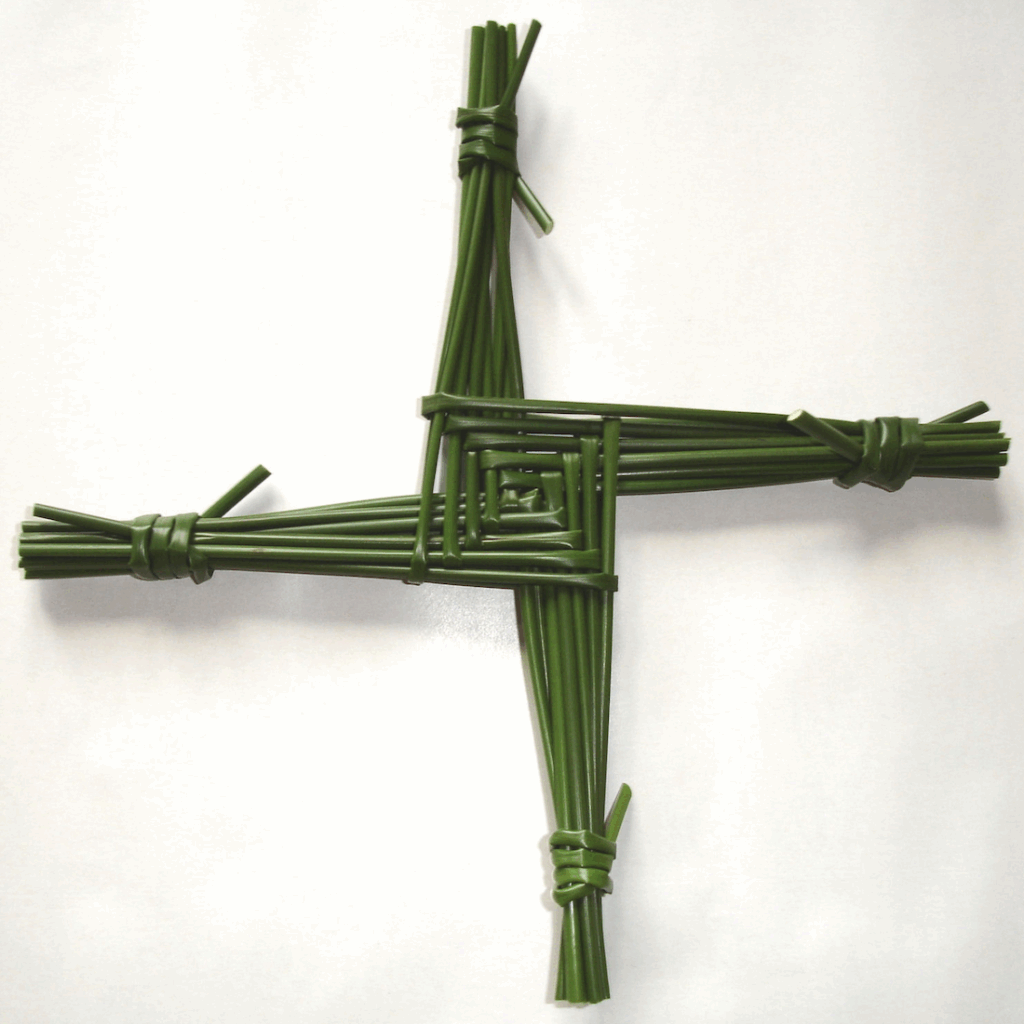
Saint Brigid’s cross, made from rushes from County Down. (Wikimedia Commons)
During the festival of Imbolc, there were certain traditions that took place, including visits to holy wells, eating special meats, holding feasts and, it is also supposed, the ritual washing of the hands, feet, and head.
The most iconic symbol of this day has become the Brigid cross which symbolized her early medieval role as the Abbess of Kildare. At Imbolc, people would weave Brigid crosses which were equilateral crosses made with rushes that were then hung above doors and windows for protection. Some traditions also saw people making a bed for Brigid in their homes on the eve of Imbolc, leaving her food and drink as well.
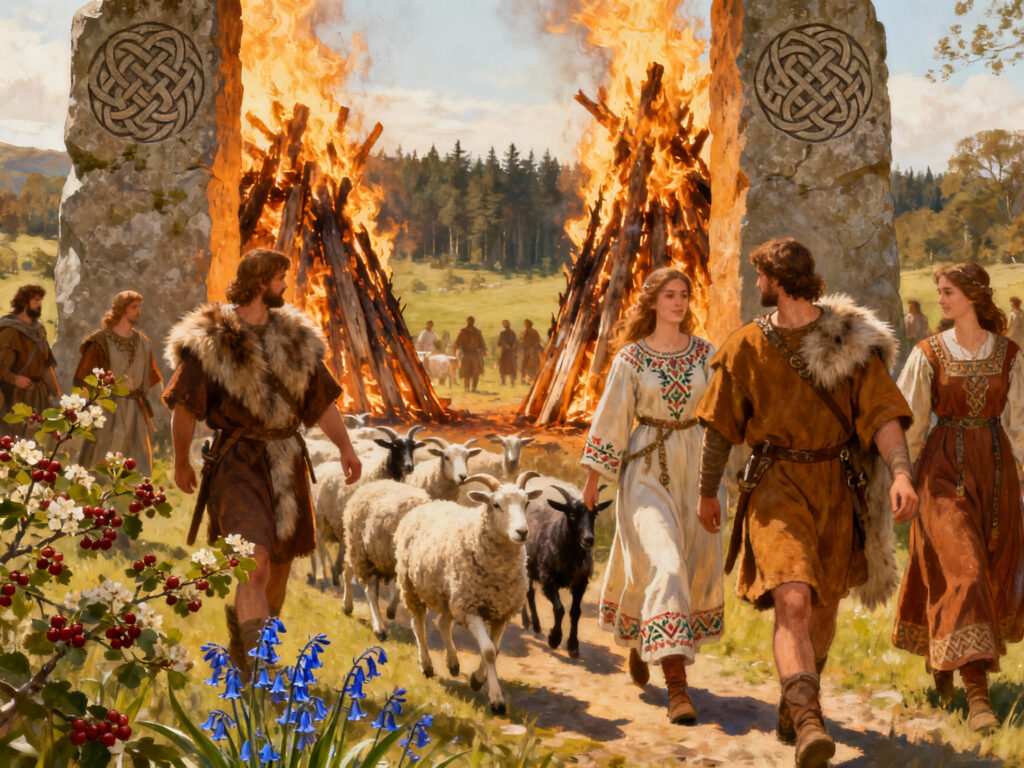
Artistic impression of men, women and livestock passing between sacred bonfires at Beltane.
BELTANE
In the Central Highlands of Scotland bonfires, known as the Beltane fires, were formerly kindled with great ceremony on the first of May, and the traces of human sacrifices at them were particularly clean and unequivocal. The custom of lighting the bonfires lasted in various places far into the eighteenth century…
…Like the other public worship of the Druids, the Beltane feast seems to have been performed on hills or eminences. They thought it degrading to him whose temple is the universe, to suppose that he would dwell in any house made with hands. Their sacrifices were therefore offered in the open air…where they were presented with the grandest views of nature, and were nearest the seat of warmth and order…
…After kindling the bonfire with the tein-eigin [a ‘need fire’ started by friction] the company prepared their victuals. And as soon as they had finished their meal, they amused themselves a while in singing and dancing round the fire.
(Sir James Frazer, The Golden Bough, LXII)
May 1st, or ‘May Day’, marked the beginning of the summer season, and Beltane was the Celtic fire festival that celebrated this.
This festival celebrated the leading of the herds to their summer pastures and included rituals to protect and purify people and cattle by having them pass between sacred bonfires. The ashes from these fires were then gathered and spread over crops for protection, but also to encourage growth.
Feasting and drinking and visits to holy wells were also a big part of Beltane celebrations, as were sacred flowers such as hawthorn, primrose, rowan, gorse, hazel, and marsh marigold. Flowers were placed over doorways, on animals, and on food for protection, so as not to be stolen by the fairy folk.
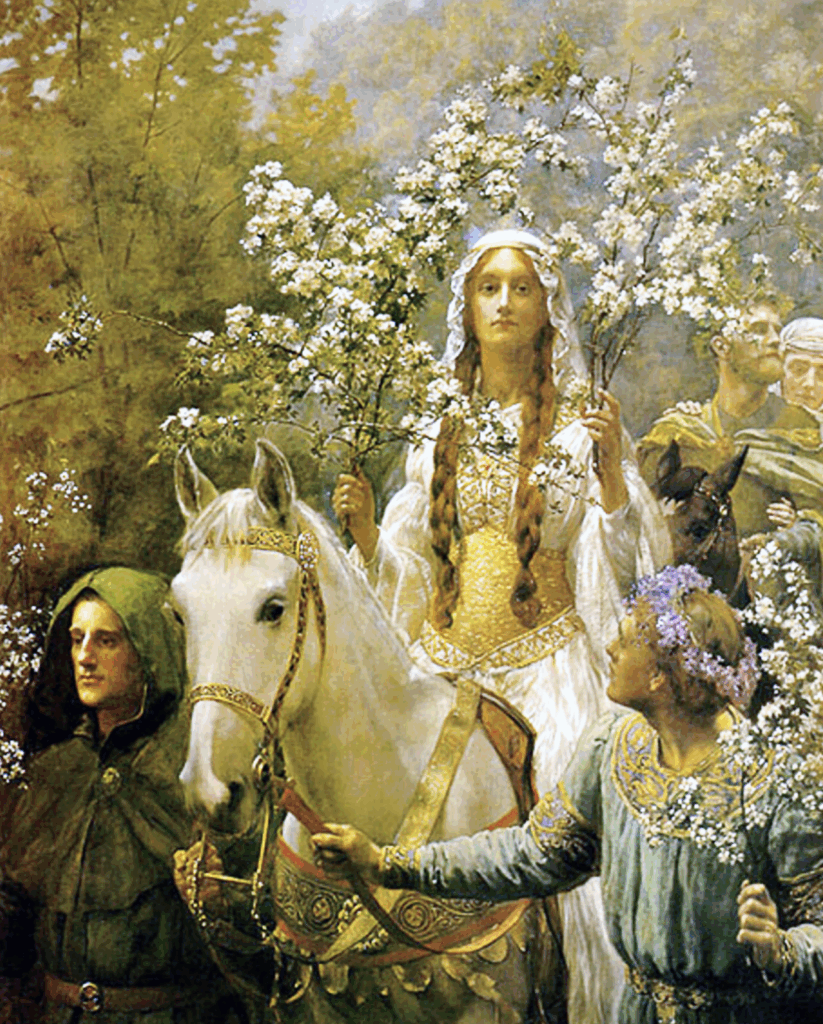
Queen Guinevere’s Maying, by John Collier
In addition to being a springtime festival of fertility and fire, Beltane was a liminal festival like Samhain, when the veil between the world and the spirit world was thinnest.
Into the modern era, a May Queen and Green Man were appointed during the festivities, and May Poles decorated with flowers and ribbons – a supposed symbol of fertility – were erected and danced around by young men and women crowned with flowers.
LUGHNASADH
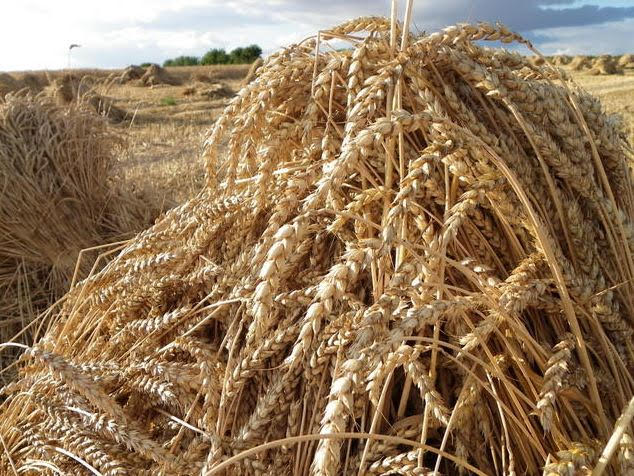
The festival of Lughnasadh, which began on August 1st, was a sacred festival to mark the beginning of the harvest season. It took place half way between the Summer Solstice and the Autumn Equinox.
Lughnasadh, also know as Gwyl Awst in Welsh, was named after the Celtic God, Lugh, a member of the Tuatha De Danann, who was a king and master craftsmen who is associated with oaths, truth, and law or rightful kingship.
In Celtic myth, Lugh founded the festival as funeral games for a goddess – perhaps the Goddess Tailtin – who died after clearing Ireland’s plains for agriculture.
The myth and festival commemorate a sort of mourning or ‘wake’ for the end of Summer. There are parallels to the Persephone myth here, in addition the Romans’ association of Lugh with the God Mercury.
They [the Celts] worship as their divinity, Mercury in particular, and have many images of him, and regard him as the inventor of all arts, they consider him the guide of their journeys and marches, and believe him to have great influence over the acquisition of gain and mercantile transactions.
(Gaius Julius Caesar, The Gallic War, Book VI, 17)
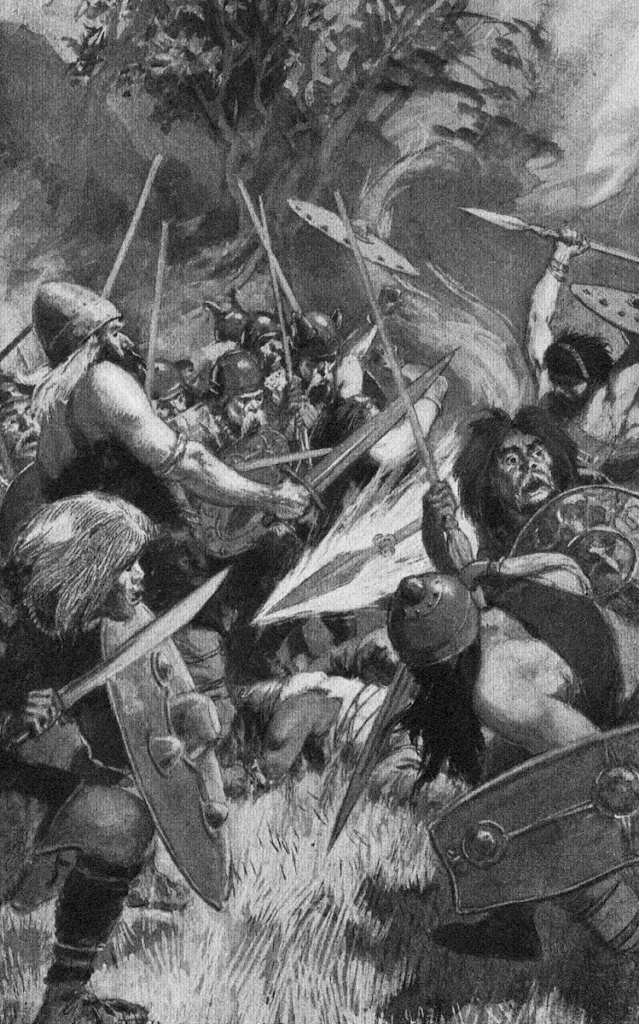
Illustration of Lugh’s magic spear by Harold Robert Millar
In Irish myth, Lugh is the father of the hero, Cuchulainn, in the Táin Bó Cúailnge. When his son is wounded in battle, Lugh appears to help heal him:
“A single man here cometh towards us now,” cried Laeg. “But what manner of man is he?” Cuchulainn asked. “Not hard to say,” Laeg made answer. “A great, well-favoured man, then. Broad, close-shorn hair upon him, and yellow and curly his back hair. A green mantle wrapped around him. A brooch of white silver in the mantle over his breast. A kirtle of silk fit for a king, with red interweaving of ruddy gold he wears trussed up on his fair skin and reaching down to his knees. A great one-edged sword in his hand. A black shield with hard rim of silvered bronze thereon. A five-barbed spear in his hand. A pronged bye-spear beside it. Marvellous, in sooth, the feats and the sport and the play that he makes. But him no one heeds, nor gives he heed to any one. No one shows him courtesy nor does he show courtesy to any one, like as if none saw him in the camp of the four grand provinces of Erin.” “In sooth, O fosterling,” answered Cuchulainn, “it is one of my friends of fairy kin that comes to take pity upon me, because they know the great distress wherein I am now all alone against the four grand provinces of Erin on the Plunder of the Kine of Cuailnge, killing a man on the ford each day and fifty each night, for the men of Erin grant me not fair fight nor the terms of single combat from noon of each day.”
Now in this, Cuchulainn spoke truth. When the young warrior was come up to Cuchulainn he bespoke him and condoled with him or the greatness of his toil and the length of time he had passed without sleep.”This is brave of thee, O Cuchulainn,” quoth he. “It is not much, at all,” replied Cuchulainn. “But I will bring thee help,” said the young warrior. “Who then art thou?” asked Cuchulainn. “Thy father from Faery am I, even Lug son of Ethliu.” “Yea, heavy are the bloody wounds upon me; let thy healing be speedy.” “Sleep then awhile, O Cuchulainn,” said the young warrior, “thy heavy fit of sleep by Ferta in Lerga till the end of three days and three nights and I will oppose the hosts during that time.” He examined each wound so that it became clean. Then he sang him the ‘men’s low strain’ till Cuchulainn fell asleep withal. It was then Lug recited the Spell-chant of Lug.
Accordingly Cuchulainn slept his heavy fit of sleep at ‘the Gravemound on the Slopes’ till the end of three days and three nights. And well he might sleep. Yet as great as was his sleep, even so great was his weariness. For from the Monday before Samhain even to the Wednesday after Spring-beginning, Cuchulainn slept not for all that space, except for a brief snatch after mid-day, leaning against his spear, and his head on his fist, and his fist clasping his spear, and his spear on his knee, but hewing and cutting, slaying and destroying four of the five grand provinces of Erin during that time.
Then it was that the warrior from Faery [Lugh] laid plants from the fairy-rath and healing herbs and put a healing charm into the cuts and stabs, into the sores and gaping wounds of Cuchulainn, so that Cuchulainn recovered during his sleep without ever perceiving it.
(Táin Bó Cúailnge, trans. Joseph Dunn)
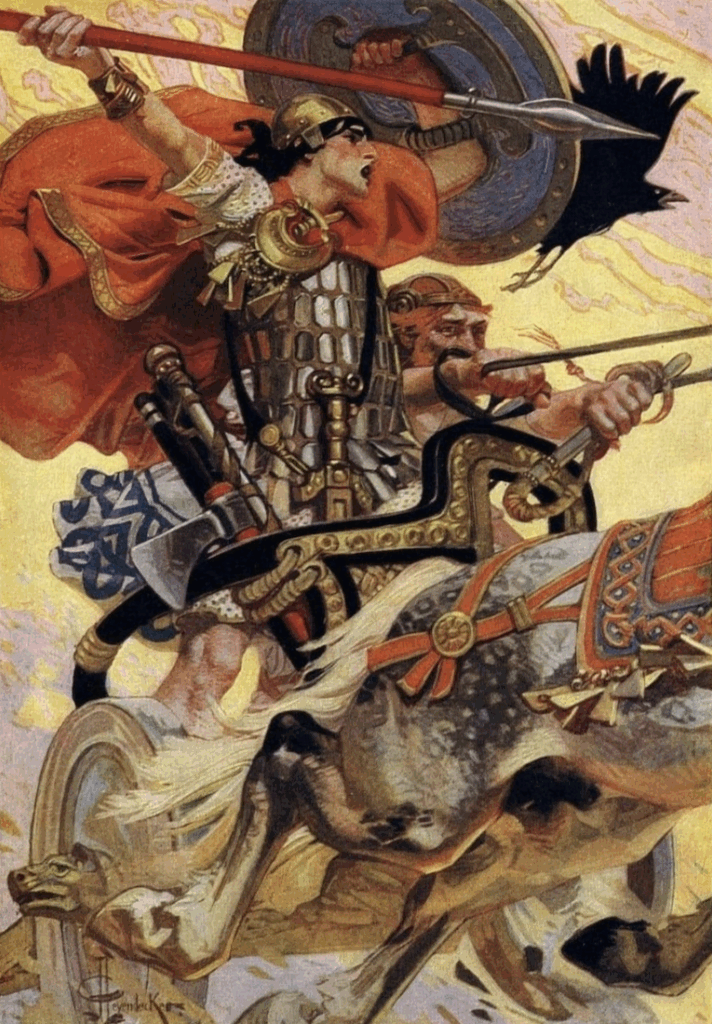
“Cuchulain in Battle”, illustration by J. C. Leyendecker in T. W. Rolleston’s Myths & Legends of the Celtic Race, 1911
There were many rituals involved in the festivities of Lughnasadh. These included a feast, the sacrifice of a bull, ritual dances, visits to holy wells, and the offering of ‘first fruits’ to the gods, especially bilberries.
With its possible origins as funeral games founded by Lugh, the festivities, especially in the Middle Ages, also involved athletic competitions, horse racing, mock battles with sticks, music and storytelling, trading, dispute settlement, and even match-making. A truce was also declared during the time of Lughnasadh.
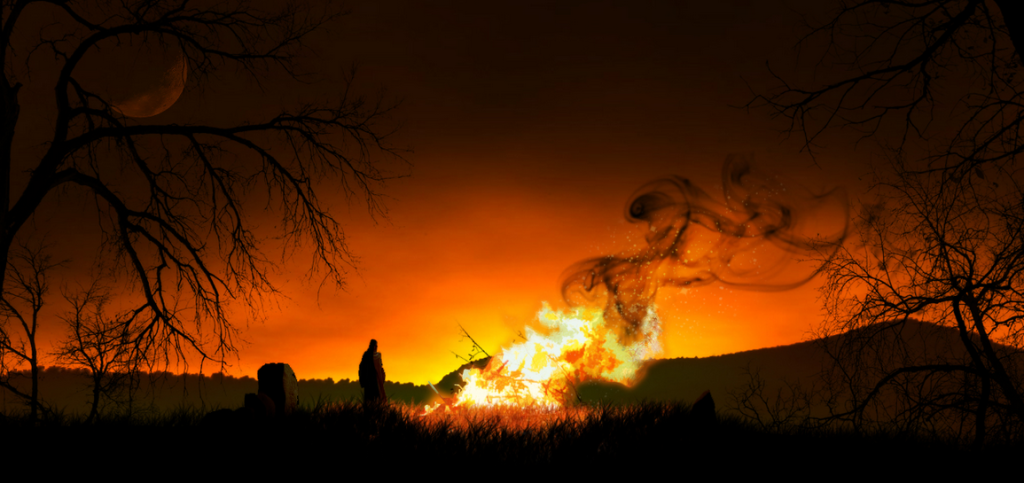
SAMHAIN
…it remains to give some account of the corresponding festival of Hallowe’en [Samhain], which announced the arrival of winter.
Of the two feasts [Beltane and Samhain] Hallowe’en was perhaps of old the more important, since the Celts would seem to have dated the beginning of the year from it rather than from Beltane…
…Another circumstance of great moment which points to the same conclusion is the association of the dead with Hallowe’en. Not only among the Celts but throughout Europe, Hallowe’en, the night which marks the transition from autumn to winter, seems to have been of old the time of year when the souls of the departed were supposed to revisit their old homes in order to warm themselves by the fire and to comfort themselves with the good cheer provided for them in the kitchen or the parlour by their affectionate kinsfolk…
…But it is not only the souls of the departed who are supposed to be hovering unseen on the day “when autumn to winter resigns the pale year.” Witches then speed on their errands of mischief, some sweeping through the air on besoms, others galloping along the roads on tabby-cats, which for that evening are turned into coal-black steeds. The fairies too are all let loose, and hobgoblins of every sort roam freely about.
(Sir James Frazer, The Golden Bough, LXII)
The last and perhaps most important of the seasonal Celtic festivals, as implied by Sir James Frazer above, is Samhain, the precursor of our modern Halloween and All Souls Day.
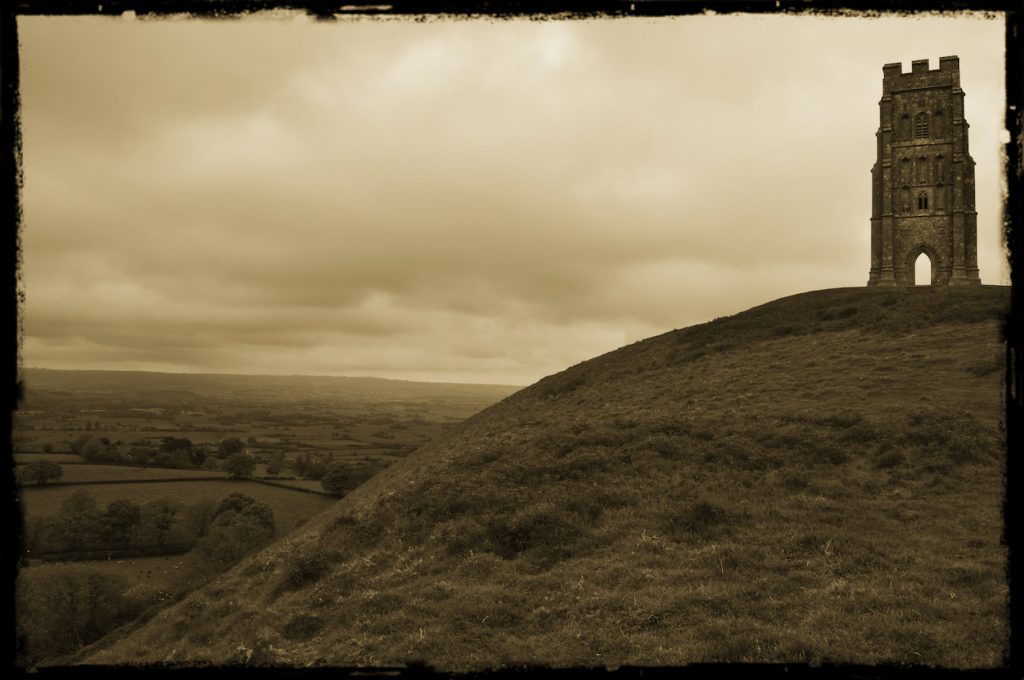
Glastonbury Tor – One of the gateways to Annwn, the Celtic Otherworld
Samhain features large in The Hearts of Heroes as it has in other books in the Eagles and Dragons series. It is the other liminal festival of the Celtic calendar when the veil between worlds is most thin and when, as Frazer points out, the dead come to walk among the living.
Samhain, which took place on October 31st and November 1st, was a time of danger and vulnerability, a boundary time when the old year died and the new year began. It was, scholars believe, the pagan Celtic New Year in ancient times.
It was at Samhain, the official beginning of winter, that the animals, especially cattle, were brought down from their summer pastures, some for slaughter and some for breeding.
Burial mounds were opened and people paid their respects to the dead who were able to come into their world from the Otherworld because the veil was thin. Contact with the Otherworld was common in Celtic religion and, for this reason, bonfires were lit on hilltops for protection and for cleansing.
Spirits and fairies were offered food and drink to ensure the survival of the people and their livestock over the coming winter. Sir James Frazer believed that Samhain and Beltane, especially of the seasonal festivals, where particular to herding communities who practiced ‘transhumance’, the seasonal moving of livestock from summer to winter pastures.
Apples and hazelnuts were important in Samhain celebrations as well. Apples were associated with the Celtic Otherworld and immortality, and apple peels were offered to the fires. Hazelnuts were associated with divine wisdom.
And, of course, mumming and guising were a tradition at Samhain in the early modern period, this tradition being a precursor of putting on costumes at Halloween.
In Ireland, Samhain was the time when the five provinces gathered at Tara for the great assemblies. In the Táin Bó Cúailnge, it was also when the invasion of Ulster began.
Perhaps the strongest pagan association with Samhain related to the dead is the Wild Hunt which was led by Gwyn ap Nudd, the Lord of Annwn, the Celtic Otherworld.
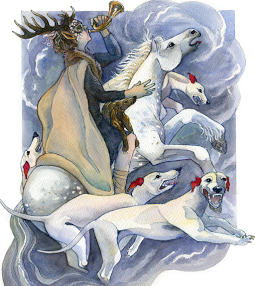
Artist impression of Gwyn ap Nudd hunting with his otherworldly hounds.
Gwyddneu:
For thou hast given me protection;
How warmly wert thou welcomed!
The hero of hosts, from what region thou comest?
[Gwyn ap Nudd is asked which region is he from. Gwyn does not answer directly]
Gwyn ap Nudd:
I come from battle and conflict
With a shield in my hand;
Many is the broken helmet pierced by the spears.
Gwyddneu:
I will address thee, exalted man,
With his shield in distress;
Brave man, what is thy descent?
[Gwyddneu (ruler of the sunken kingdom of Cantre’r Gwaelod) now asks about Gwyn ap Nudd’s family]
Gwyn ap Nudd:
Carngrwn [Round-hoofed] is my horse, the torment of battle,
Fairy am I called, Gwyn the son of Nudd,
The lover of Creudilad, the daughter of Llud.
Gwyddneu:
Since it is thou, Gwyn, an upright man,
From thee there is no concealing;
I also am Gwydneu Garanhir.
[Gwyn ap Nudd’s horse is becoming impatient and wants to return to Tawë in Annwn]
Gwyn ap Nudd:
He will not leave me in a parley with thee,
By the bridle, as is becoming;
But will hasten away to his home on the Tawë .
It is not the nearest Tawë I speak of to thee,
But the furthest Tawë
Eagle! I will cause the furious sea to ebb.
Polished is my ring, golden my saddle and bright
To my sadness
I saw a conflict before Caer Vandwy.
Before Caer Vandwy a host I saw,
Shields were shattered and ribs broken
Renowned and splendid was he who made the assault.
Gwyddneu:
Gwyn ab Nud, the hope of armies,
Sooner would legions fall before the hoofs
Of thy horses, than broken rushes to the ground.
Gwyn:
Handsome my dog and round-bodied,
And truly the best of dogs;
Dormach was he, which belonged to Maelgwn.
Gwyddneu:
Dormach with the ruddy nose! what a gazer
Thou art upon me! because I notice
Thy wanderings on Gwibir Vynyd.
Gwyn:
I have been in the place where was killed Gwendoleu,
The son of Ceidaw, the pillar of songs,
When the ravens screamed over blood.
I have been in the place where Bran was killed,
The son of Gweryd, of far-extending fame,
When the ravens of the battle-field screamed.
I have been where Llachau was slain,
The son of Arthur, extolled in songs,
When the ravens screamed over blood.
I have been where Meurig was killed,
The son of Carreian, of honourable fame,
When the ravens screamed over flesh.
I have been where Gwallawg was killed,
The son of Goholeth, the accomplished,
The resister of Lloegyr, the son of Lleynawg.
I have been where the soldiers of Prydain
[Britain] were slain,
From the East to the North;
I am alive, they in their graves!
I have been where the soldiers of Prydain
[Britain] were slain,
From the East to the South
I am alive, they in death!
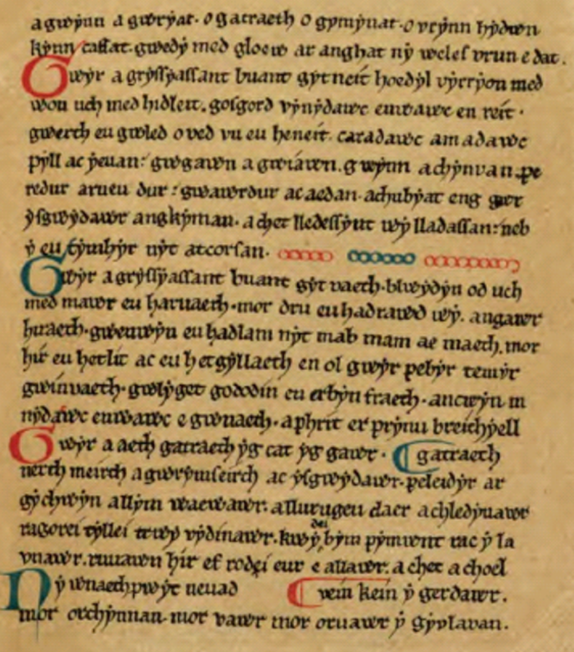
(The Dialogue of Gwyn ap Nudd and Gwyddno Garanhir, The Black Book of Carmarthen XXXIII)
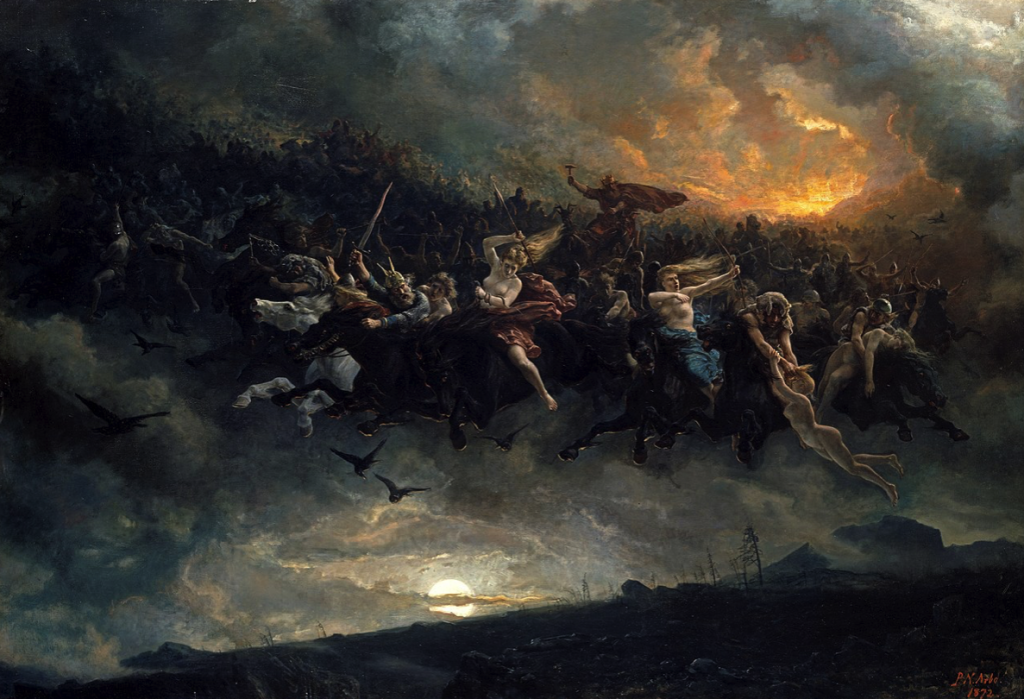
The Wild Hunt (1872) by Peter Nicolai Arbo
Mainly at Samhain, but also at other liminal times of the year, Gwyn ap Nudd, the Lord of Annwn, a sort of ‘King of the Fairies’, rode out on his magical horse with his white, otherworldly hounds with white-tipped ears to lead the dead in the Wild Hunt.
In later traditions, Gwyn ap Nudd was replaced by others, including King Arthur, as leader of the Wild Hunt at Samhain. In the 19th century, there were reports that locals had seen the king’s ghost riding with his hounds at South Cadbury Castle, in Somerset.
For fans of the Eagles and Dragons series, Gwyn ap Nudd, the Lord of Annwn, is a terrifying figure who has appeared before, and will appear again…
Just as our modern New Years is today, Samhain, the New Year’s festival of the ancient Celts, was at once both a sombre and joyous celebration. As a time of great spiritual energy in the world, when gods visited men, shapeshifters and spirits roamed the land, and all manner of supernatural beings crossed the veil between worlds, Samhain was one of the most important times of year on the Celtic calendar. It was a time to honour the gods and the dead, a time of fear, but also a time of gratitude.
Thank you for reading.
We hope you’ve enjoyed this article about the seasonal festivals of the ancient Celts.
Tune in for Part IV in The World of The Hearts of Heroes when we will be visiting one of the settings in the novel, ‘The Fairy Glen’ at Betws-y-Coed on the eastern edge of the ruggedly beautiful region of Snowdonia in Wales.
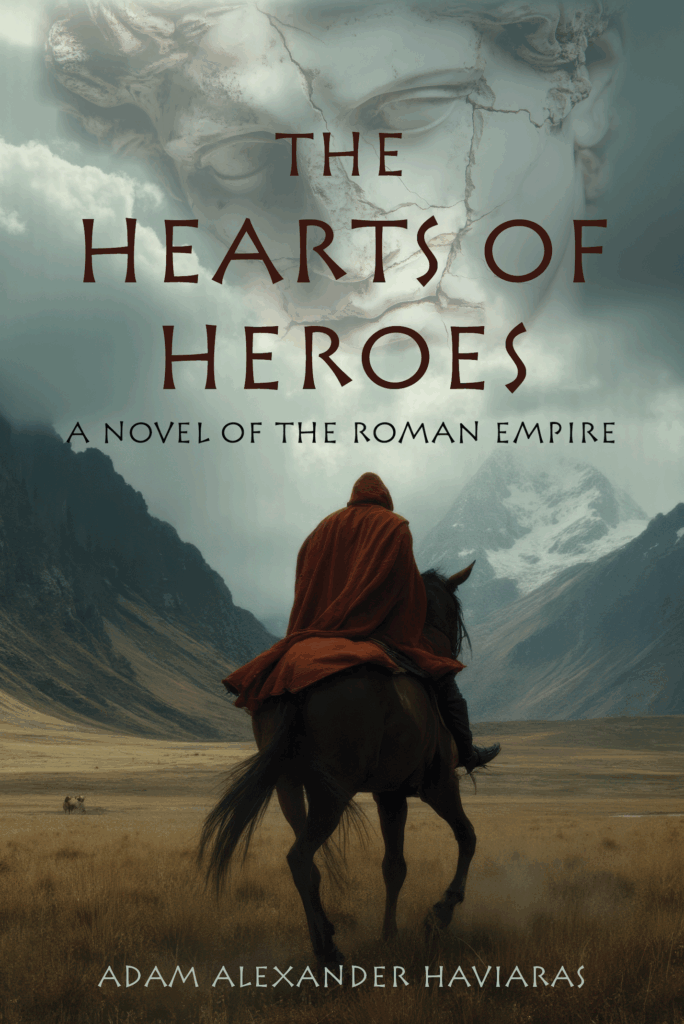
The Hearts of Heroes: A Novel of the Roman Empire is available ebook, paperback and deluxe hardcover editions from all major online retailers, independent bookstores, brick and mortar chains, and your local public library.
CLICK HERE to buy a copy and get ISBN#s for the edition of your choice.
If you are new to the Eagles and Dragons historical fantasy series, you can start your epic adventure with the award-winning, #1 bestselling prequel, A Dragon among the Eagles.