Greetings Readers and History-Lovers!
Welcome back to The World of The Hearts of Heroes!
If you missed Part V in the this blog series about the Romans on the Isle of Anglesey, you can read that article HERE.
Today, in Part VI, we are heading through the mists of time to what was known to the ancient Britons as Ynis Wytrin, that is, today’s Glastonbury. There, we will explore the foundation of what is believed to be the very first church in Britain. Join us as we explore the history behind The Lady Chapel at Glastonbury Abbey…
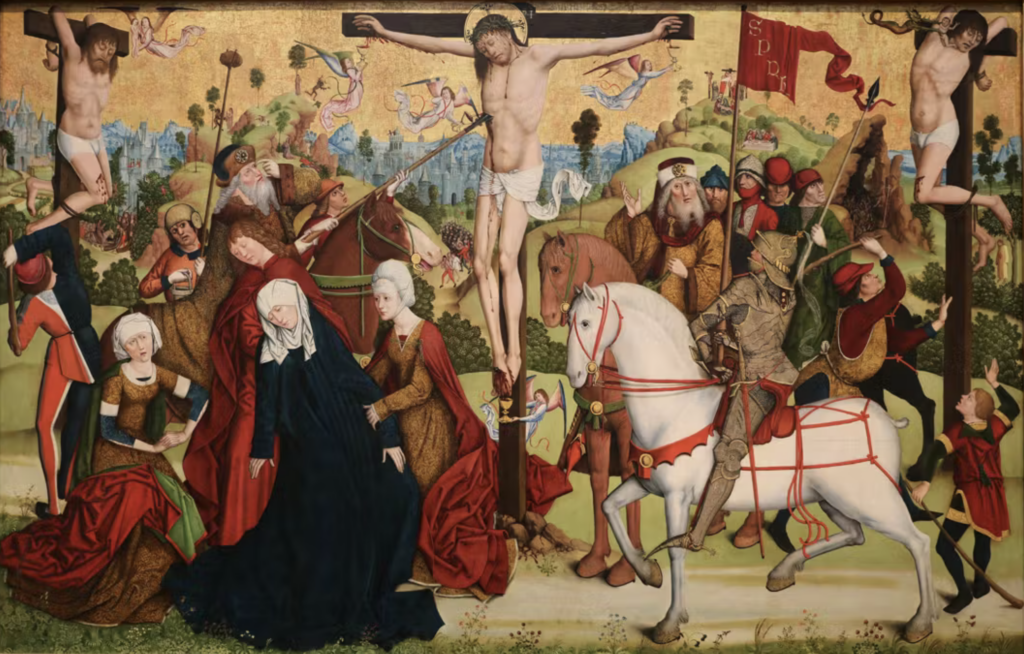
Calvary, attributed to Master of the Death of Saint Nicholas of Münster, c. 1470-1480
For in whom have all the nations believed, but in Christ? — Parthians, Medes, Elamites; the inhabitants of Mesopotamia, Armenia, Phrygia, Cappadocia; the dwellers in Pontus and Asia, and Pamphylia; tarriers in Egypt and the region of Africa beyond Cyrene; Romans and Jews; and the regions of the Britons, which were inaccessible to the Romans, but are subject to Christ.
(Tertullian of Carthage, Adversus Judaeos, VII, c. A.D. 197)
The quote above is one of the earliest recorded mentions of Christianity coming to Britain. What it does not tell us, however, is how truly important this coming of Christianity to that far-off island at the edge of Rome’s empire truly was. It is a tale that is steeped in myth and legend that has deep roots in the Matter of Britain and the foundations of the Christian faith in that ancient isle.
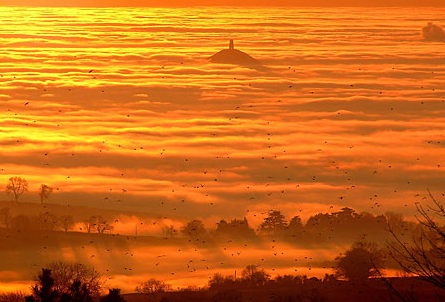
Readers of the Eagles and Dragons series will know what a central role Ynis Wytrin plays in the story. It is also a place that has played a central role in my own life and academic study of Arthuriana, for I lived and wrote there for some years, wandered the pathways beside ancient oaks and yews, climbed up the slopes of the Tor and Wearyall Hill, and sat in quiet contemplation beside the Chalice Well.
I also spent many a day on the grounds of Glastonbury Abbey, gazing up at the soaring and majestic ruins of what was once the second largest abbey in all of Britain. But Glastonbury Abbey is not just another assemblage of ruins bearing the scars of Henry VIII’s rage. It is much more than that.
Long before the great stone abbey was erected by the Normans, this was the site of the very first Christian settlement in the British Isles, and the very first Christian temple or ‘church’. It was built and dedicated by none other than Joseph of Arimathea in honour of St. Mary, the Virgin Mother of Christ.
When the even was come, there came a rich man of Arimathaea, named Joseph, who also himself was Jesus’ disciple: He went to Pilate, and begged the body of Jesus. Then Pilate commanded the body to be delivered. And when Joseph had taken the body, he wrapped it in a clean linen cloth, And laid it in his own new tomb, which he had hewn out in the rock: and he rolled a great stone to the door of the sepulchre, and departed…
(Matthew, Gospel of Matthew, 27:57-60)
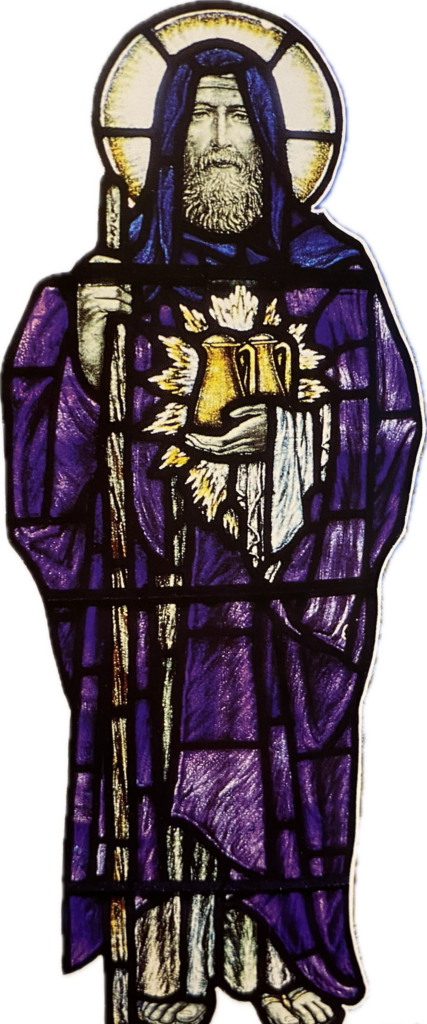
Joseph of Arimathea
Joseph of Arimathea, an older disciple of Jesus (believed by some to actually be Christ’s uncle) became, over time, central to the story of the coming of Christianity to Britain and even stories of the Holy Grail, which he is said to have brought with him. According to tradition, Joseph and twelve followers built a wattle church on the site on land he was given by the local king, Arviragus (possible ruler of South Cadbury Castle at the time) around the middle of the first century A.D., at the end of the reign of Emperor Tiberius (A.D. 14-37).
Meanwhile, to an island numb and chill with ice and far removed, as in a remote nook of the world, from the visible sun, Christ made a present of his rays (that is, his precepts), Christ the true sun, which shows its dazzling brilliance to the entire earth, not from the temporal firmament merely, but from the highest citadel of heaven, that goes beyond all time. This happened first, as we know, in the last years of emperor Tiberius, at a time when Christ’s religion was being propagated without hindrance…
(Gildas, De Excidio Britanniae, I, VIII, c. A.D. 540)
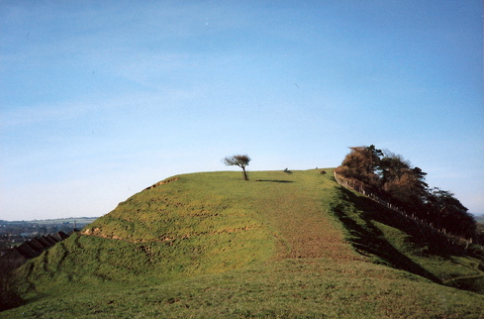
Wearyall Hill and the Holy Thorn. Joseph and his followers are said to arrived at a dock at the foot of this hill. He planted his staff into the ground and it took root, becoming the Holy Thorn.
Having been granted land by the local king, Arviragus, Joseph and his followers are believed to have built a temple dedicated to the Virgin Mary, Christ’s mother, on the site. Before the ‘Lady Chapel’, as it was later called, this sacred yet humble place of worship was known as the ‘Old Church of St. Mary’.
The first church, dedicated to St. Mary by Joseph and his followers, was a simple wattle and daub structure with a well (later named ‘St. Joseph’s Well’), and a small cemetery beside it. Here, the new Christianity lived in peace and harmony beside the pagan Britons who had already lived in and revered Ynis Wytrin for generations.
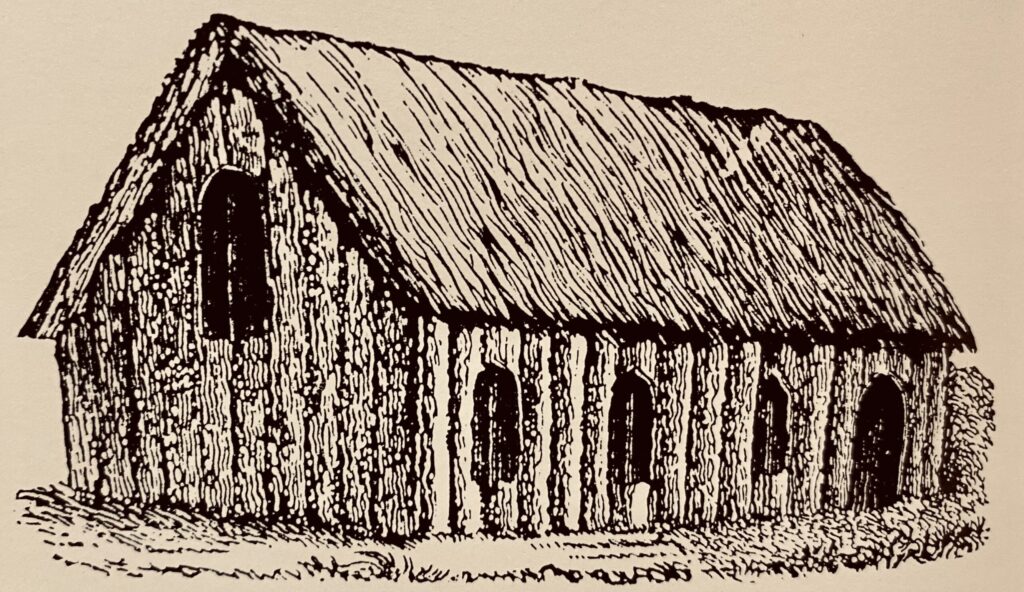
17th century artist impression of the original wattle church built by Joseph of Arimathea and his followers at Ynis Wytrin.
Then desiring that the word of Christ should be yet further spread abroad, he chose twelve of his disciples and sent them to Britain to proclaim the word of life and preach the Incarnation of Jesus Christ, and on each of them he devoutly laid his right hand; and over them he appointed, it is said, his dearest friend, Joseph of Arimathea who had buried the Lord. They arrived in Britain in the sixty-third year from the Incarnation of the Lord, and the fifteenth from the Assumption of the Blessed Mary, and preached the faith of Christ with all confidence.’
The king gave them an island on the borders of his country, surrounded by woods and thickets and marshes, called Ynis Wytrin. Two other kings in succession, though pagans, granted to each of them a portion of land: hence the Twelve Hides have their name to the present day. These saints were admonished by the archangel Gabriel to build a church in honour of the Blessed Virgin. They made it of twisted wattles, in the thirty-first year after the Lord’s Passion and the fifteenth after the Assumption of the glorious Virgin. Since it was the first in that land, the Son of God honoured it by dedicating it to His Mother.
(William of Malmesbury, On the Antiquity of Glastonbury, c. A.D. 1129)
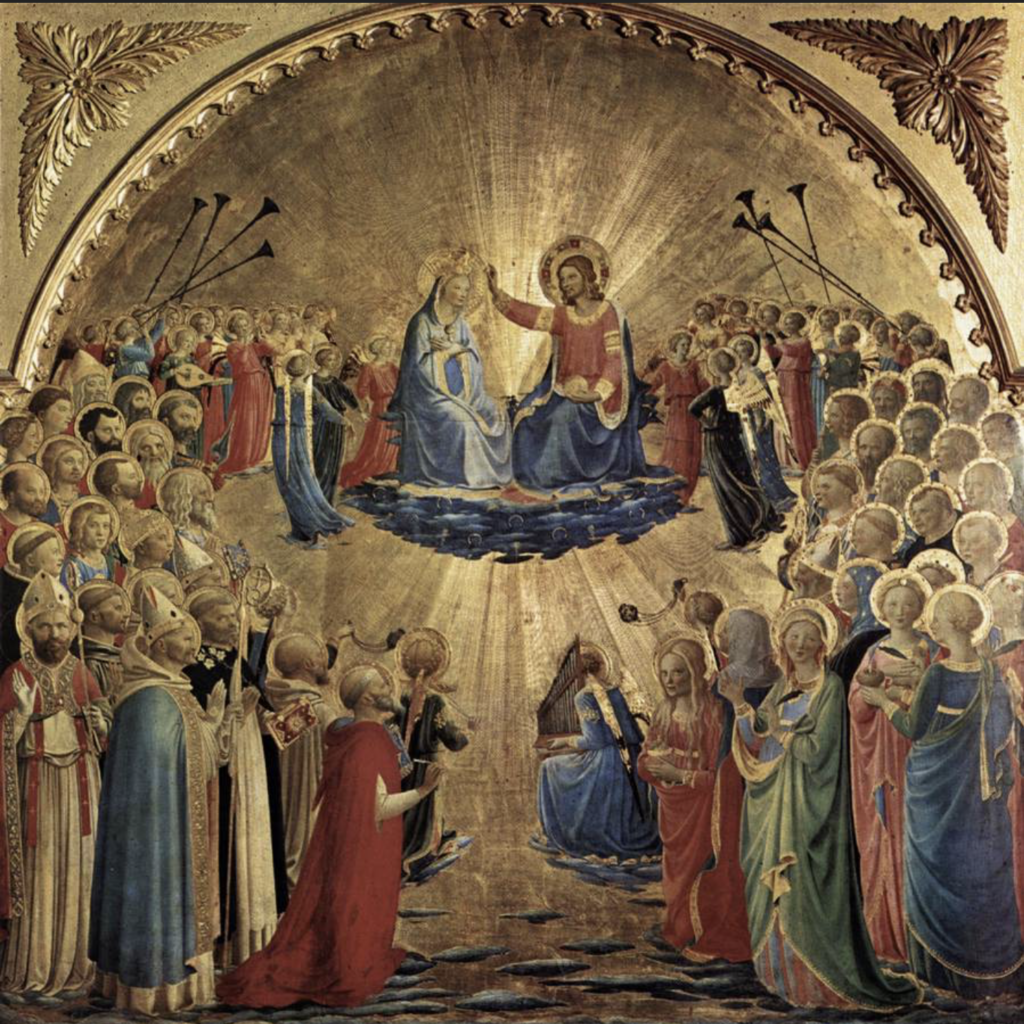
“These all continued with one accord in prayer… with Mary the mother of Jesus.”, Acts 1:14
Coronation of the Virgin, by Fra Angelico, ca. 1432
In the second century A.D. (c. A.D. 166), over one hundred years after the first wattle church had been built by Joseph of Arimathea and his followers, a new church was built by two Christian missionaries who were sent by Pope Eleutherius at the request of a British king named ‘Lucius’ (not the Lucius of the Eagles and Dragons series) who wished to be made a Christian.
The two men whom the Pope sent were named Phagan and Deruvian, and they rebuilt the original, aging wattle church, and this became what is known as the ‘Old Church of St. Mary’.
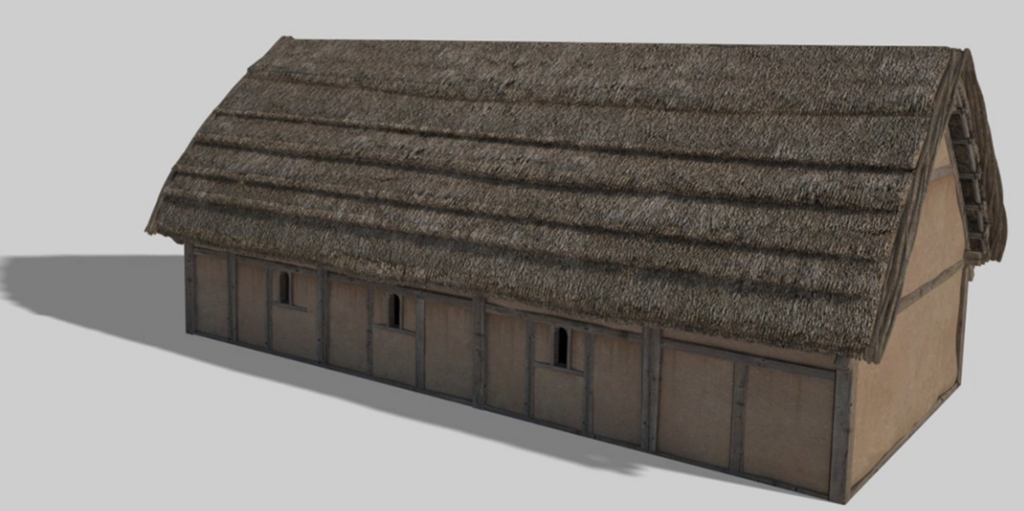
Digital reconstruction of the ‘Old Church’ (Centre for the Study of Christianity & Culture, University of York)
There came, then, these two holy men, Phagan and Deruvian, and preached the word in Britain in A.D. 166. When they came to the Isle of Avalon [Ynis Wytrin] they found the church, ‘built, as it is said, by the hands of the disciples of Christ and made ready by God for the salvation of men, which afterwards the Maker of the heavens … shewed that He had consecrated to Himself and to Mary the Holy Mother of God’. This was 103 years after the coming of the disciples of St Philip. St Phagan and St Dernvian remained here nine years. ‘They found in ancient writings the whole story, how when the Apostles were dispersed throughout the world St Philip the Apostle came with a multitude of disciples to France and sent twelve of their number to preach in Britain. And these by the guidance of an angelic vision built that chapel which afterwards the Son of God dedicated in honour of His Mother; and to these twelve three kings, though pagans, granted for their sustenance twelve portions of land.’
Accordingly St Phagan and St Deruvian chose twelve of their companions and settled them on the island. They dwelt as anchorites in the very spots where the first twelve had dwelt. ‘Yet often they assembled at the Old Church (vetusta ecclesia) for the devout performance of divine worship. And just as three pagan kings had granted the island with its appendages to the first twelve disciples of Christ in days gone by, so Phagan and Deruvian sought from King Lucius that the same should be confirmed to those their twelve companions and to others who should come after them.
(William of Malmesbury, On the Antiquity of Glastonbury, c. A.D. 1129)
It is this second church of St. Mary that is present in Ynis Wytrin in the Eagles and Dragons series in the early third century A.D.
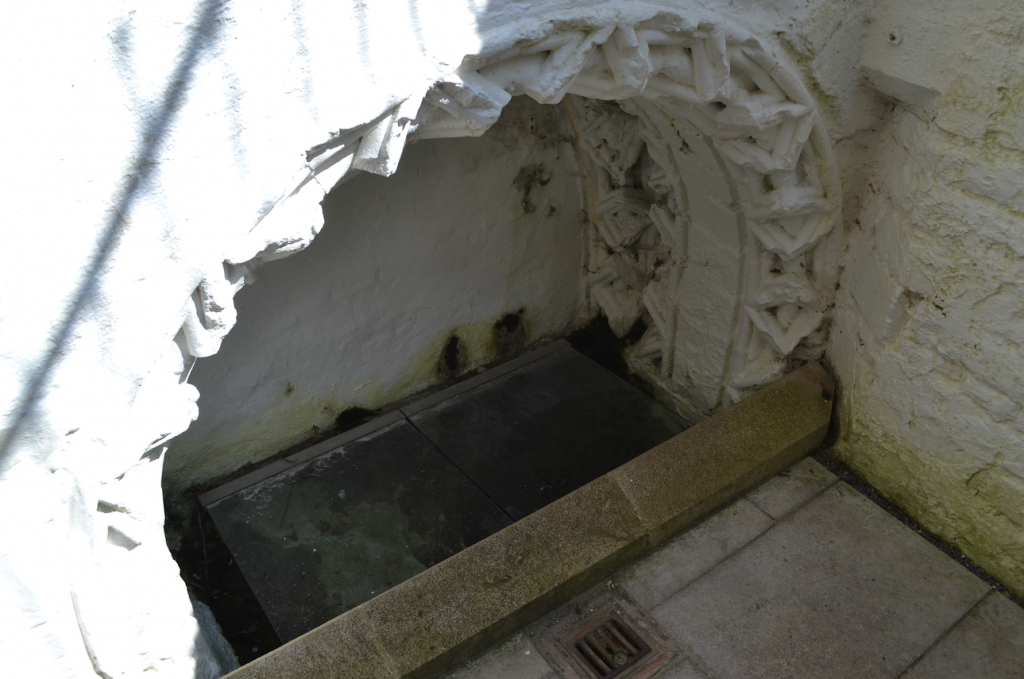
St. Joseph’s Well in the crypt of the Lady Chapel, on the site of the Old Church of St. Mary
Up until the expansion of the church in stone by the Anglo Saxons in the early 8th century, under King Ine of Wessex, it was the second church built by Phagan and Deruvian that was present throughout the 5th and 6th centuries, what is generally believed to be ‘Arthurian’ period.
In the early days of Christianity in Britain, this first chapel and the well were the predecessors of the magnificent Norman ruins of the abbey we see today. The Lady Chapel was the site of the first Marian cult in Britain, and in the words of Geoffrey Ashe “there is no rival tradition whatsoever. When all of the fantastic mists have dispersed, ‘Our Lady St. Mary of Glastonbury’ remains a time-hallowed title.”
It became a place that Christians gravitated to. Indeed, several Celtic saints are said to have come here, including St. David, St. Columba, and St. Bridget who allegedly left her ‘wallet’ and distaff there and which, after she departed, were preserved as holy relics. Most importantly, perhaps, was Ynis Wytrin’s association with St. Patrick, the Romano-British missionary who became the patron saint of Ireland, and whom some stories name as the first abbot of Glastonbury.
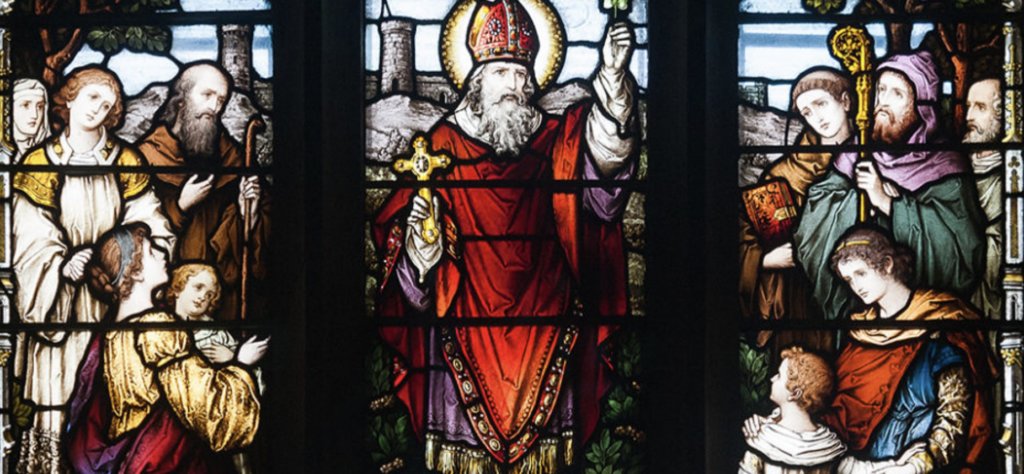
St Patrick preaching at Tara at St Patrick’s Cathedral, Armagh, Northern Ireland
St Germanus of Auxerre, having come to the aid of the Britons against English invaders and Pelagian heretics, on his return took Patrick with him. Presently he sent him, by order of Pope Celestine, to preach in Ireland. When his work was done, he came to Glastonbury. There he found twelve brethren living as anchorites: he gathered them into a community and became their abbot, ‘as the following writing, which he himself in his own day composed, manifestly declares….
‘In the name of our Lord Jesus Christ. I Patrick, the humble servant of God, in the year of His Incarnation 430, was sent into Ireland by the most holy Pope Celestine, and by God’s grace converted the Irish to the way of truth; and, when I had established them in the Catholic faith, at length I returned to Britain, and, as I believe, by the guidance of God, who is the life and the way, I chanced upon the isle of Ynis Wytrin, wherein I found a place holy and ancient, chosen and sanctified by God in honour of Mary the pure Virgin, the Mother of God: and there I found certain brethren imbued with the rudiments of the Catholic faith, and of pious conversation, who were successors of the disciples of St. Phagan and St. Deruvian, whose names for the merit of their lives I verily believe are written in heaven…’
(William of Malmesbury, On the Antiquity of Glastonbury, c. A.D. 1129; quoting The Charter of St. Patrick)
St. Patrick’s story became a part of the fabric of Glastonbury’s mythology and, after his death, his relics, and those of another saint by the name of Indracht (thought by some to be an abbot of Iona) were preserved in two ‘pyramids’ (a sort of A-framed shrine) to either side of the high altar in the church of St. Mary.
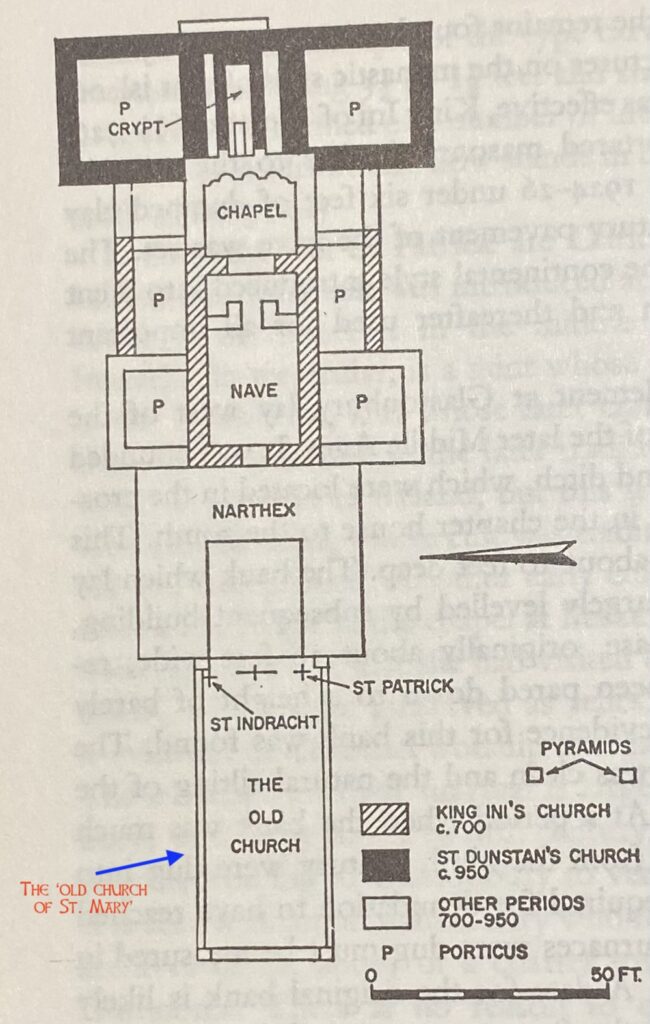
Plan of the later Saxon church which included the ‘Old Church of St. Mary’ at the bottom, then rebuilt in stone. (from The Quest for Arthur’s Britain, ed. Geoffrey Ashe)
One cannot speak about the Old Church of St. Mary without also speaking about the ancient cemetery that sat just to the south of the chapel. These were at the heart of the early monastic settlement of Ynis Wytrin and contained many stone-lined graves. At the centre of the cemetery there were, according to Ralegh Radford who excavated the site, two large ‘pyramids’ with crosses as tall as twenty-eight feet. Most importantly there were, supposedly, two mausolea at the heart of the cemetery that are believed to have held the remains of St. Patrick and St. Indracht. Some believe that St. David may also have been buried there.
Only the most important of people would have been buried near the mausolea containing the remains of those venerated saints in the cemetery beside the church build by disciples of Christ in honour of the Virgin Mary.
This church, then, of all I know in England is the most ancient: hence its name. The place is crowded with the bodies of saints. Under the pavement, above and beneath the altars, relics are everywhere. Rightly is it called the heavenly sanctuary on earth and the depository of saints. Happy are they who dwell there! Who shall fail of heaven, with patrons such as these to plead their cause? So sacrosanct is the place that none dare profane it, none swear falsely by it. The truth of this finds its support in testimonies of every age.
(William of Malmesbury, On the Antiquity of Glastonbury, c. A.D. 1129)
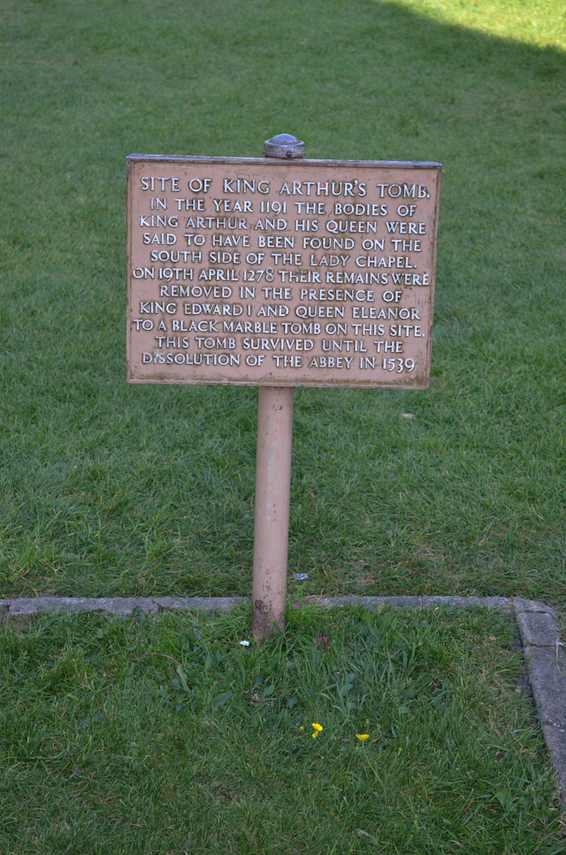
Spot where Arthur and Guinevere’s bones are said to have been discovered in the ancient cemetery south of the chapel.
And here, we come to perhaps the most famous person associated with Glastonbury: King Arthur.
Let it be certain to all that it is in the graveyard of the monastery of Glastonbury, after his mortal wound on the river Camlan, that Arthur was buried, between two crosses of stone made from the ingenuity of craftsmanship. And these were raised standing highly, with letters on them which had been to proclaim that the grave of Arthur was there. And now those letters have been worn away from age. Let it be known, however, to all, that the grave of Arthur was not of marble stone. There was no grave for Arthur, except that he was placed inside an oak after it had been hollowed out, and he was buried sixteen feet deep in the earth. The grave is two parts of length, as if the two highest thirds were separated from the [lower] third. And as if it were a border between them, the third part is separated from them by the arranged bones of Arthur, which were large and sturdy. In the skull there were sixteen wounds, and each one of them had closed and hardened except one, and that one was open and large, as though it were certain that it was from that one that he had become dead. In the third part of the grave, like the two parts of the bottom, were the bones of Gwenhwyfar his wife, as they can be recognized as smaller and more feminine…
…Besides that, it was king Arthur who was the chief founder of the monastery of Glastonbury, for before the English came to the island, he had given land and earth and other goods to that monastery, which he consecrated in honour of the Blessed Virgin Mary, whom he loved more than that all the other saints, and not without cause. And because of that, he caused her image to be put on the two shoulders of his shield on the side next to him. And as it is said, in every battle and fight which he was in, he would kiss her feet in true humility and love for her…
…And in the end, Arthur was honourably buried in the oldest and most powerful monastery in the whole kingdom, as was befitting to place a man of such great fame and honour as that.
(Gerald of Wales, De Principis Instructione and Speculum Ecclesiae, c. A.D. 1216)
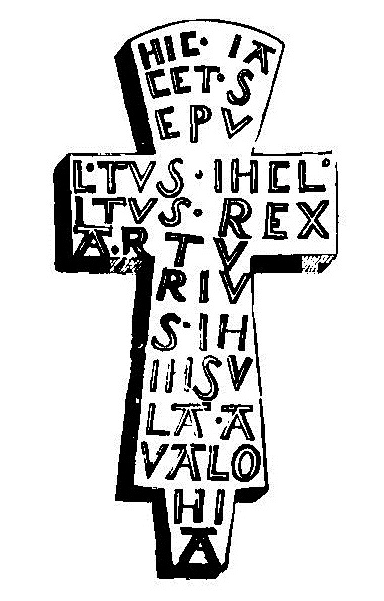
17th century engraving of the ‘Arthur Cross’ discovered in the burial beside the Lady Chapel
In A.D. 1184 a fire ravaged the abbey and the monks needed to rebuild. Around the time of the fire, a Welsh bard is supposed to have revealed to King Henry II that King Arthur himself was buried within the abbey grounds.
The king passed this information on to the Abbot of Glastonbury who later ordered excavations to be carried out. In 1191, it is said that the monks found the bones of a man and a woman in a hollowed out tree trunk who were none other than Arthur, and his queen, Guinevere.
With the remains was a lead cross with the words ‘Hic Iacet Sepultus Inclitus Rex Arturius in Insula Avalonia’ which translates as ‘Here lies buried the renowned King Arthur in the Isle of Avalon’.
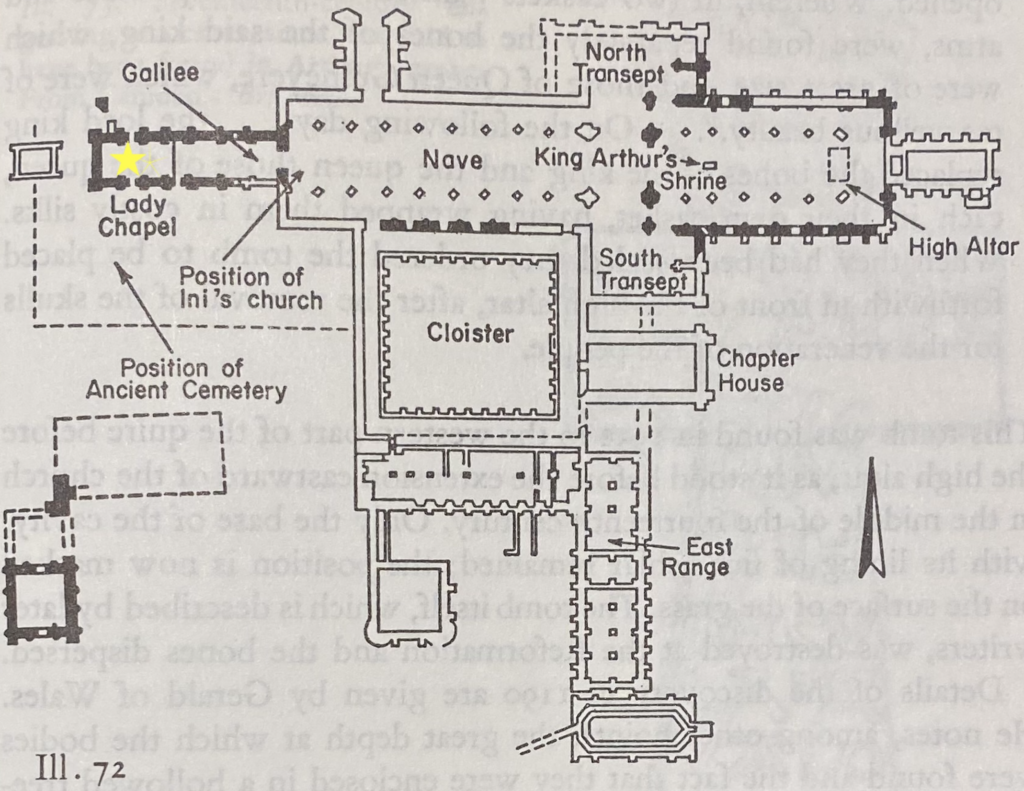
Plan of the full medieval abbey which included the ‘Lady Chapel’ built on the site of the ‘Old Church of St. Mary’ at the bottom, then rebuilt in stone. (from The Quest for Arthur’s Britain, ed. Geoffrey Ashe)
A lot of doubt has been cast on the monks’ discovery with many believing that it was a hoax created by the monks to boost tourism through pilgrimage. The remains were treated as relics and later moved within the abbey during the reign of Edward I in the early 13th century.
It is important to note that the archaeologist who excavated the abbey in the 1960s, Dr. Ralegh Radford, indicated that the monks’ story might not have been that far-fetched, and that there was indeed a person of great import from the correct period buried in the graveyard just south of the Lady Chapel. As with all things in Glastonbury, faith is always a part of the great equation.
And it is that faith that returns us to the original disciples who came with Joseph of Arimathea and who built that first temple or church to St. Mary.
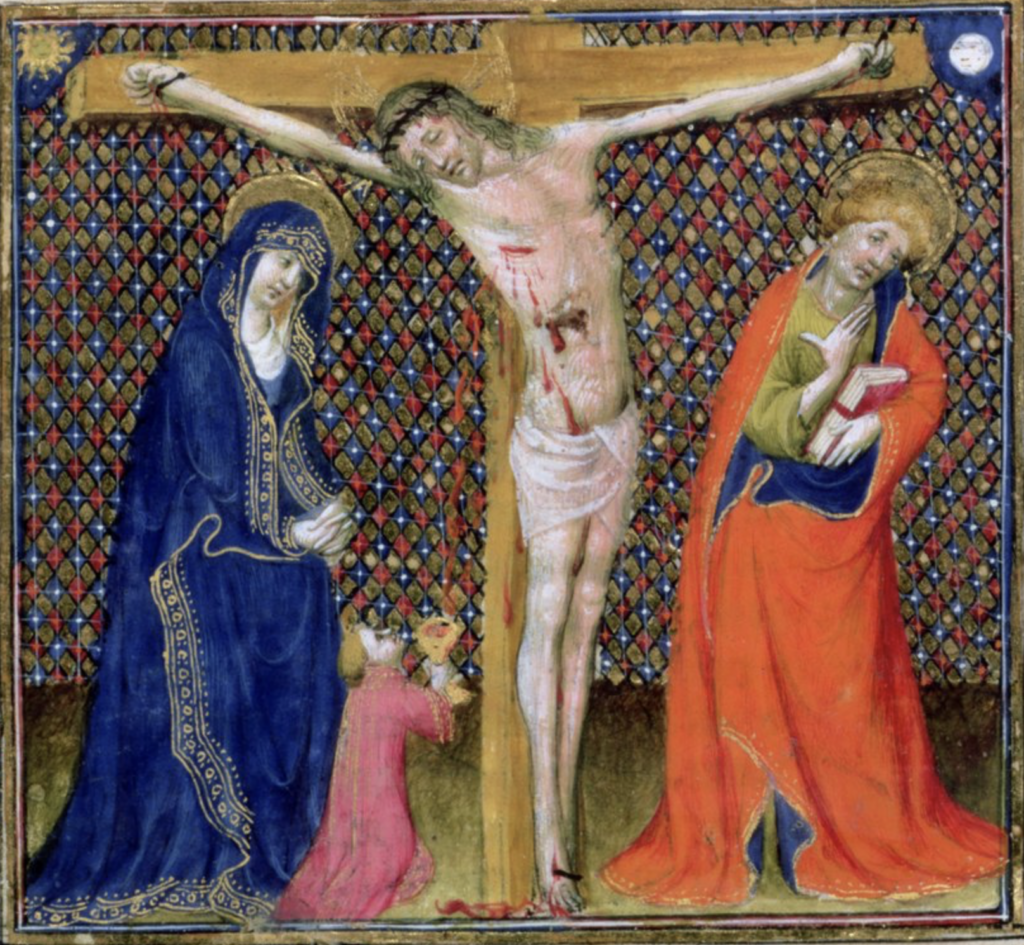
Joseph of Arimathea beside Mary, collecting the Blood of the Crucified Christ, from La Quite de Saint Graal
Joseph carried the Grail and, through his piety and that of the faithful, invoked Our Lady so that the holy vessel would be protected and glorified…
And Joseph came, weeping, to his vessel, and knelt before it and said: ‘Lord who was born of the Virgin, by your holy pity and gentleness, and to save our obedient servant; Lord, I saw you truly both alive and dead, and saw you again, in the tower where I was imprisoned, after you had suffered the agonies of death, and you bade that, whenever I needed you, I should come before this precious vessel which held your precious blood; so truly, Lord, I beg and pray you now to guide me…
(Robert de Boron, Joseph of Arimathea, c. A.D. 1190)
Over time, and in addition to sailing to Britannia with his followers, and founding the first church dedicated to St. Mary, it was also told that Joseph of Arimathea brought with him the Holy Grail.
This is one of the main themes of Medieval Arthurian romance.
Joseph of Arimathea, the veneration of the Virgin Mary, the Holy Grail, and King Arthur and his knights were all linked, shrouding history beneath a veil of myth and legend that has inspired generations ever since.
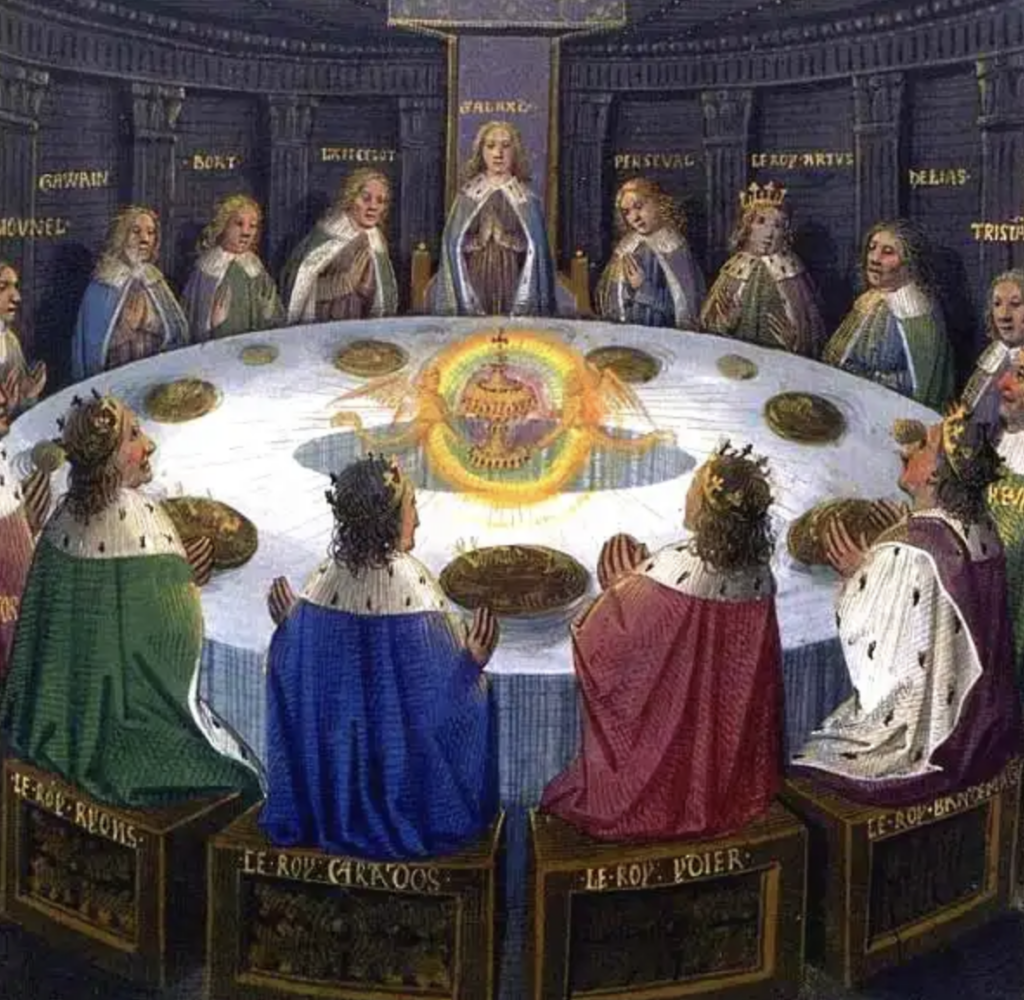
King Arthur’s knights, gathered at the Round Table to celebrate Pentecost, see a vision of the Holy Grail – 15th-century manuscript illumination.
Before the fight and the encounter at the Castle of the Grail, the knights prayed to Our Lady to obtain victory and strength…
And in the chapel, they lifted their hands and voices toward the Virgin Mary, asking for help and guidance in their quest for the Holy Grail.
(Early Vulgate Cycle, Queste del Saint Graal, c. A.D. 1215-1230)
When it comes to Glastonbury being the mythical Isle of Avalon and the resting place of the Holy Grail and of King Arthur himself, there are myriad doubters and believers.
Did Joseph of Arimathea indeed come to Britannia after the death of Christ and found the first temple or church dedicated to the Virgin Mary? Did he bring the Holy Grail with him? Was the ‘Old Church of St. Mary’ the original Grail Chapel?
We may never know for certain. At the end of the long day, however, it really is a question of faith and what one believes.
What is certain is that for almost two thousand years, both saints and sinners, warriors and poets, tourists and faith-seekers have been drawn to that magical place where early Christians first arrived in Britannia and built a humble church to honour Mary, the mother of Christ.
The king and the knights prayed to the Virgin Mary to protect them and to aid them.
(Chrétien de Troyes – Perceval, ou le Conte du Graal, c. A.D. 1180)
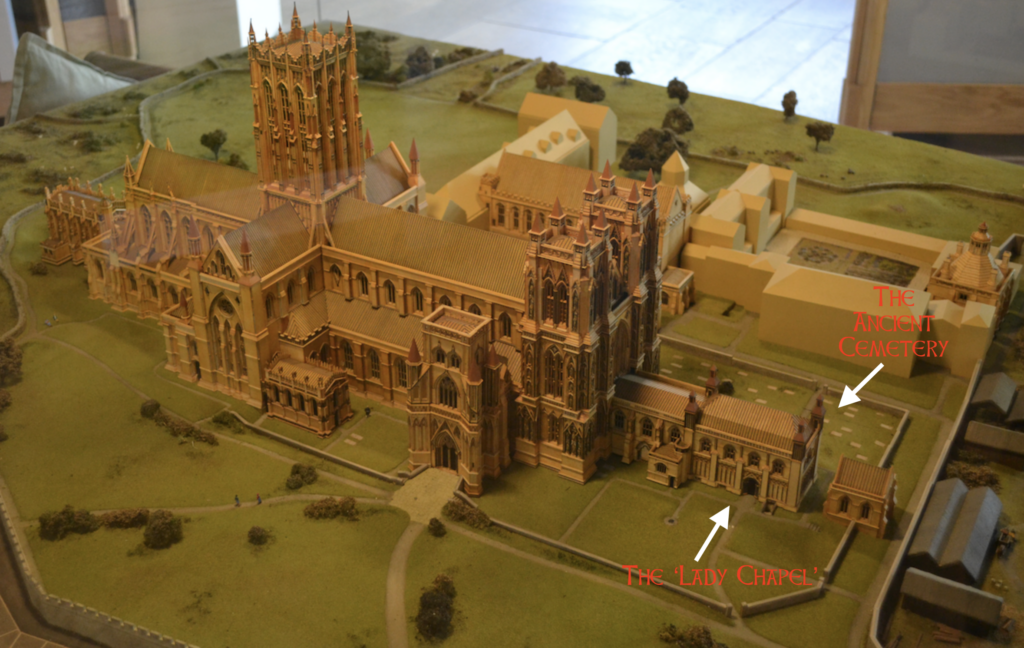
Reconstruction of the later Medieval abbey at Glastonbury with the ‘Lady Chapel’ at the western end. (Glastonbury Abbey Museum)
If you would like to learn more about the other sites associated with Joseph of Arimathea, King Arthur, the Holy Grail and more in and around Glastonbury, be sure to read our popular articles Ynis Wytrin: The Place Beyond the Mists, and The Dragon’s Domus (about South Cadbury Castle, the historical Camelot)
You can also join Adam on magical walking tours of Glastonbury to visit all of the sites mentioned, as well as South Cadbury Castle, in our two highly-acclaimed videos on the Eagles and Dragons Publishing YouTube and Rumble channels:
In Insula Avalonia: A Tour of Glastonbury and the Isle of Avalon
and
Camelot: A Tour of the Ancient Hillfort of South Cadbury Castle
Stay tuned for Part VII in The World of The Hearts of Heroes when we will be looking at the reign of Emperor Alexander Severus and the end of the Severan dynasty.
Thank you for reading.
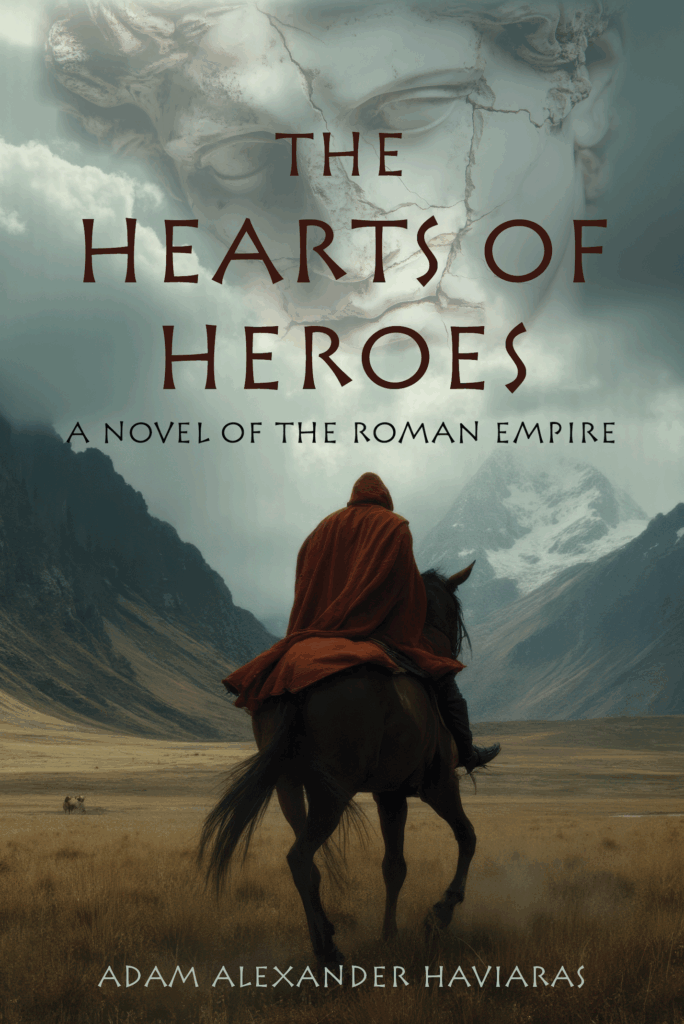
The Hearts of Heroes: A Novel of the Roman Empire is available ebook, paperback and deluxe hardcover editions from all major online retailers, independent bookstores, brick and mortar chains, and your local public library.
CLICK HERE to buy a copy and get ISBN#s for the edition of your choice.
If you are new to the Eagles and Dragons historical fantasy series, you can start your epic adventure with the award-winning, #1 bestselling prequel, A Dragon among the Eagles.