Greetings Readers and History-Lovers!
In this article we’re going to be taking a brief look at one of the great monuments of Roman Athens: Hadrian’s Library
This magnificent centre of learning at the heart of Roman Athens was, arguably, the greatest gift given to the city by Emperor Hadrian, a great philhellene (lover of all things Greek!)
We will discuss what the ‘library’ structure entailed (hint, hint! – it was much more than a library), and if you read until the end there is a special surprise in the form of a new release!

Emperor Hadrian
Roman Athens was a rich and vibrant place in its day with many monuments added to that already great city, including the Roman Agora and the Odeon of Herodes Atticus.
But the Library of Hadrian was more than a functional structure for the city. It was a symbol Athens’ great culture and tradition of learning, as well as a symbol of the respect and esteem in which Emperor Hadrian held the city.
Hadrian had the library built on his third visit to Athens in A.D. 132. It was located just north of the Roman Agora of Athens which had been built one-hundred and fifty years before.

The western facade with the propylon, the monumental entrance to the library (Wikimedia Commons)
The library was accessed by way of a grand, monumental entrance, or propylon, on the west side which was flanked by Corinthian columns of pink marble and green rock, each topped by a statue.
The entire complex of Hadrian’s Library was approximately 122 x 82 meters and was comprised of a high-walled enclosure with a colonnaded courtyard garden, or peristylium, at the centre of which was a large, rectangular pool, possibly surrounded by trees and benches where people could sit and read or talk.
On the north and south sides of the courtyard were two exedrae (semi-circular rooms) and one oikos (a rectangular room) which were open to the gardens and which could be used for teaching, relaxation or study.
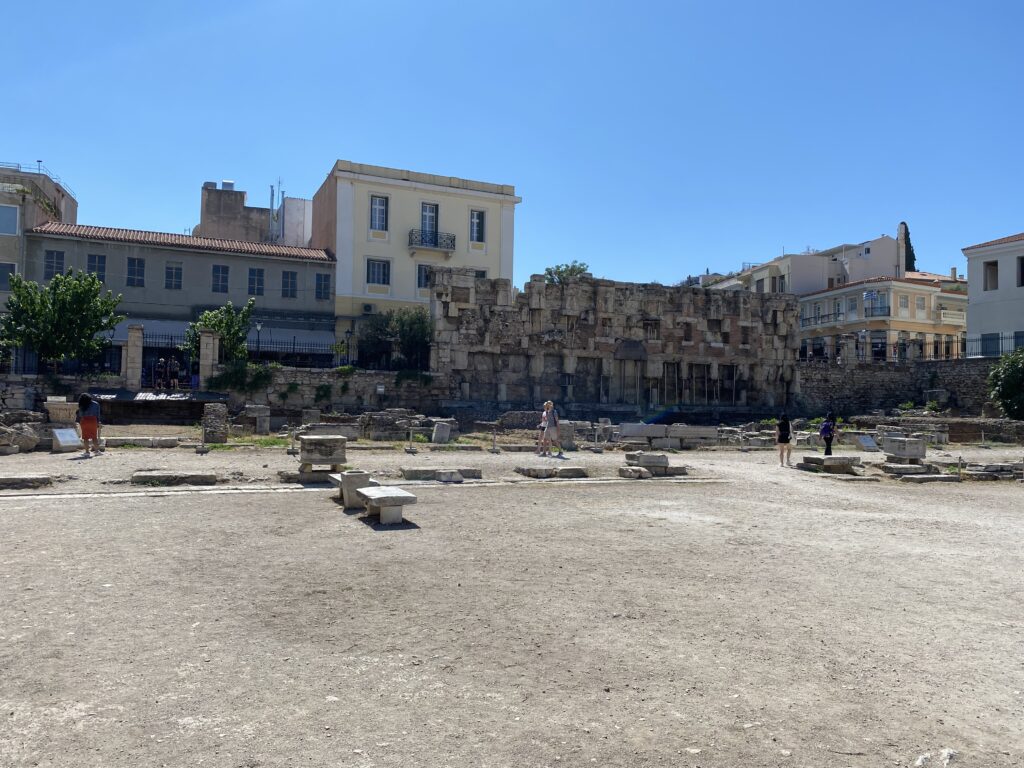
The bibliostasion (the library) at the eastern end of the complex.
At the back of the complex, on the western side, was the bibliostasion, the library itself where the papyrus scrolls were safely kept in cedar cabinets with shelves known as armaria.
The bibliostasion was two storeys high and had an ornate marble floor, cedar roof, and marble columns with a statue of Emperor Hadrian in a large niche in the middle.
The library held everything from histories and philological texts, to legal and state documents, and philosophical and mathematical treatises.
On either side of the bibliostasion there were also two lecture halls, or auditoria, with seating, and two large reading rooms.
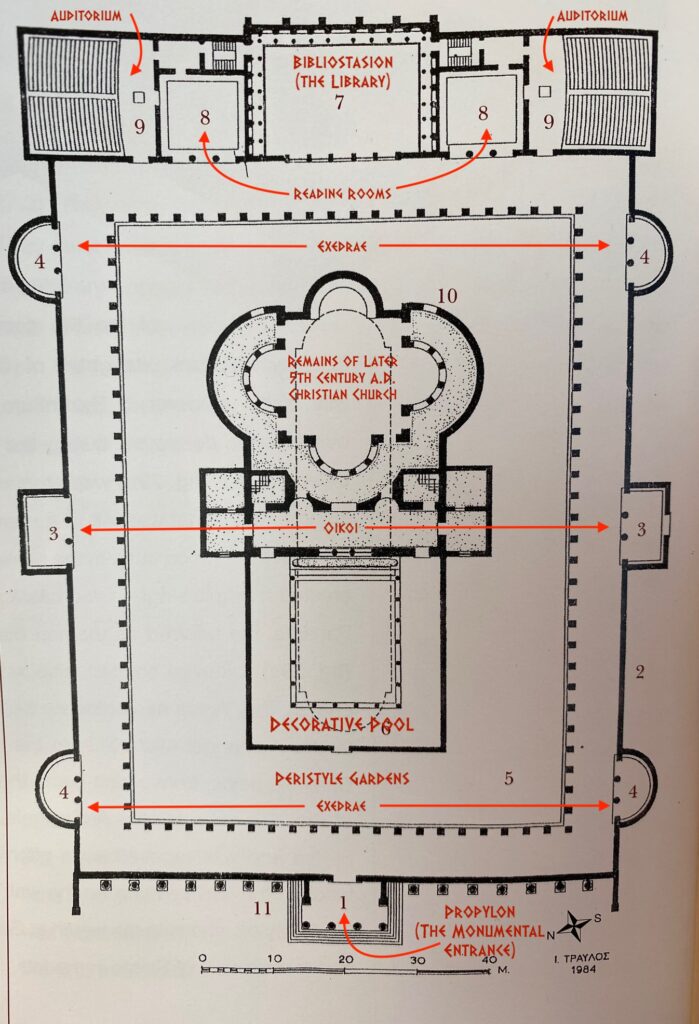
Plan of Hadrian’s Library
Hadrian’s Library was, no doubt, an oasis of learning in the heart of Athens, a quiet place to study and learn, away from the raucous atmosphere of the Roman Agora which lay next door, immediately to the south.

3D model recreation of Hadrian’s Library beside the Roman Agora of Athens (courtesy of AncientAthens3D.com)
When we visited the site, it was on a scorching day in July. That morning, we got an early start but even so, by the time we arrived at the archaeological site, the temperature was already pushing forty degrees Celsius.
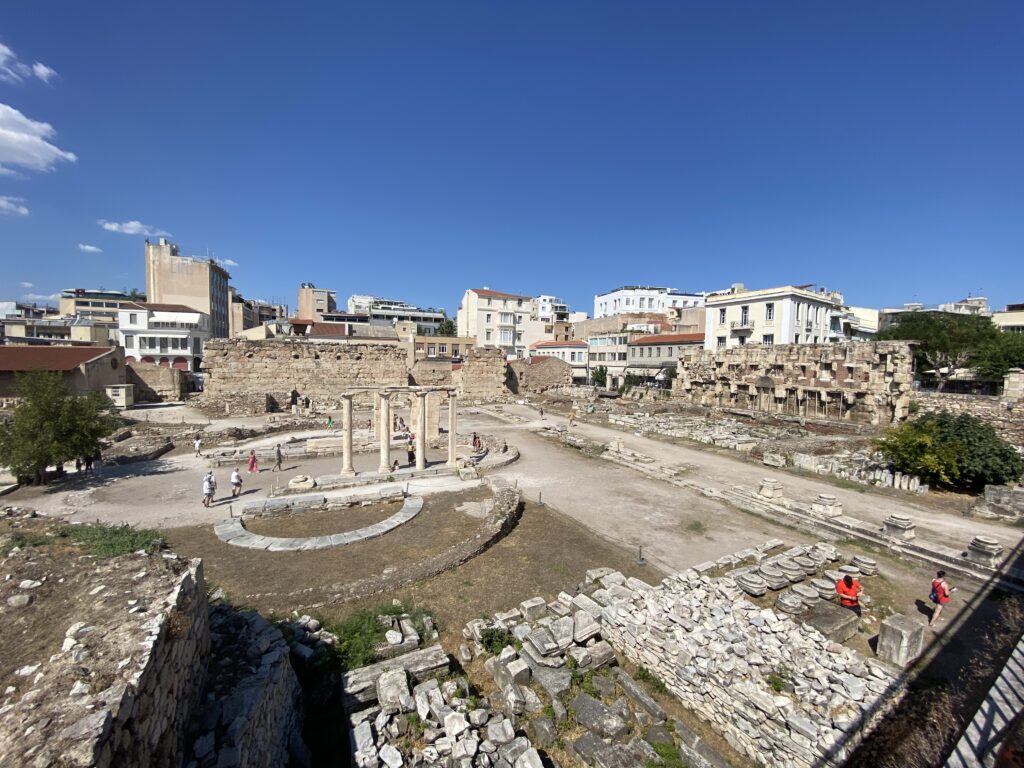
However, we quickly forgot about the heat as we walked through the ruins of this once-great library of Athens, making our way over the ruins of the western wall, beside the propylon, and on into the courtyard where the gardens and pool once formed a quiet place of repose and study.
At the far end, the ruins of the bibliostasion rose up before us and we imagined the armaria filled with ancient texts, many of which are lost to time.
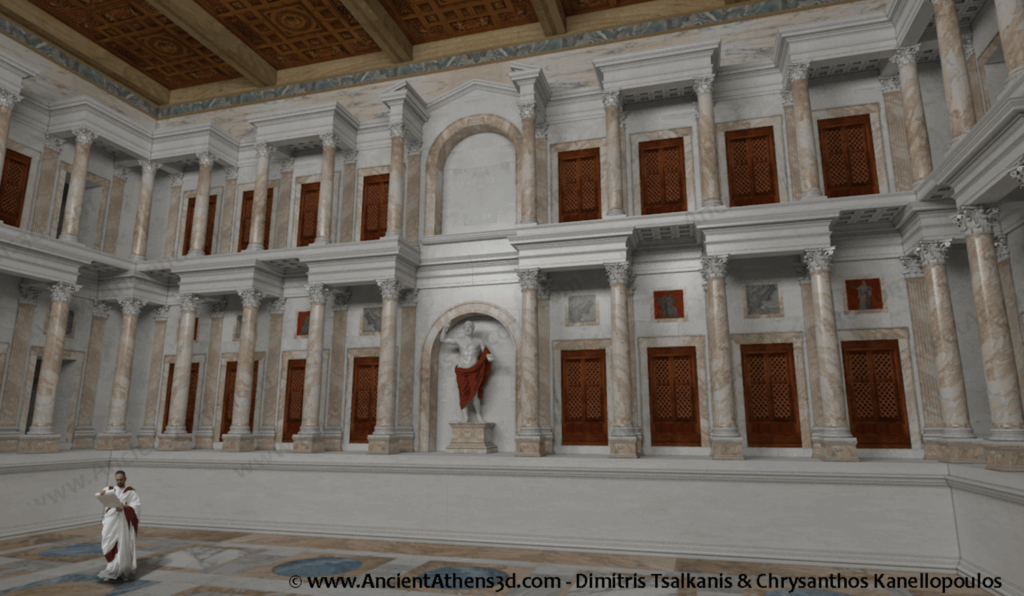
3D model recreation of the bibliostasion with two levels of armaria (courtesy of AncientAthens3D.com)
Sadly, Hadrian’s Library did not stand for very long. In A.D. 267, it was badly damaged in the Herulian invasion of the city which laid waste to so many of Athens’ great monuments.
It was eventually repaired by the Praefectus of Illyricum, Herculius, in the early 5th century A.D., at which time a Christian church was erected where the decorative pool had been.
The library, however, would never be the same.

Inscription found onsite which mentions Emperor Hadrian
And now for the new release we mentioned earlier!
If you are unable to visit Hadrian’s Library for yourself, you can now take a tour of the archaeological site with us in our new video Hadrian’s Library – A Tour of the Archaeological Site in Athens.
You can watch this on the Eagles and Dragons Publishing YouTube and Rumble channels, or by clicking below.
We hope you enjoy the tour!
The Library of Hadrian is one of the settings in An Altar of Indignities, Book II in our multi award-winning series, The Etrurian Players.
For more information about this site and others, ancient history, and Greek Mythology, be sure to visit the Article Archive.
If you are interested in visiting Athens, Greece, and are looking for discounts on airfare, accommodation, and personal tours of the archaeological sites, be sure to visit our Ancient World Travel page by CLICKING HERE to take advantage of the deals we have curated for our followers.
To get discounted tickets (just for our subscribers!) to archaeological sites, museums and other amazing tours and experiences in Athens, click the links below:
Tiquets: https://tiqets.tpx.lt/yWNAK6g3
Viator: https://viator.tpx.lt/HY7lVjgZ
Lastly, if you’re a fan of Ancient Greece, Greek Mythology, or the history of the Roman Empire, be sure to check out Eagles and Dragons Publishing’s range of unique clothing, art, housewares and more in the AGORA on Amazon. CLICK HERE to shop now!
Thank you for reading!