The World of A Dragon among the Eagles – Part V – The City of Alexander

The World of A Dragon among the Eagles

In this fifth and final part of The World of A Dragon among the Eagles, we’re going to take a brief look at a city that has perhaps captured history-lovers’ imaginations more than any other – Alexandria.

There were, of course, many Alexandrias in the world, stretching from Greece to India, but the one we are going to discuss, and which provides the setting for the final third of A Dragon among the Eagles, is Alexandria in Egypt.
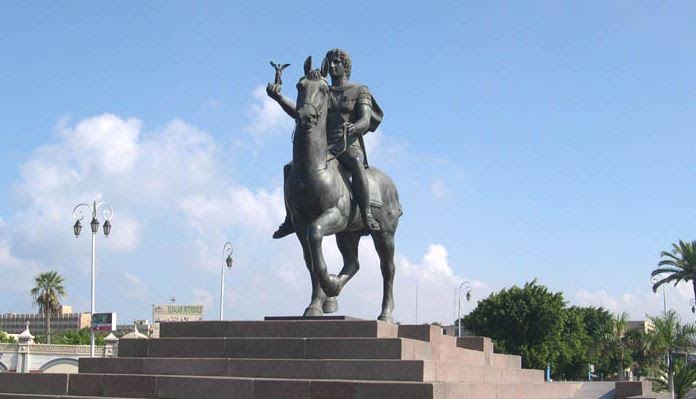
Statue of Alexander in downtown Alexandria

Statue of Alexander in downtown Alexandria

Alexandria was founded by Alexander the Great in about 331 B.C., near the westernmost branch of the Nile Delta. From a few scattered fishing villages, it grew to become one of the world’s great metropolises, a centre for trade, religion and learning the world had not really seen to that point.

There are many origin stories to the foundation of Alexandria, but the one I often refer to is that given by Arrian who says the following:

 From Memphis he sailed down the river again with his Guards and archers, the Agrianes, and the Royal Cavalry Squadron of the Companions, to Canobus, when he proceeded round Lake Mareotis and finally came ashore at the spot where Alexandria, the city which bears his name, now stands. He was at once struck by the excellence of the site, and convinced that if a city were built upon it, it would prosper. Such was his enthusiasm that he could not wait to begin the work; he himself designed the general layout of the new down, indicating the position of the market square, the number of temples to be built, and what gods they should serve – the gods of Greece and the Egyptian Isis – and the precise limits of its outer defences. He offered sacrifice for a blessing on the work; and the sacrifice proved favourable.

            A story is told – and I do not see why one should disbelieve it – that Alexander wished to leave his workmen the plan of the city’s outer defences, but there were no available means of marking out the ground. One of the men, however, had the happy idea of collecting the meal from the soldiers’ packs and sprinkling it on the ground behind the King as he led the way; and it was by this means that Alexander’s design for the outer wall was actually transferred to the ground.

(Arrian; The Campaigns of Alexander, Book III)

There is no real way to know whether this is true or not, but it is not impossible. Alexander was a man of vision, and learned in architecture, planning and much more. As a conqueror of the world, as many saw him, it was to be expected that he create one he hoped would have been a perfect city at the centre of the known world.
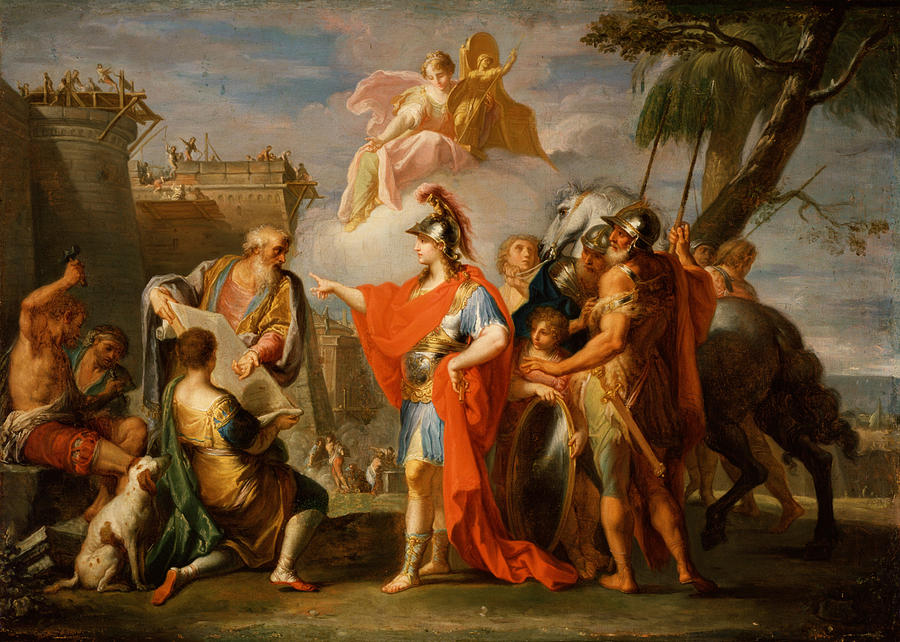
Alexander The Great Founding Alexandria by Placido Costanzi

The Egyptians had welcomed Alexander as a liberator against the Persians who had disrespected their gods. Alexander, on the other hand, respected Egypt’s ancient gods, and was even declared the son of Zeus Ammon by the famous Oracle at Siwa in the western desert.

Egypt’s new pharaoh had great plans for the city, but he died long before it could be completed. That task fell to Alexander’s friend and general, Ptolemy I, founder of the Ptolemaic dynasty, the last dynasty of Egypt before Rome took over.

Alexandria quickly became a destination that thrived under the Ptolemies, and as the resting place of Alexander the Great’s body, a major tourist destination. It was the greatest of the Hellenistic cities, dwarfing all others.

As time marched on, so did Rome.
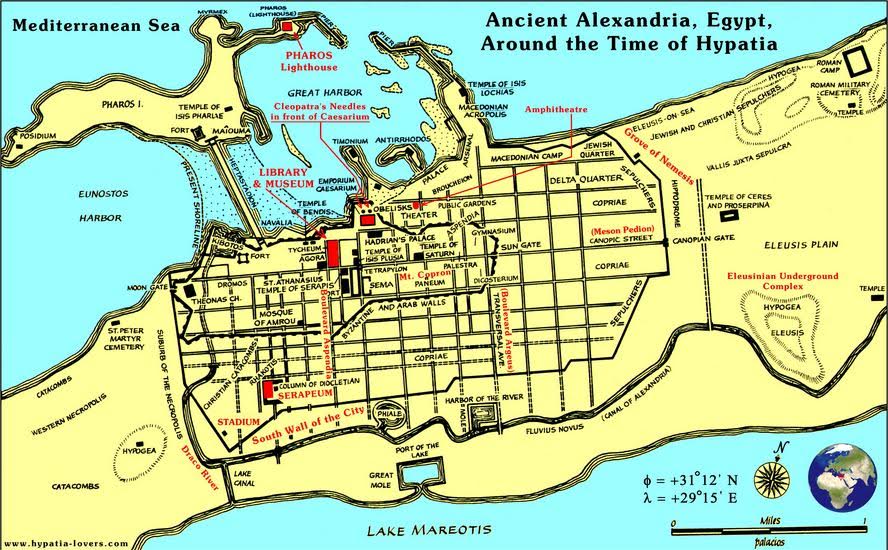
Ancient Alexandria in the years after Severus

Ancient Alexandria in the years after Severus

Alexandria came under Roman jurisdiction in the will of Ptolemy Alexander in 80 B.C. Then, when a domestic dispute broke out between Ptolemy’s children, Ptolemy and Cleopatra, Rome, under Gaius Julius Caesar, stepped in to settle the dispute.

Most of you probably know this part of the story, how Caesar threw his weight behind Cleopatra, making her sole Queen of Egypt in about 47 B.C. They had a son, Caesarion, and the rest is history.

With the death of Caesar, Marcus Antonius and Cleopatra joined forces with the hopes of creating a new, greater Hellenistic world with Alexandria at the centre. But those hopes were dashed by Rome at the Battle of Actium where Octavian came out victorious and as a result, brought Alexandria under the control of Rome.

This is probably one of the most famous periods in Roman history, but it took place two hundred years before A Dragon among the Eagles.

What happened to Alexandria after the Battle of Actium? What did things look like for the city of Alexander?

Even though Rome remained the centre of the Empire, and basically the Mediterranean world, Egypt lost little importance. In fact, it gained, being as it was the granary of the Roman Empire, before the North Africa provinces came to the fore. Alexandria was so important that Octavian kept it under direct imperial control, making it so that Alexandria had no governor, and therefore, no one powerful enough to hold Rome’s grain hostage.
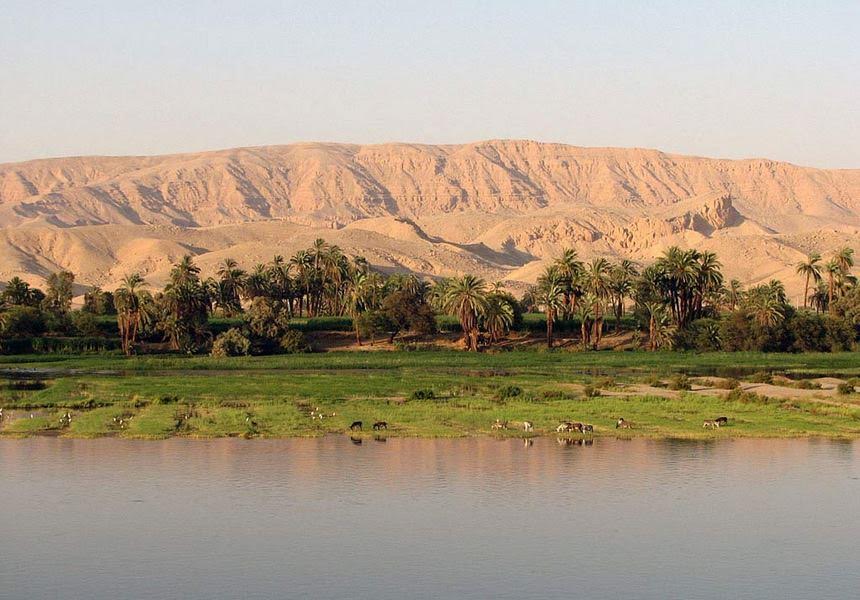
Fertile land of the Nile

Fertile land of the Nile

Alexandria was beautiful and learned, but it was also tumultuous .

In A.D. 115 it was destroyed during the Greek-Jewish civil war. Luckily, that great phil-Hellene emperor, Hadrian, decided to rebuild the city so that it could continue to thrive.

By the time of A Dragon among the Eagles, when Emperor Septimius Severus and his legions came into Egypt at the conclusion of the Parthian campaign around A.D. 199, Alexandria was once again a metropolis to rival Rome.

Alexandria was always well placed at the crossroads of the world, beside the waters of the Nile Delta, at the edge of the Silk Road, and with free access to the rest of the Mediterranean Sea.

It was built on a narrow strip of land which was sandwiched between the Mediterranean to the north, and the fresh waters of Lake Mareotis to the south.
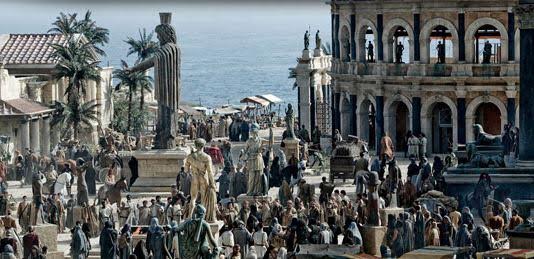
Alexandrian street scene in movie Agora

Alexandrian street scene in movie Agora

To the east of the city was the Eleusis Plain which contained an underground complex where the Eleusinian Mysteries, that major ritual of Ancient Greece, were presumably carried out. Closer to the sea on that side of the city were the Jewish and Christian sepulchers, as well as temples and Roman cemeteries beyond the Grove of Nemesis.

On the western side of the city, beyond the Draco River which ran along the south of the city and into the Fluvius Novus, the Great Canal of Alexandria, was the western necropolis which also contained Christian catacombs.
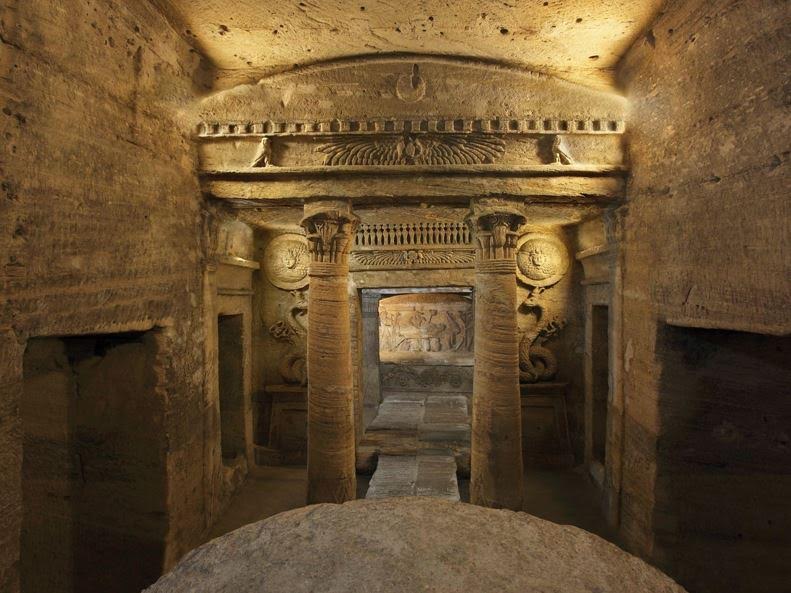
Alexandrian catacombs with mixture of Egyptian, Hellenistic and Roman styles

Alexandrian catacombs with mixture of Egyptian, Hellenistic and Roman styles

If you have seen the movie Agora, with Rachel Weiss, you will have seen a later, dirtier recreation of Alexandria from the time of this particular story.

At the heart of Alexandria were the temples and palaces, and the Cema destrict where the tomb of Alexander the Great was located. Through it all ran the great city street known as the Canopic Way.
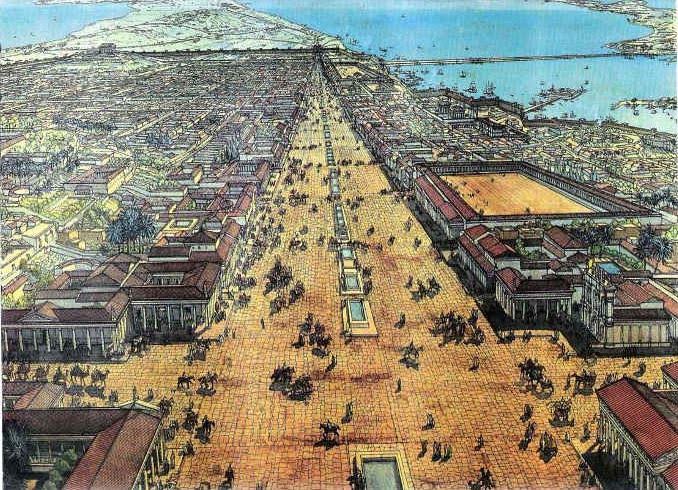
Alexandria's Canopic Way (artist impression)

Alexandria’s Canopic Way (artist impression by Egyptologist Jean-Claude Golvin)

The Canopic Way, with the Sun Gate in the East, and the Moon Gate to the West, was ancient Alexandria’s main artery. It was the place to see and be seen, where giant litters carrying perfumed ladies went back and forth in the shadow of luxurious villas and temples. There were huge fountains running down the middle of the thoroughfare. Perhaps the Canopic Way was a sort of ancient version of Rodeo Drive, or 5th Avenue?

The success and livelihood of Alexandria did not necessarily stem from the richness of the street, nor the number of its temples, but rather from the Great Harbour which was faced by the royal palaces, agora, and the Great Library.

Across the man-made mole known as the Heptastadion, a bridge of about seven stades long, was the island of Pharos, and the structure that beckoned all the world to Alexandria – the Lighthouse.
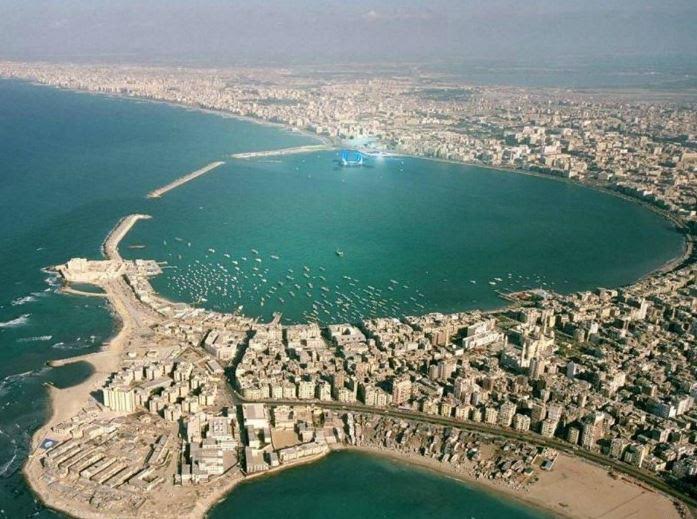
The City of Alexander today

The City of Alexander today

As one of the wonders of the ancient world, the great lighthouse of Alexandria set this city apart, and if that was the beacon, the library, for many, was what awaited them. It has been said that the previous library, that which stood during the reign of Cleopatra, burned down, and all the treasures it contained with it.

However, there are some theories that say the great library was never fully destroyed, that many of the works survived and that the library continued to send people out into the world to collect copies of every book or work ever created.
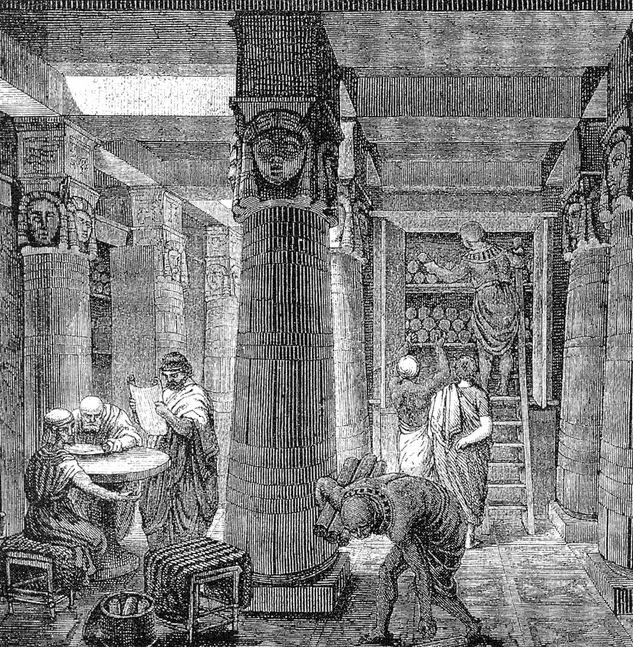
Library of Alexandria

Library of Alexandria

I wonder if Alexandria would have lived up to the Conqueror’s expectations as he was laying out the city with his men’s rations, prior to his defeat of the Persian Empire?

It is ironic that the body of Alexander also became a big draw in Alexandria, for people came from around the ancient world to see this titan among men.

Augustus himself stopped to see Alexander’s body after the Battle of Actium, and successive emperors did likewise, including Septimius Severus who, for some strange reason, closed Alexander’s tomb to the public prior to going on a Nile cruise with his wife, Julia Domna.

Writing about this ancient city was no easy feat. First of all, I had to discover which structures were actually there during this time, and which I could not include.

It was also fun writing about Alexandria, in comparison to Rome, for it was generally believed that Alexandrian morals were much looser than those of Rome, making it something of a brilliant, seedy, learned metropolis.

When Lucius Metellus Anguis arrives in Alexandria, a city he has dreamed of visiting for a long time, he is torn between two worlds.
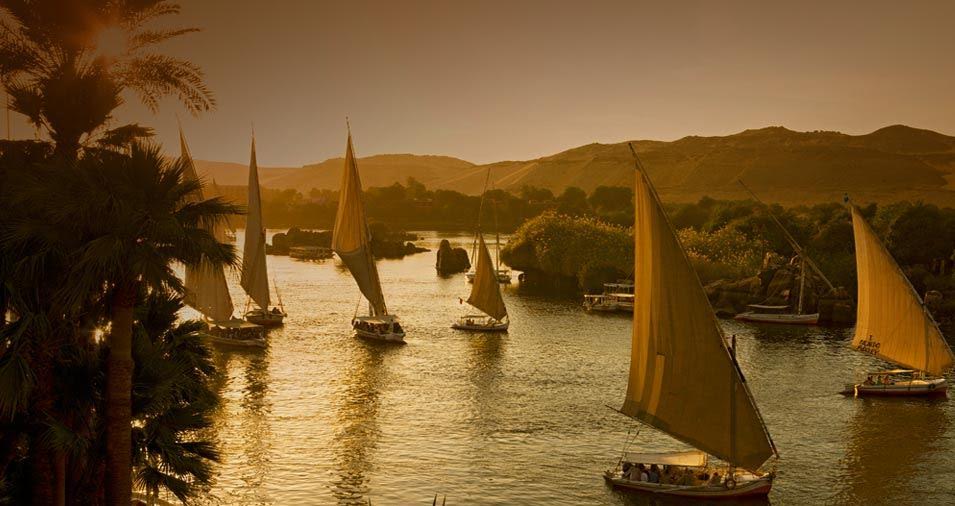
Can't really blame the Emperor and Empress for taking a Nile cruise!

Can’t really blame the Emperor and Empress for taking a Nile cruise!

This made for some interesting and fun storytelling.

But it seems to me, after the research I’ve done, and after having written in that world, that Alexandria was anything but uniform, despite its logical grid of streets laid out by Alexander.

Alexandria was a world of contrasts, of perhaps the worst and the best that life had to offer. It preserved culture, and destroyed it, but it always rose from the ashes.
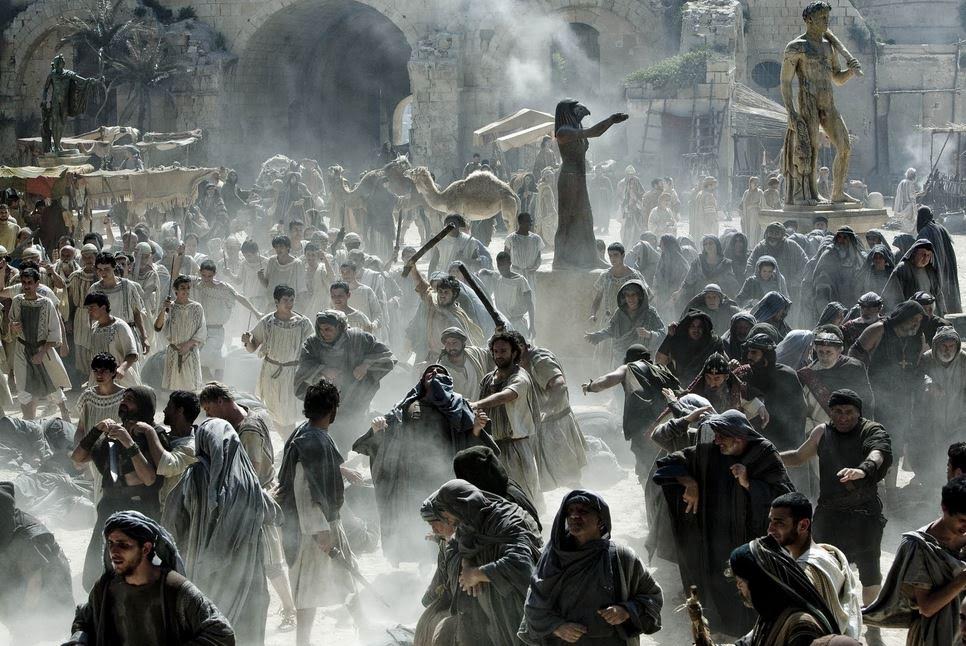
Riotous Alexandrians in the movie Agora

Riotous Alexandrians in the movie Agora

The glory days of its early Hellenistic existence were long gone, but perhaps under Rome, it experienced a revival that may not have been possible under the drunken ancestors of Cleopatra? I’m not sure, but if Cleopatra’s father saw the need to have Rome care for it after his death, there must have been a reason for it.
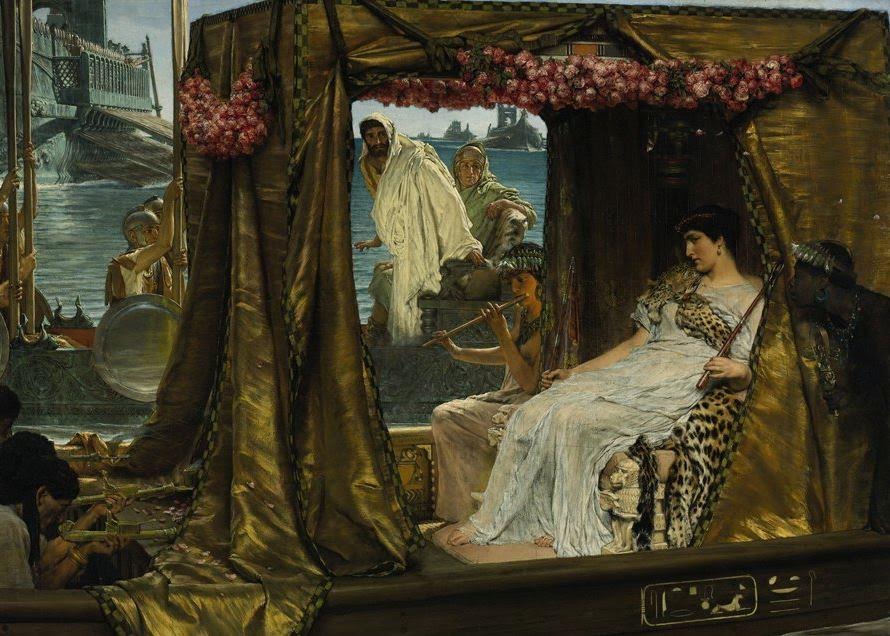
Antony and Cleopatra

Antony and Cleopatra

Well, that’s the end of this blog series about The World of A Dragon among the Eagles.

I hope you’ve enjoyed it and found it informative, even though I have only but scratched the surface of some of these topics. If you missed any of the posts, or if you would like to re-read them, you can see them all by CLICKING HERE TO READ THE FULL SERIES.
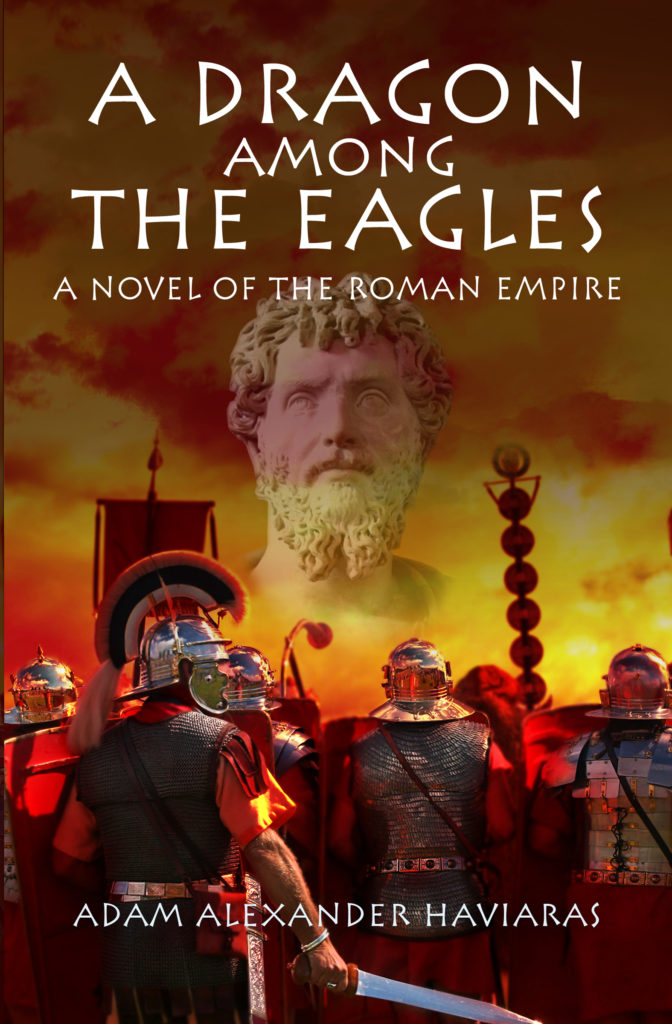
A Dragon among the Eagles, is now available on Amazon and Kobo, and very soon on iTunes/iBooks.

It is also now available in paperback from Amazon and Create Space.

So, if your interest is piqued, download a copy today and let us know what you think by leaving an honest review.

The story continues in Children of Apollo, so be sure to also check that out.

To stay up-to-date with new releases in this and other series by Eagles and Dragons Publishing, be sure to sign-up for the mailing list By Clicking Here. You’ll have first access to new releases, special offers, blog posts, and much more! 

Thank you for reading!

Facebooktwitterpinterest

The World of A Dragon among the Eagles – Part IV – Cities Under Siege

The World of A Dragon among the Eagles

One of the great things about reading and writing historical fiction is that one is given the chance to journey to a time and place far away from the modern world.

In this fourth part of The World of A Dragon among the Eagles, we’re going on location to some of the places where the action takes place, some of which, sadly, are still making headlines today.

This won’t be an in-depth look at these ancient cities, for their histories are long and varied, and they each deserve their own a book. Here, we’re just going to take a brief look at their place in this story.

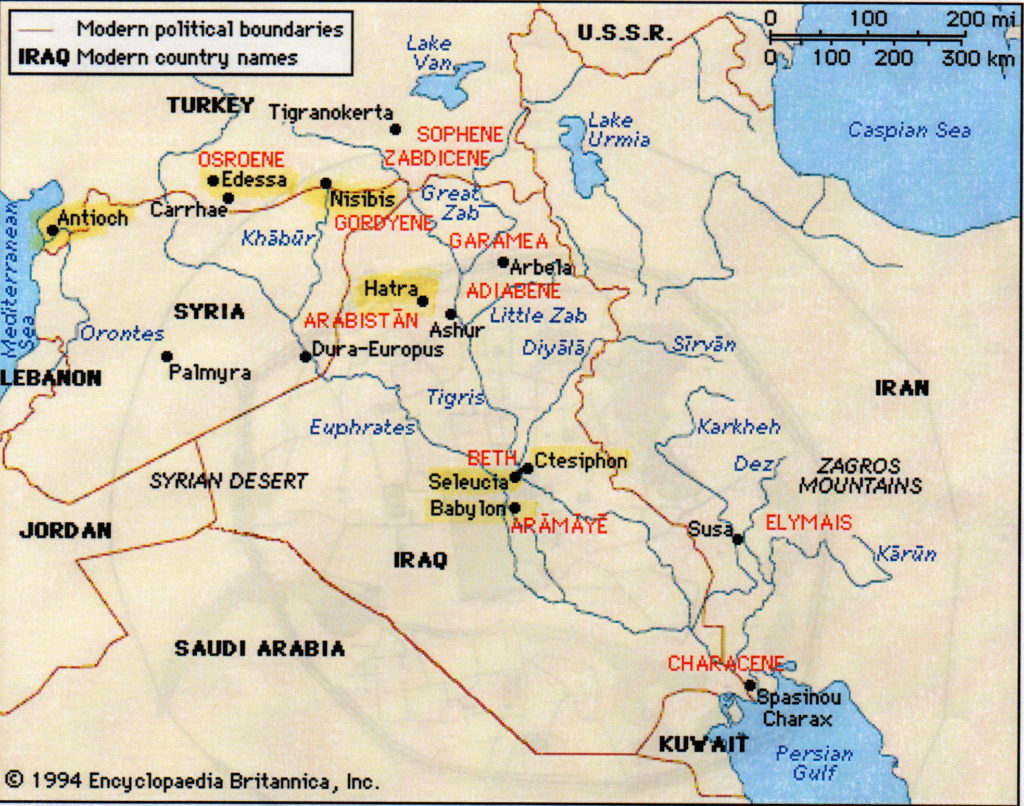
Sites where A Dragon among the Eagles takes place

Sites where A Dragon among the Eagles takes place

The first third of A Dragon among the Eagles takes place in Rome, then Athens, and a little at Amphipolis which has gained recent fame for the massive tomb and the excavations there which have been linked to the period of Alexander the Great.

However, we are not going to look at Rome and Athens, as we visit those cities much more in Children of Apollo and Killing the Hydra, the sequels to A Dragon among the Eagles. If you would like to read more about Amphipolis, you can read this BLOG POST HERE.

For this blog, we are mainly concerned with the cities where Lucius Metellus Anguis, our protagonist, gets his first taste of war with the Legions.

Mesopotamia is said to be the cradle of civilization, a land of alternating fertility and desert where the first cities were built, and empires made. It also was, and is, a land of war, a land of terrible beauty.

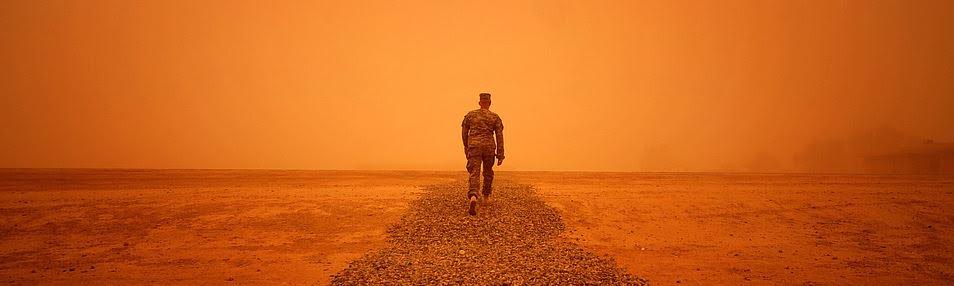
Trooper in modern Iraq

Trooper in modern Iraq

For millennia, successive civilizations have fought over this rich land, a land from which Alexander the Great had decided to rule his massive empire.

In A Dragon among the Eagles, Lucius Metellus Anguis’ legion arrives at the port of Antioch where Emperor Severus has assembled over thirty legions on the plains east of the city.

Antioch, which was then located in Syria, now lies in modern Turkey, near the city of Antyaka. It was founded in the fourth century B.C. by one of Alexander’s successor-generals, Seleucus I Nicator, the founder of the Seleucid Empire.

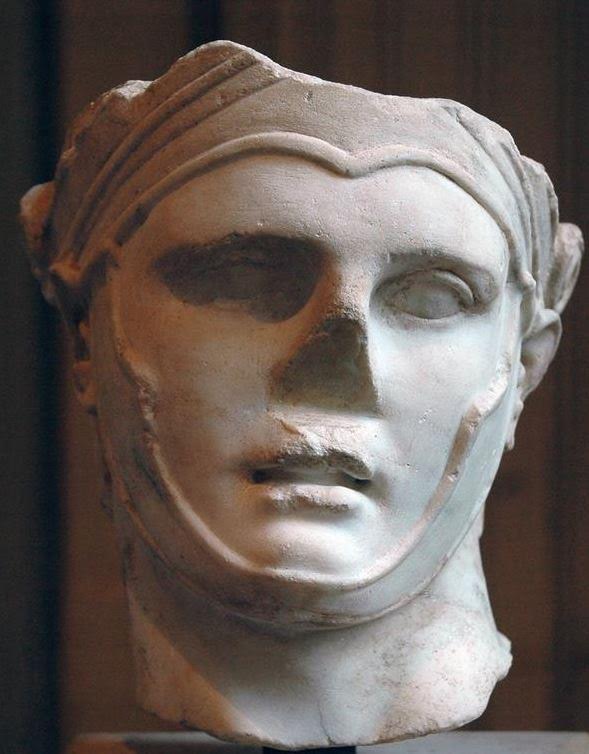
Seleucus I Nicator

Seleucus I Nicator

Seleucus named this city after his son, Antiochus, a name that would be taken by later kings of that dynasty.

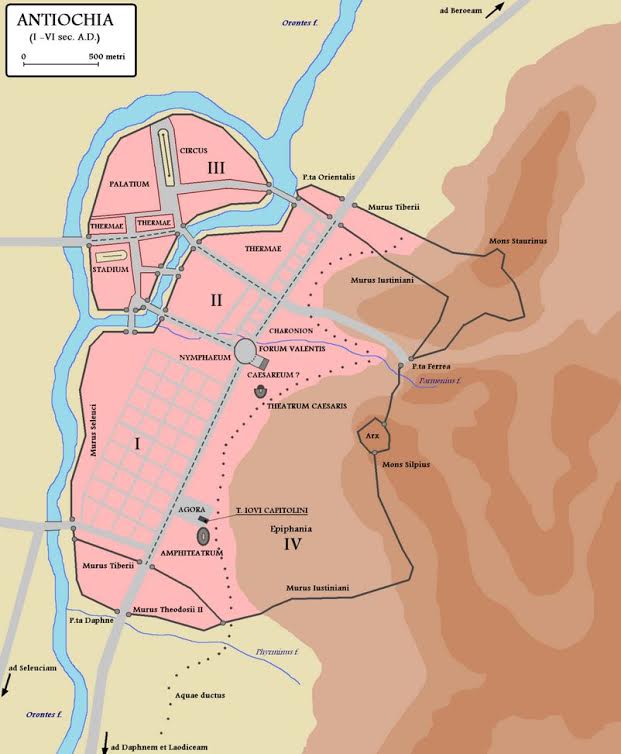
Antioch was called the ‘Rome of the East’, and for good reason. It was rich, mostly due to its location along the Silk Road. Indeed, Antioch was a sort of gateway between the Mediterranean and the East, with many goods, especially spices, travelling through it. It is located on the Orontes river, and overlooked by Mt. Silpius.

Antioch in the Roman Empire

Antioch in the Roman Empire

In the book, we catch a glimpse of this Ancient Greek city that was greatly enhanced by the Romans who saw much value in it. Actually, most of the development in Antioch took place during the period of Roman occupation. Enhancements included aqueducts, numerous baths, stoas, palaces and gardens for visiting emperors, and perhaps most impressive of all, a hippodrome for chariot racing that was 490 meters long and based on the Circus Maximus in Rome.

Antioch, during the late second century A.D., rivalled both Rome and Alexandria. It was a place of luxury and civility that was in stark contrast to the world of war where the legions were headed.

Some ruins of Nisibis today

Some ruins of Nisibis today

In writing A Dragon among the Eagles, I have followed the itinerary presented to us by Cassius Dio, the main source for this period in Rome’s history and the Severan dynasty. So, the order in which we are looking at these locales is roughly the order in which Severus’ legions are supposed to have attacked them.

The first real battle in the book, and the first time our main character experiences battle, is at the desert city of Nisibis.

At the time, Nisibis was under Roman control. However, that control was about to break according to Dio, as the Romans inside were just holding onto it. This is due mainly to the leadership of the Roman general, Maecius Laetus, whom we meet in the story.

Laetus managed to hold the defences of Nisibis until Severus’ legions showed up, and was hailed as a hero for it.

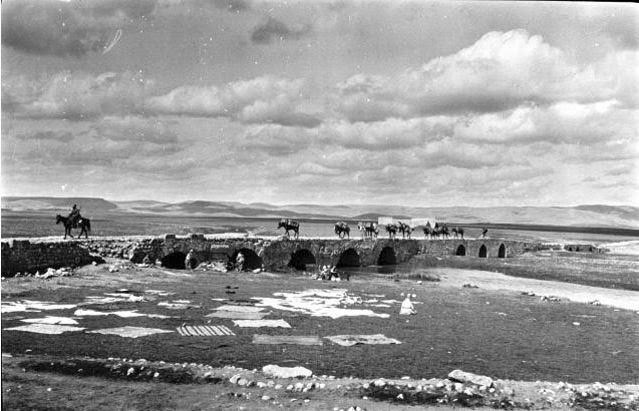
Nisibin Bridge - Gertrude Bell's caravan crossing bridge.

Nisibin Bridge – Gertrude Bell’s caravan crossing bridge.

Nisibis was situated along the road from Assyria to Syria, and was always an important centre for trade. This was the only spot where travellers could cross the river Mygdonius, which means ‘fruit river’ in Aramaic. Today it is located on the edge of modern Turkey.

Early in its history, Nisibis was an Aramaen settlement, then part of the Assyrian Empire, before coming under the control of the Babylonians. In 332 B.C. Alexander the Great, and then throughout the Roman-Parthian wars, it was captured and re-captured, over and over.

Such is the fate of strategically placed settlements, especially when they are located along the Silk Road.

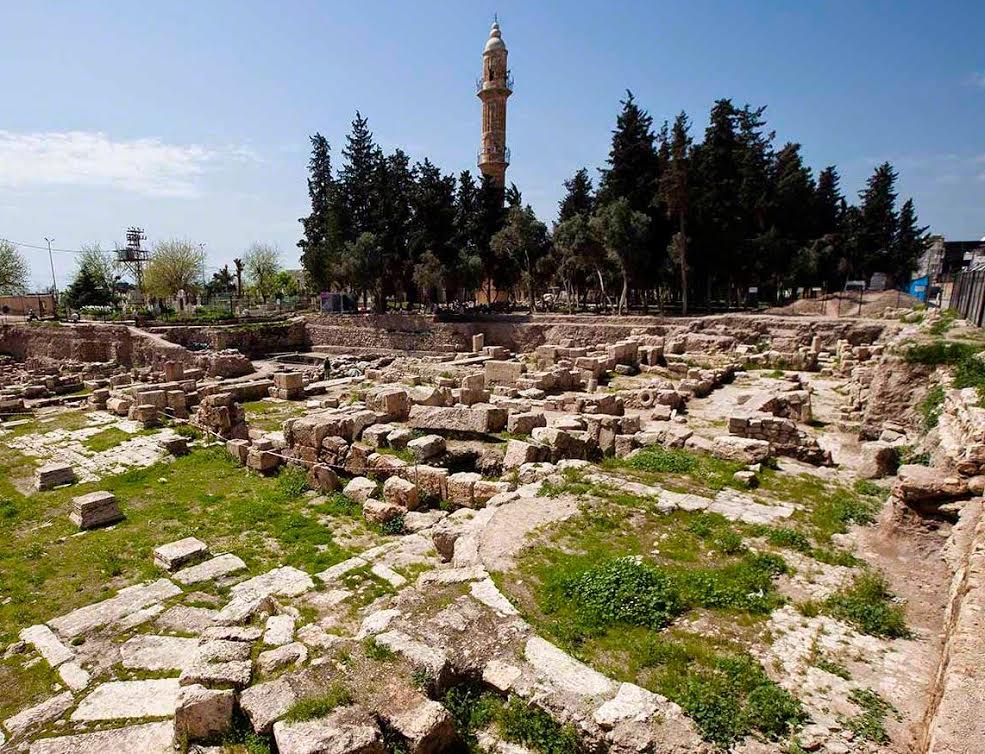
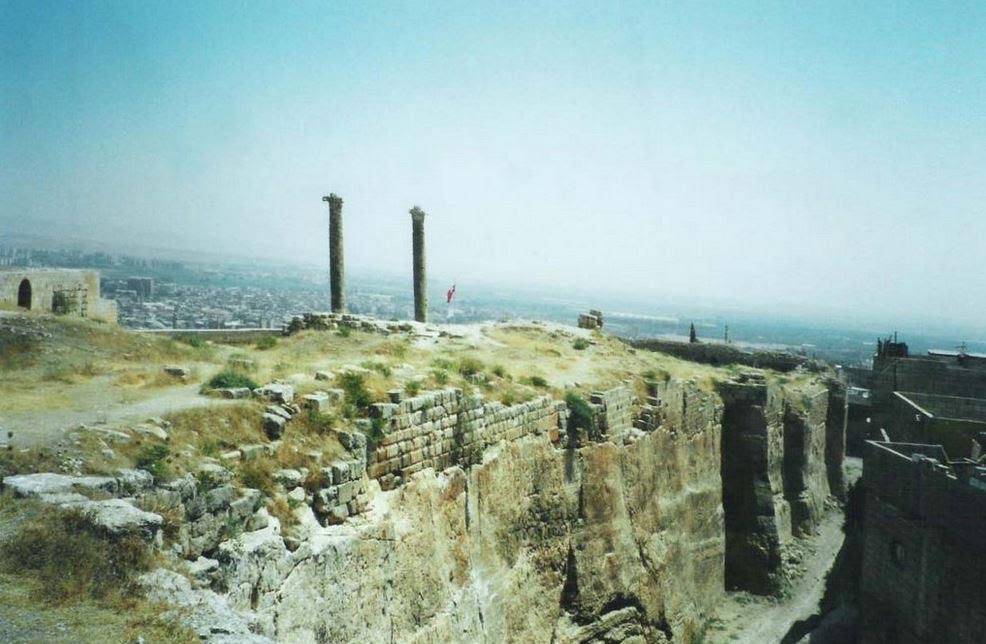
Ruins of Edessa

Ruins of Edessa

From the bloody fighting in Nisibis, Severus’ forces then moved into the Kingdom of Osrhoene and the upper Mesopotamian city of Edessa, located in modern Turkey.

Edessa was originally an ancient Assyrian city that was later built up by the Seleucids.

Edessa’s independence came to an end in the 160s A.D. when Marcus Aurelius’ co-emperor, Lucius Verus, occupied northern Mesopotamia during one of the Roman-Parthian wars.

From that point on, Osrhoene was forced to remain loyal to Rome, but things changed when the civil war broke out between Severus, Pescennius Niger, and Clodius Albinus. Osrhoene threw their support behind Niger, who was then governor of Syria.

When Severus came out the victor in the civil war, it was inevitable that Edessa and Osrhoene would have to face the drums of war.

Edessa was where King Abgar of Osrhoene, who was sympathetic to the Parthians, was holed up as Severus’ legions advanced.

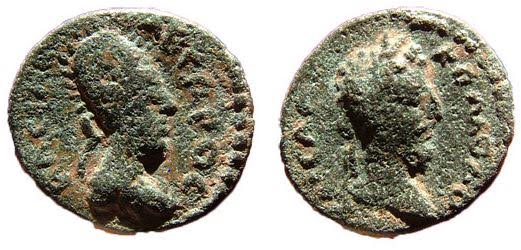
King Abgar of Osrhoene and Commodus

King Abgar of Osrhoene and Commodus

One has to wonder what King Abgar was thinking as Severus approached this ancient city. Whatever it was, and whatever he said to the Roman Emperor when he arrived, it must have been acceptable, for Abgar was permitted to keep his throne as a client king of the Empire.

There was a siege, but it seems that with King Abgar accepting Rome’s overlordship, and Severus’ need to move south, this is why the Osrhoenes escaped any large scale retribution.

In a way, it was not so for Lucius Metellus Anguis, for whom Edessa proves to be a harsh and enlightening experience.

At this time, Septimius Severus had his sights set on southern Mesopotamia and the great cities of Seleucia, Babylon, and the Parthian capital of Ctesiphon.

Ancient Babylon

Ancient Babylon

The legions made their way south, directly for Seleucia-on-Tigris.

Seleucia, as the name suggests, was built by the Seleucus I Nicator in 305 B.C. as the capital of his empire. It was located sixty kilometers north of Babylon, and just across the Tigris River, on the west bank, from Ctesiphon. Today, Seleucia is located in modern Iraq, thirty kilometers south of Baghdad, and in its day, it was a major city in Mesopotamia.

It was a great Hellenistic city in the third and second centuries B.C., with a rich mixture of Greco-Mesopotamian architecture, and walls enclosing a full 1,400 acres as well as a population of 60,000 people.

When the Parthians took Seleucia, the capital was moved across the river to Ctesiphon and, though the city remained in use and inhabited, it went into a slow decline.

During the Roman-Parthian wars, Seleucia was burned by Trajan, rebuilt by Hadrian, and then destroyed again. Like a battered boxer with heart, it kept rising from the ground until there was no more will to keep it alive.

By the time Severus’ legions were marching on Seleucia, the Parthians had abandoned it completely, giving the Romans a foothold on the Tigris River, opposite their capital.

Seleucia on Tigris c.1927

Seleucia on Tigris c.1927

Ctesiphon would have to wait, however, for there was another magnificent and symbolic prize within Severus’ grasp at that time – Babylon.

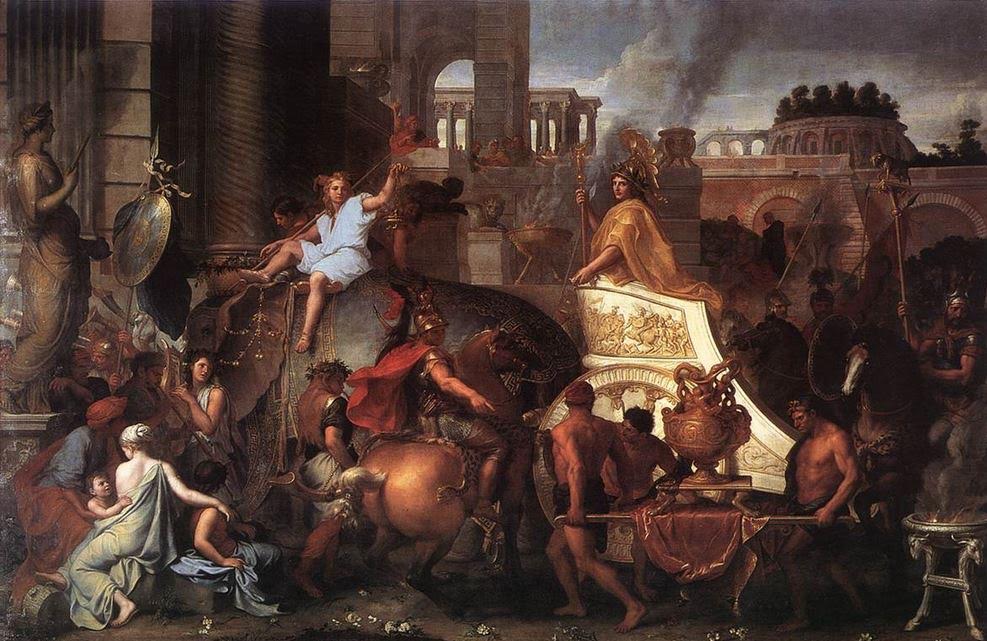
Alexander entering Babylon (Charles Le Brun)

Alexander entering Babylon (Charles Le Brun)

I find that when I utter the name of Babylon, I get chills. Think about it, this is one of the most famous of ancient cities! This was the place that welcomed Alexander the Great with open arms and triumph, the place from which he had decided to rule his titanic empire, and the place where he died.

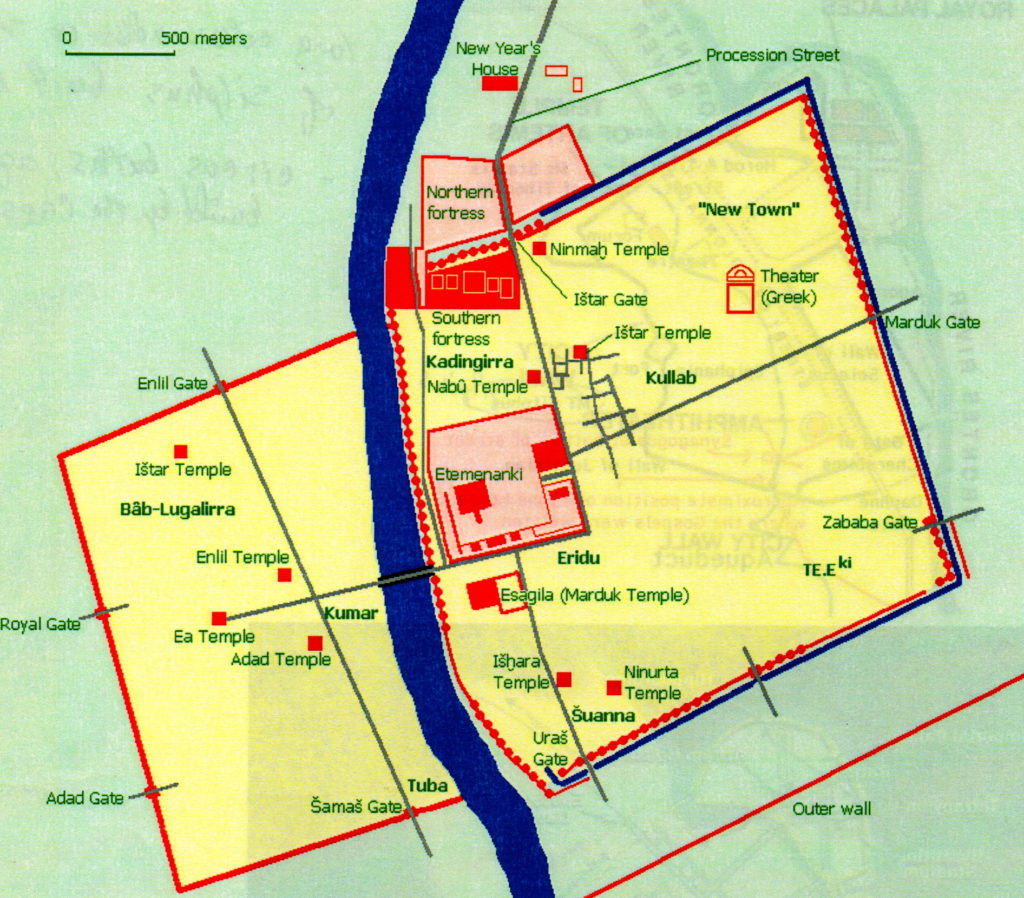
Babylon was located on the fertile plain between the Tigris and Euphrates rivers. Actually, part of it was built over the Euphrates.

The original settlement of Babylon is said to date to about 2300 B.C when it was part of the Semitic Akkadian Empire. It was fought over and rebuilt, and in about 1830 B.C. it became the seat of the first Babylonian dynasty.

From about 1770 B.C. to 1670 B.C. Babylon was the largest city in the world with a population of over 200,000.

Perhaps the most famous period in Babylon’s long and ancient history is during what is known as the Neo-Babylonian Empire (626-539 B.C.), and especially the reign of King Nebuchadnezzar II (605-562 B.C.)

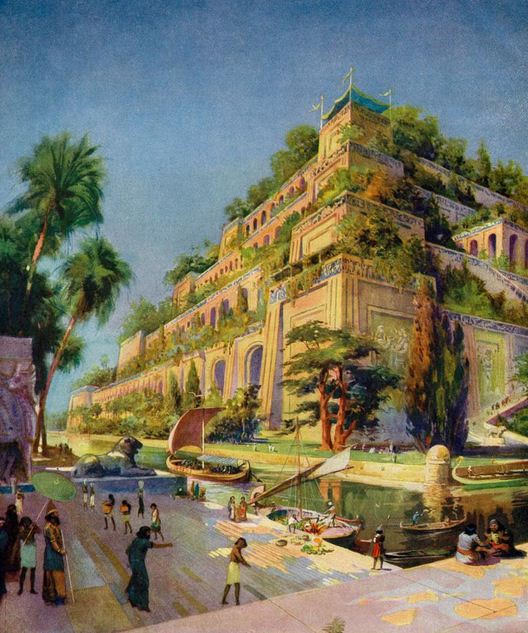
Then Hanging Gardens of Babylon

Then Hanging Gardens of Babylon

Nebuchadnezzar was a great builder, and it was he who made Babylon one of the most beautiful cities of the ancient world, home to one of the Seven Wonders.

He built the famed Hanging Gardens of Babylon for his Median wife who missed the lushness of her homeland, and he also constructed the giant ziggurat of Etemenanki beside the temple of Marduk.

Babylon at this time must have been a sort of paradise on earth with the ziggurat as the doorway to the heavens. The walls of the city too, were so big that it was said that two chariots could pass each other as they drove along the top of the walls.

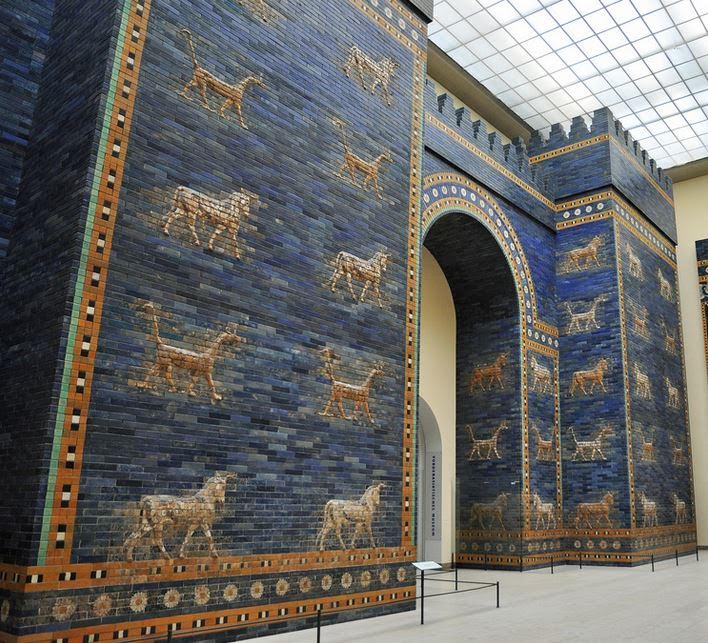
Ishtar Gate of Babylon at Pergamon Museum Berlin

Ishtar Gate of Babylon at Pergamon Museum Berlin

When the Seleucids came onto the scene and Babylon’s power and beauty faded into history, the population was moved to Seleucia, one supposes to bolster the economy of the great new capital envisioned by Seleucus I.

There was a lot of history at Babylon, and it’s not improbable that all the Romans who marched through there thought of Alexander as they approached, including Severus.

But Babylon was a very different place when the legions marched on it late in A.D. 198.

Just as Seleucia had been abandoned, so too was Babylon. And so, with barely a drop of blood being shed, the Romans walked into this ancient city of faded glory in stern silence, their prize almost too easily won.

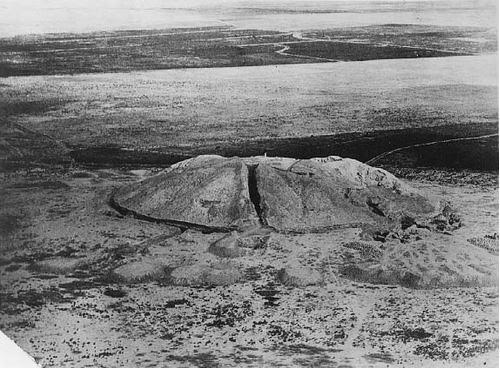
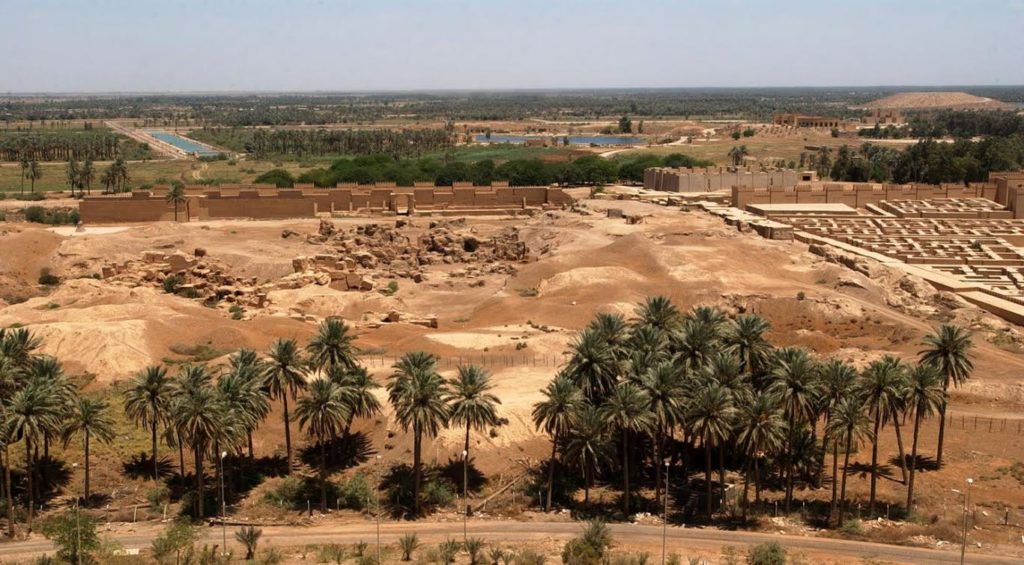
Ruins of Babylon (Wikimedia Commons)

Ruins of Babylon (Wikimedia Commons)

It was time for the real battle.

With Seleucia and Babylon basically given over to Rome and Severus’ legions, the forces of Rome and Parthia converged on the capital of Ctesiphon.

This time, the Parthians were waiting.

Ctesiphon, compared to the other cities we have seen, was a relatively new settlement on the east bank of the Tigris River, facing Seleucia. It was built around 120 B.C. on the site of a military camp built by Mithridtes I of Parthia. At one point in time, it merged with Seleucia to form a major metropolis straddling the river.

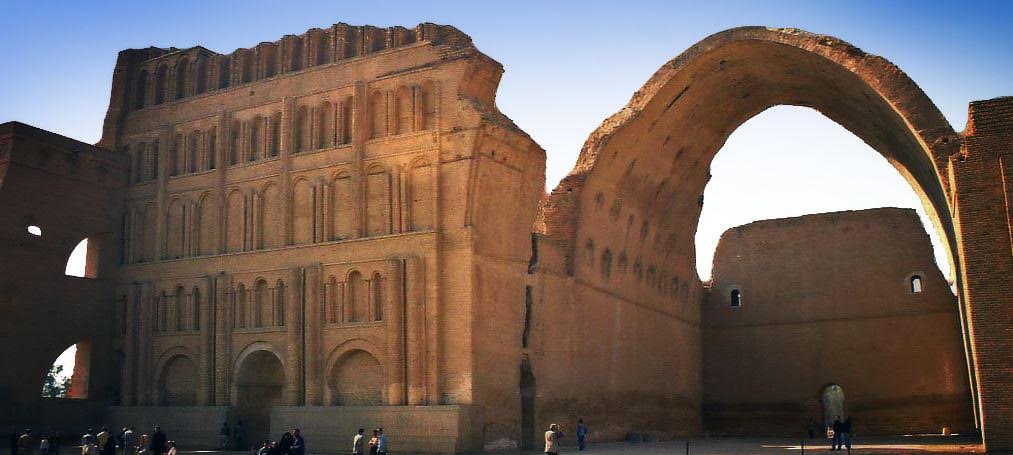
Ctesiphon's ruins today, including the great audience hall.

Ctesiphon’s ruins today, including the great audience hall.

During the Roman-Parthian wars, Ctesiphon did not have an easy time of it. It was captured by Rome five times in its history, the last time by Septimius Severus who burned it to the ground and enslaved much of the population.

The Greek geographer, Strabo, describes the foundation of Ctesiphon here:

In ancient times Babylon was the metropolis of Assyria; but now Seleucia is the metropolis, I mean the Seleucia on the Tigris, as it is called. Nearby is situated a village called Ctesiphon, a large village. This village the kings of the Parthians were wont to make their winter residence, thus sparing the Seleucians, in order that the Seleucians might not be oppressed by having the Scythian folk or soldiery quartered amongst them. Because of the Parthian power, therefore, Ctesiphon is a city rather than a village; its size is such that it lodges a great number of people, and it has been equipped with buildings by the Parthians themselves; and it has been provided by the Parthians with wares for sale and with the arts that are pleasing to the Parthians; for the Parthian kings are accustomed to spend the winter there because of the salubrity of the air, but they summer at Ecbatana and in Hyrcania because of the prevalence of their ancient renown.

Being built by the Parthians, Ctesiphon, unlike Seleucia, Babylon, or the other places we have discussed, was a Parthian invention. Probably the greatest structure of this capital was the great, vaulted audience chamber, or hall, which seems to be all that remains today. In truth, there is very little information on other structures within Ctesiphon itself.

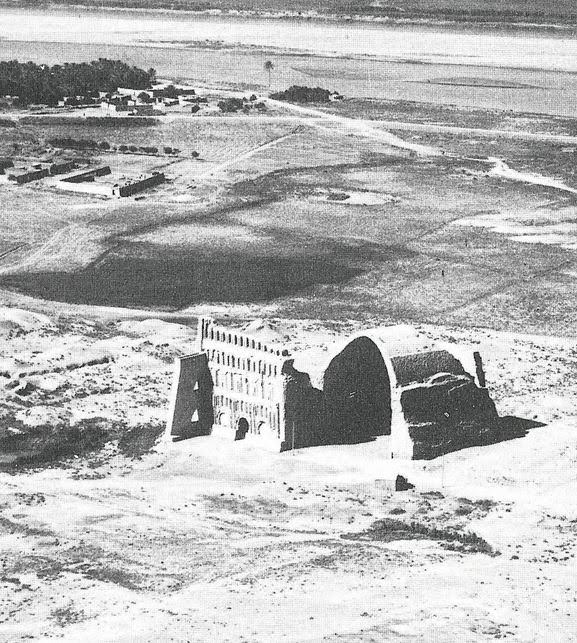
Ctesiphon from the air

Ctesiphon from the air

The final sack of Ctesiphon by Severus’ legions in A.D. 197 was a brutal affair, and one that ended that city and provided the death blow to the Parthian Empire.

In A Dragon among the Eagles, the Roman attack on Ctesiphon is one of the major battle scenes which I had envisioned a long time ago. Imagine, almost thirty legions lined up on the other side of the river with the entire force of Parthian horse archers and heavy cataphracts awaiting them.

The Romans had to cross the river, gain a beachhead, and then push forward. In the end, Rome prevailed, but at great cost to the troops.

One would have thought that with the sacking of the Parthian capital, all would be finished, but there was another score for Rome to settle, another city to take – the desert city of Hatra.

As I write this, I have a pang of sadness, for while I was researching and writing about Hatra and the Roman siege there, extremist groups in the Middle East were in the process of the wonton destruction of this ancient heritage site. Writing this part of the book was indeed an odd experience.

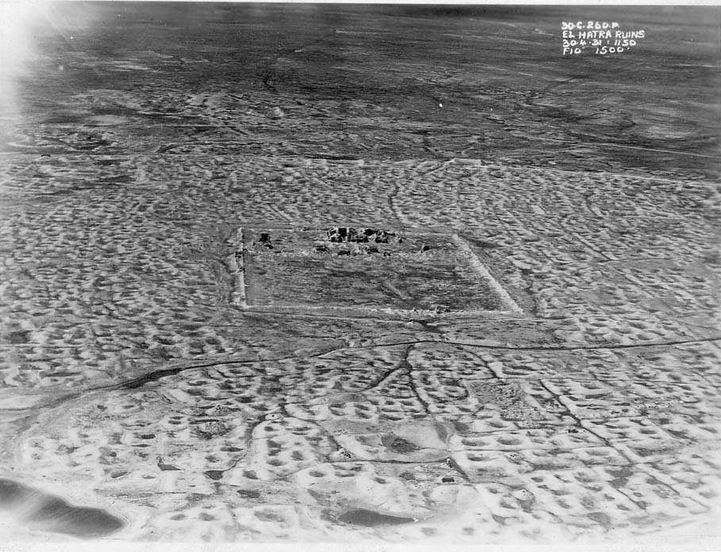
Hatra is located in modern Iraq, about 290 kilometers north of Baghdad, on the Mesopotamian desert, far from either the Tigris or Euphrates. It was built by the Seleucids, those Hellenistic giants we’ve heard so much about, around the third century B.C.

Hatra old survey aerial photo

Hatra old survey aerial photo

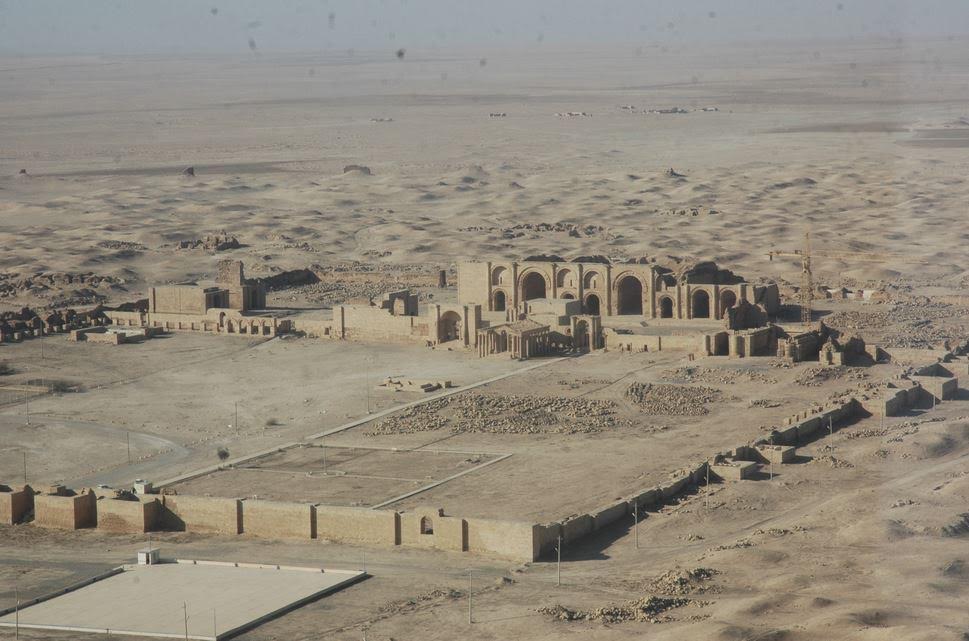
It flourished under the Pathians too as a center of religion and trade during the first and second centuries A.D. What is fascinating about Hatra is the harmony and religious fusion it represented. This remote desert city was a place where Greek, Mesopotamian, Canaanite, Aramean, and Arabian religions lived peacefully side-by-side. And for 1,400 years it was protected and preserved by Islamic regimes, until it was destroyed in 2015.

It was the best-preserved Parthian city in existence.

Hatra before the 2015 destruction

Hatra before the 2015 destruction

When Septimius Severus turned his attention on Hatra after the fall of Ctesiphon, it was with a goal of doing what no other Roman, even Trajan, had been able to do.

It was personal too, for Hatra and its ruler, Abdsamiya, had supported Pescennius Niger against Severus in the civil war.

But there were a few reasons Hatra had withstood Roman sieges, including the two attempted by Severus in his Parthian campaign.

First of all, Hatra was remote, stranded out in the desert with its own water source within the walls, but none without. The nearest water was over forty miles in any direction. A legion could only march a maximum of twenty-five miles in one day. So, thirst for those laying siege was a big factor.

Then there were the walls – two of them. Hatra was protected by immense, circular, inner and outer walls, the diameter of which was 2 kilometers, or 1.2 miles. Along these massive walls were 160 towers, making this island fortress of the sand seas no easy target.

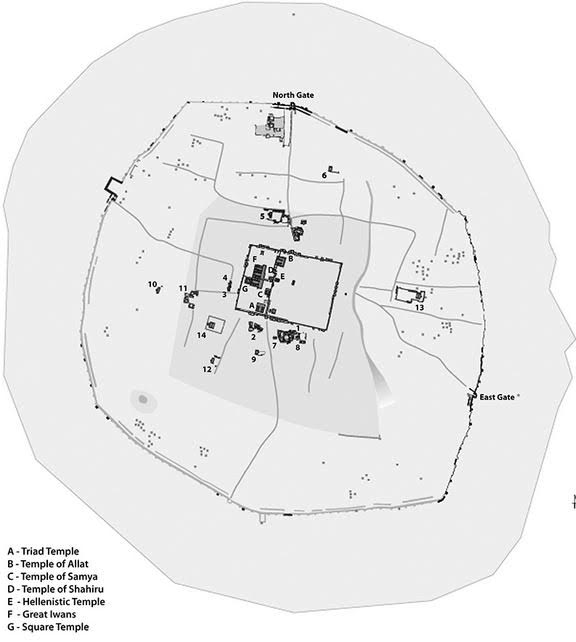
Hatra Map (with temples labelled)

Hatra Map (with temples labelled)

At Hatra’s heart were the sacred buildings of the gods of various religions, gods whom many believed protected the city from attack.

The temples within Hatra covered a total of 1.2 hectares, and that area was dominated by the Great Temple of Bel which was about 30 meters high.

Hatra withstood two major attacks by Roman emperors, Trajan and Severus. Every time, Hatra’s walls, and her gods, turned Rome back.

Cassius Dio describes Severus’ last siege of Hatra:

He himself made another expedition against Hatra, having first got ready a large store of food and prepared many siege engines; for he felt it was disgraceful, now that the other places had been subdued, that this one alone, lying there in their midst, should continue to resist. But he lost a vast amount of money, all his engines, except those built by Priscus, as I have stated above, and many soldiers besides…

When the walls were breached, Severus gave the Hatrans time to consider surrender, as he respected the religious importance of the place, especially the temple of the Sun God. But the Hatrans were stubborn, and the troops were fed up:

Thus Heaven, that saved the city, first caused Severus to recall the soldiers when they could have entered the place, and in turn caused the soldiers to hinder him from capturing it when he later wished to do so [threat of mutiny].

Once again, Hatra resisted being conquered by Rome, making it the only place Severus’ legions were not able to take.

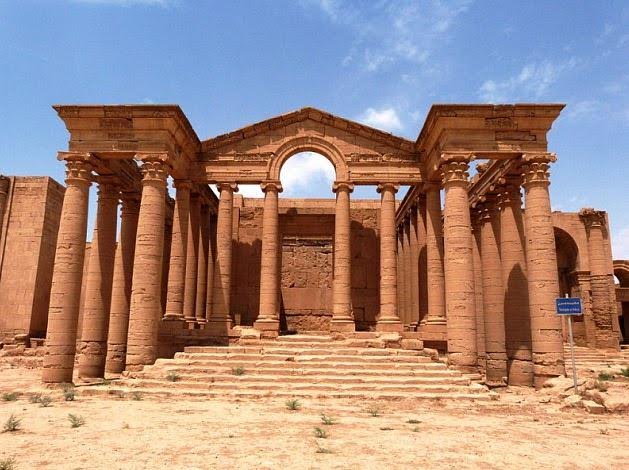
One of Hatra's many magnificent temples

One of Hatra’s many magnificent temples

It is sad that, in light of the events of 2015, it seems Hatra’s gods finally deserted it.

To see more of Hatra before its destruction, CLICK HERE to watch the UNESCO video.

I hope you’ve enjoyed this march with the legions! In the next post, we’ll be going somewhere more civilized – the City of Alexander the Great!

This past week has been a good one for A Dragon among the Eagles, for in the UK it became an Amazon #1 Bestseller in three categories, including Historical Fantasy. It is also climbing in the Amazon US charts too, so thank you to everyone for supporting the book!

For those of you who prefer to read paperbacks, A Dragon among the Eagles is now available in trade paperback format from either Amazon or Create Space.

And as ever, thank you for reading.

Facebooktwitterpinterest