Greetings Readers and Romanophiles!
Welcome back to The World of The Hearts of Heroes, the blog series in which we are exploring the history, people, and places behind-the-scenes of the newest Eagles and Dragons historical fantasy novel.
If you missed the previous post on the very first church at Glastonbury, you can read that by CLICKING HERE.
In this seventh and final article, we’re going to look at the reign of Emperor Alexander Severus (A.D. 222-235) and how it brought about the end of the Severan dynasty.
Let’s begin…
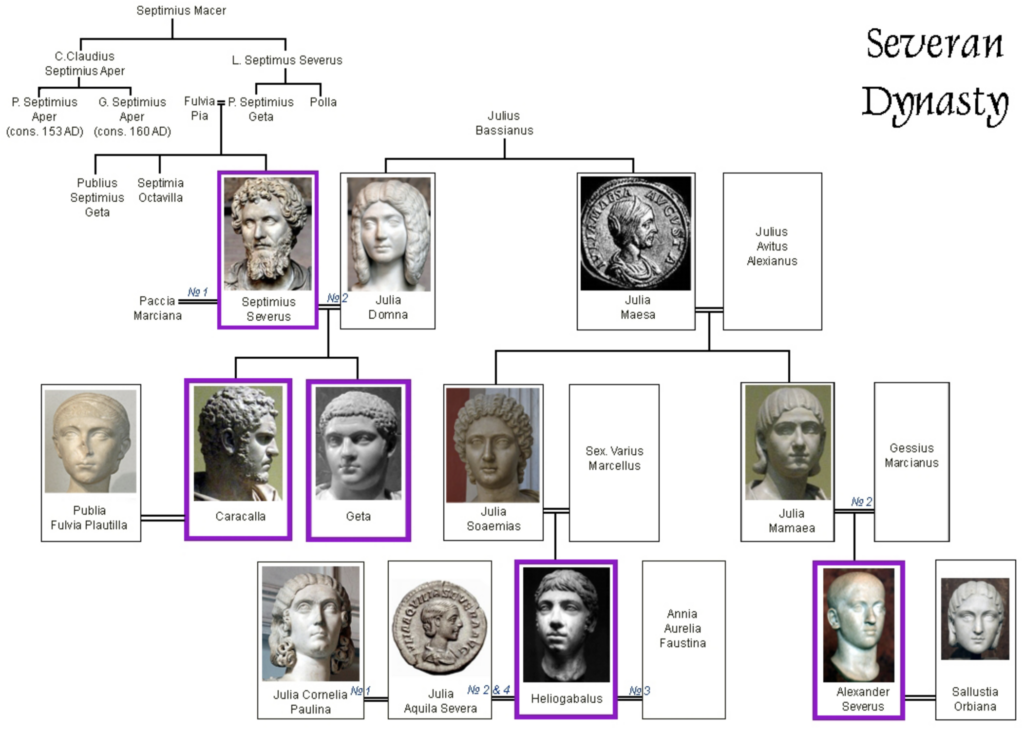
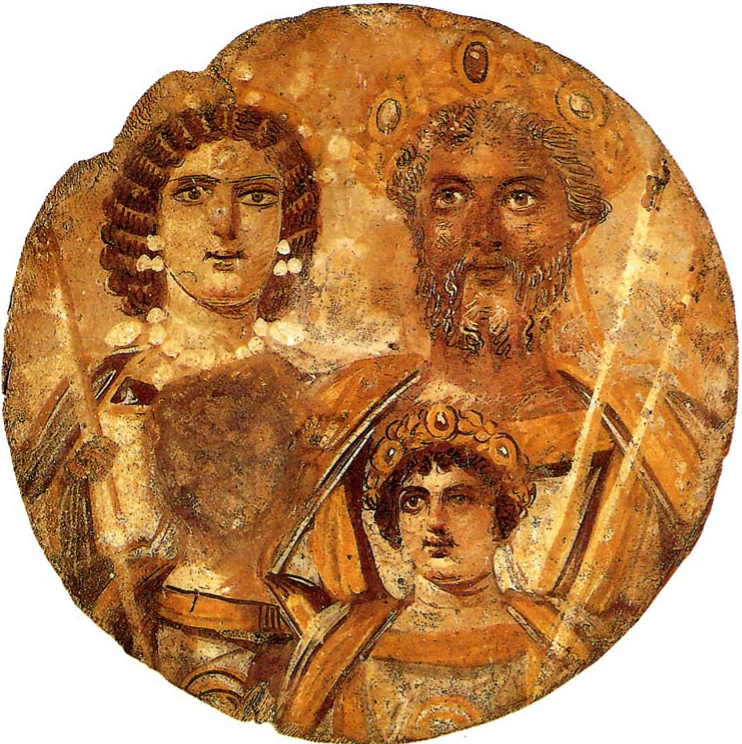
The Severan Dynasty (Wikimedia Commons)
Sunt lacrimae rerum et mentem mortalia tangunt.
‘There are tears for things, and mortal sorrows touch the heart.’
(Virgil, The Aeneid, 1.462)
It has been quite an adventure getting to this point in the Eagles and Dragons series for, like the hero Aeneas looking back on his memories of war and toil above, my time spent with the Severans, researching and writing about them, has come to an end.
The Severan dynasty is, strangely enough, often overlooked by historians, authors, and scriptwriters who tend to focus on the sensational Julio-Claudians or the stoic Antonines. This is somewhat surprising as the years from A.D. 193 to A.D. 235 not only saw the Roman Empire at its greatest extent and power, but the period also, as is believed by some historians, brought about the beginning of the end of the Roman Empire.
However, it was the lack of attention to the Severans that provided the opportunity with this series of books to cut a new path to explore the history of this dynasty through fiction. From the powerful rise of Septimius Severus and the ‘Syrian women’, their actions, and the mistakes of their heirs, we have received a masterclass in the nature of power and politics, the importance of military might, and the fragility of the Pax Romana. We have learned about the two-faced nature of trust and the fickle ways of fortune.
The dynasty that Septimius Severus (A.D. 193-211) established through sheer will, blood, and determination eventually came to a lamentable end due to flawed nature of familial love, the shortcomings of his successors, and the jealousies and aspirations of others.
The Hearts of Heroes takes place in the final years of the Severans, during the reign of its last emperor, Alexander Severus. As we shall see, at the outset of his reign, he provided a much-needed glimmer of hope during a dark period in Rome’s history, but it was not enough to prevent the eventual downfall of that once-powerful family…
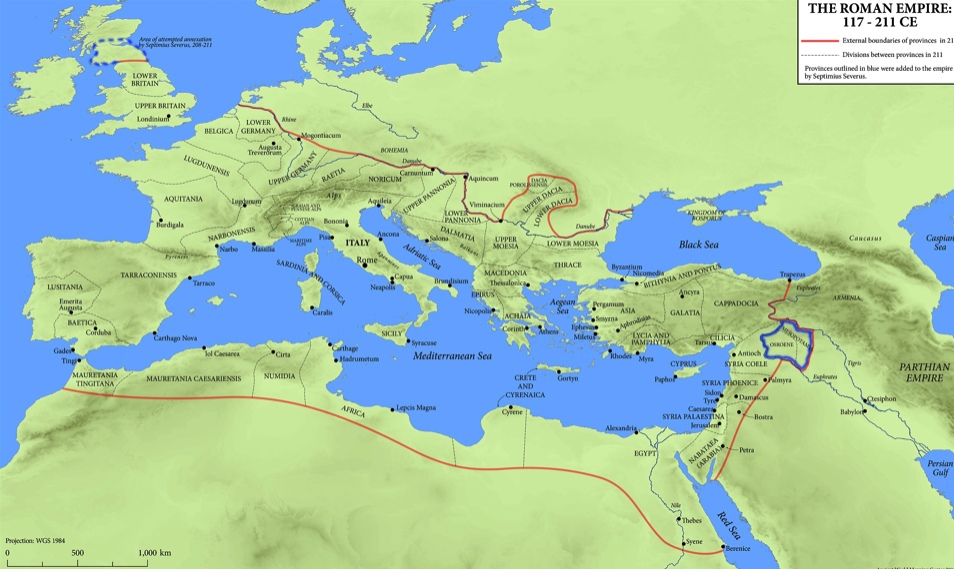
Map of the Roman Empire at its greatest extent (Oxford Research Encyclopedias)
Before we get into the reign of Alexander Severus, it is important to look at the brief reign of his slightly older cousin, Marcus Aurelius Antoninus, known to us as Emperor Elagabalus, or ‘Heliogabalus’ (A.D. 218-222).
Elagabalus was the son of Julia Soaemias who was the daughter of the power Syrian woman, Julia Maesa, sister to Empress Julia Domna. That made him the great-nephew, by marriage, of Emperor Septimius Severus.
In hindsight, if there could be said to be a stain on the Severan line of succession, it would be Elagabalus, for though Caracalla’s reign was riddled with violent episodes, he did make an attempt at ruling the Empire and leading the army. Elagabalus’ reign, however, is marked by controversy, sexual debauchery, and murder which, if the sources are correct, seems akin to the madness of the reign of Caligula. In addition to this, and like Caligula, he made strange appointments to high positions, and disrespected Rome’s gods in favour of his dark Syrian god, Elagabal.
Elagabalus was set upon the imperial throne at just fourteen years old through the wiles of his grandmother, Julia Maesa, on year after the previous pretender, Marcus Opellius Macrinus (the only non-Severan of the period) conspired to have Emperor Caracalla murdered. Julia Maesa, took advantage of the unrest around Emperor Macrinus to instigate a rebellion and have Elagabalus declared emperor after the Battle of Antioch on June 8, A.D. 218.
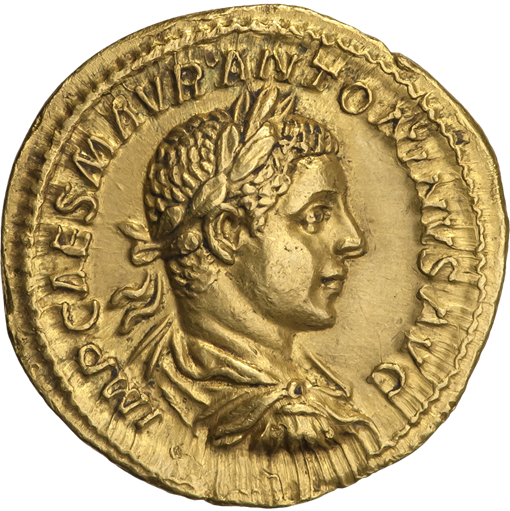
Aureus of Elagabalus (c. A.D. 204-222)
It soon became apparent that Elagabalus was not suited to the role of Emperor, opting instead for dark rituals, cross-dressing, and generally disregarding the traditions of the Senate and people of Rome.
Perhaps most dangerous of all, he had lost the respect of the army. Cassius Dio, one of our main sources for the period, speaks to this:
The false Antoninus [Elagabalus] was despised and put out of the way by the soldiers. Thus it is that persons, particularly if armed, when they have once accustomed themselves to feel contempt for their rulers, set no limit to their right to do what they please, but keep their arms ready to use against the very man who gave them that power.
(Cassius Dio, Roman History, XVII)
Elagabalus’ grandmother, Julia Maesa, saw what was coming and, no doubt with the murder of Caracalla (with whom she had been very close) in mind, she began planning ahead so as to avoid another upstart like Macrinus.
She pinned her hopes on her other grandson, Alexianus (later Alexander Severus)…
Observing his actions, Maesa suspected that the soldiers were outraged by his eccentricities. Fearing that if Heliogabalus were killed, she would become a private citizen again, she tried to persuade the youth, who was in every respect an empty-headed young idiot, to adopt as his son and appoint as caesar his first cousin and her grandson, the child of her other daughter, Mamaea.
She told the emperor what it pleased him to hear, that it was clearly necessary for him to have time to attend to the worship and service of his god and to devote himself to the rites and revelries and divine functions, but that there should be another responsible for human affairs, to afford him leisure and freedom from the cares of empire. It was not necessary for him, she said, to look for a stranger or someone not a relative; he should entrust these duties to his own cousin.
(Herodian, The Roman History, V 7.1, 7.2)
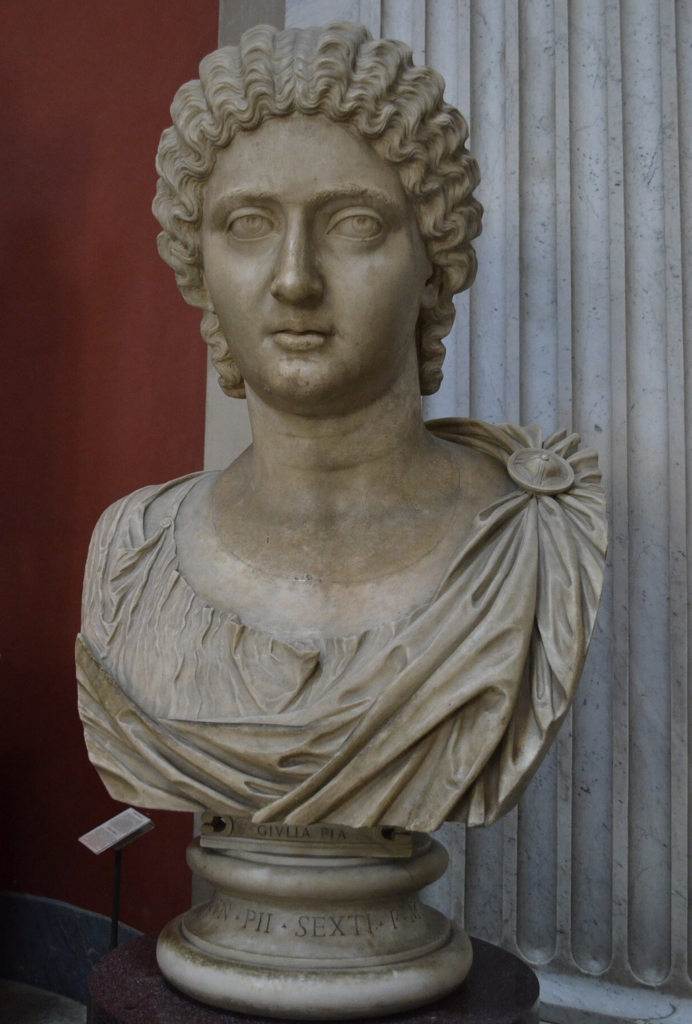
Julia Maesa (A.D. 160-224)
And so, in A.D. 221, Alexander, who was twelve at the time, was adopted by his cousin Elagabalus as his heir, and given the title of ‘Caesar’.
This was a very dangerous time for the young Alexander, for in being so close to his mad, older cousin, he was in greater danger. If not for the two strong women looking after him – his grandmother, Julia Maesa, and his mother, Julia Mamaea – he would certainly have fallen victim to Elagabalus and his retinue.
Herodian, the main source for the reign of Alexander Severus, describes what happened…
After adopting Alexander as caesar, Heliogabalus [Elagabalus] undertook to teach him his own practices; he instructed him in dancing and prancing, and, enrolling him in the priesthood, wanted the lad to imitate his appearance and actions.
But his mother Mamaea kept Alexander from taking part in activities so disgraceful and unworthy of an emperor. Privately, she summoned teachers of every subject and had her son trained in the lessons of self-discipline; since he devoted himself to wrestling and to physical exercise as well, he was, by his mother’s efforts, educated according to both the Greek and the Roman systems. Heliogabalus, much annoyed at this, regretted his decision to make Alexander his son and partner in the empire.
He therefore banished Alexander’s teachers from the imperial palace; he put to death some of the most distinguished and sent others into exile. The emperor offered the most absurd excuses for doing this, claiming that these men, by teaching Alexander self-control, educating him in human affairs, and refusing to allow him to dance and take part in the frenzied orgies, would corrupt his adopted son. The madness of Heliogabalus increased to such a degree that he appointed all the actors from the stage and the public theaters to the most important posts in the empire, selecting as his praetorian prefect a man who had from childhood danced publicly in the Roman theater…
…They kept continual watch upon the youth [Alexander] when they saw that Heliogabalus was plotting against him. His mother Mamaea did not allow her son to touch any food or drink sent by the emperor, nor did Alexander use the cupbearers or cooks employed in the palace or those who happened to be in their mutual service; only those chosen by his mother, those who seemed most trustworthy, were allowed to handle Alexander’s food.
(Herodian, The Roman History, V 7.4-8.2)
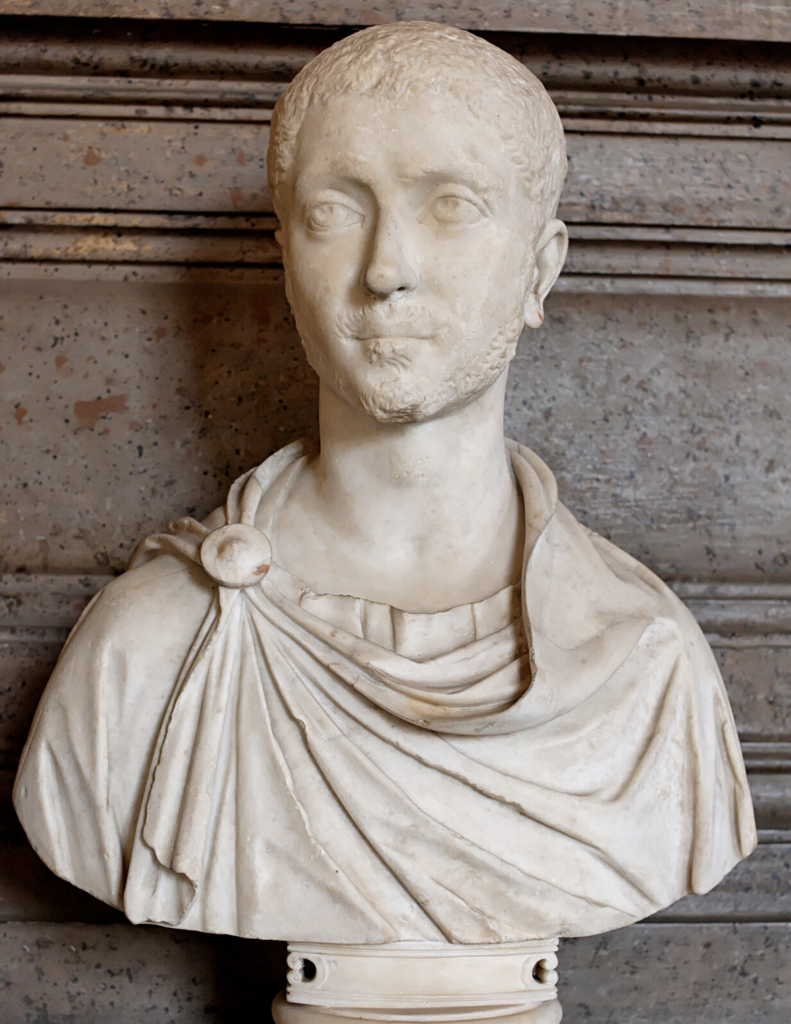
Alexander Severus (A.D. 208-235)
It was only by his grandmother’s ruthlessness, his mother’s love, the respect of the Praetorians, and the gold Maesa and Mamaea lavished upon them, that Alexander survived that period, despite several plots by the Emperor to have him killed.
Julia Maesa, who was well used to surviving the dangers of an imperial court, saw the great danger that Elagabalus posed to them all. She plotted with the Praetorians to have Elagabalus removed. The Praetorians, it seems, did not need a great deal motivation in this, for when many of them showed favour to the younger Alexander, Elagabalus had them arrested. This was the final straw.
In March, A.D. 222, when the Emperor, his mother Soaemias, and Alexander were at the Castra Praetoria, the deed was done:
The praetorians were enraged by this order; since they had other reasons, also, for hating Heliogabalus, they wished now to rid themselves of so disgraceful an emperor, and believed, too, that they should rescue the praetorians under arrest. Considering the occasion ideal and the provocation just, they killed Heliogabalus and his mother Soaemias (for she was in the camp as Augusta and as his mother), together with all his attendants who were seized in the camp and who seemed to be his associates and companions in evil.
They gave the bodies of Heliogabalus and Soaemias to those who wanted to drag them about and abuse them; when the bodies had been dragged throughout the city, the mutilated corpses were thrown into the public sewer which flows into the Tiber.
(Herodian, The Roman History, V 8.8-8.9)
Elagabalus was just eighteen when he died so ignominious a death. Cassius Dio, who would have known all of them, describes their end in gruesome detail:
His mother [Soaemias], who embraced him and clung tightly to him, perished with him; their heads were cut off and their bodies, after being stripped naked, were first dragged all over the city, and then the mother’s body was cast aside somewhere or other, while his was thrown into the river.
(Cassius Dio, Roman History, LXXX, 20)
Thus, Julia Maesa succeeded in having her own daughter and grandson removed, and her other grandson proclaimed Emperor by the Praetorian Guard at just fourteen years old.
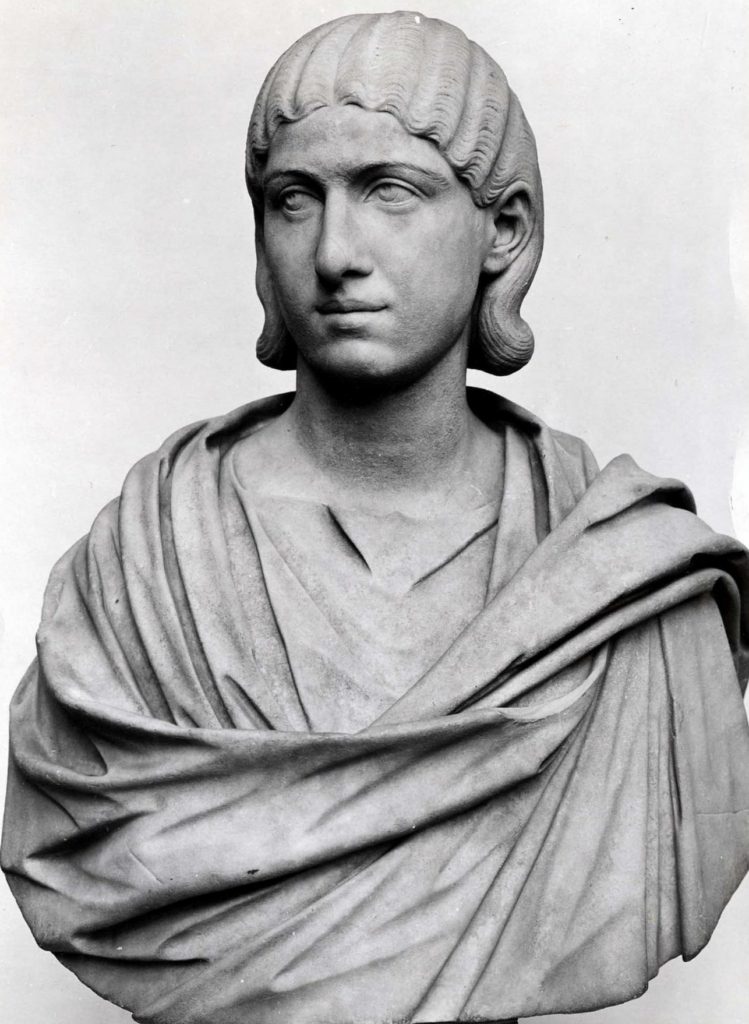
Julia Mamaea (A.D. 180-235)
A period of normalcy returned to the Empire with Alexander Severus being given the title and role of Emperor while his grandmother and mother managed and controlled imperial affairs in a more moderate and equitable administration that appeared to lean more toward common sense and nurturing the loyalty of the troops, a lesson they had all learned the importance of from Septimius Severus.
Together, they chose from members of the Senate an advisory council of sixteen wise men to guide the Emperor in decision making. This also gave a measure of power (at least perceived power) back to the aristocracy. The insults done to Rome’s gods were also fixed as their statues were replaced and those of Elagabalus’ choosing were removed. And, in the business of government, matters of state and public affairs were entrusted to competent lawyers and orators rather than actors, and military affairs were given over to actual men experienced in war.
It seemed like a new and hopeful age was upon the Empire and the Roman people.
But then, in A.D. 226, the matriarch of the Severan dynasty, Julia Maesa, died of old age. She received imperial honours and was deified.
And so, Julia Mamaea was now alone with the Emperor who was now about eighteen years old.
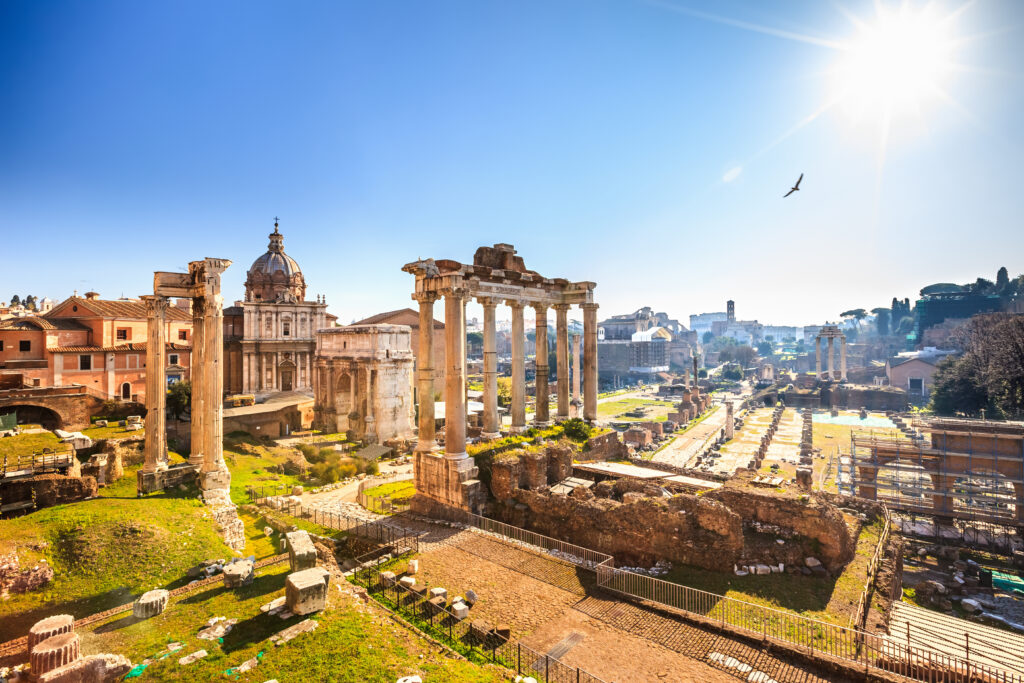
The Forum Romanum – The Heart of Ancient Rome with the Arch of Septimius Severus (centre left)
Julia Mamaea knew that she and her son were in a precarious position at this point in time and so, according to Herodian, she took steps to protect him with extreme vigilance. She also sought to control him, no doubt traumatized by the years of her nephew’s rule.
Now left alone with her son, Mamaea tried to govern and control him in the same fashion. Fearing that his vigorous young manhood might plunge him into the errors of adolescence because his power and position were assured, Mamaea kept the palace under close guard and allowed no one suspected of debauchery to approach the youth. She was afraid that his character would be corrupted if his flatterers aroused his growing appetites to disgraceful desires.
She therefore induced him to serve as judge in the courts continually and for most of each day; occupied with important matters and the necessary business of the empire, he would have no opportunity to indulge in scandalous practices. Alexander’s deportment was governed by a character naturally mild and civilized, and much inclined to benevolence, as was made clear when the youth grew older.
At any rate, he entered the fourteenth year of his reign without bloodshed, and no one could say that the emperor had been responsible for anyone’s murder. Even though men were convicted of serious crimes, he nevertheless granted them pardons to avoid putting them to death, and not readily did any emperor of our time, after the reign of Marcus, act in this way or display so much concern for human life. Indeed, over a period of many years, no one could recall that any man had been condemned to death by Alexander without a trial.
(Herodian, The Roman History, VI 1.5-1.7)
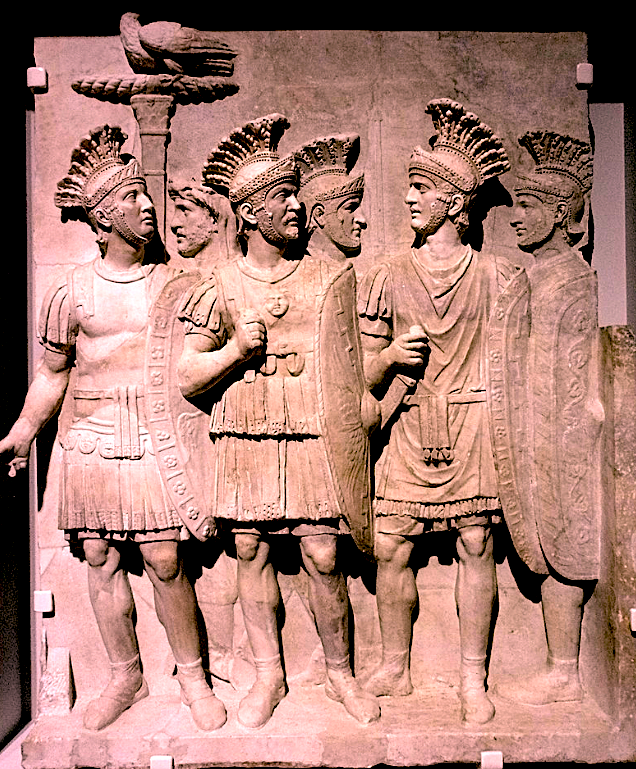
The Praetorian Guard
According to historian Michael Grant, Julia Mamaea’s tenure as Mater Augusti et Castrorum, ‘Mother of the Augustus and Mother of the Camp’, was the “climactic point of feminine power” in Ancient Rome. In addition to being highly protective of the Emperor, she was also a prudent and intelligent ruler, maintaining good relations with the advisory council, the Senate, and with the Christian community. She did, apparently, argue with Alexander Severus’ empress, Sallustia Barbia Orbiata, whom he married in A.D. 225, and whose father, Seius Herennius, was later executed for plotting against the Emperor. In the wake of that event, the young empress was exiled and Alexander Severus was left with his mother to rule alone, with help from advisors like Cassius Dio.
Though Alexander’s reign appeared to be a sort of Golden Age of peace and prosperity for a time, there were issues that arose. Official supervision of trade and industry grew steadily, and the coinage was debased. State subsidies of education and tax rebates for guilds and property owners contributed to a financial crisis.
It also seems that Julia Mamaea had developed a paranoia when it came to protecting her son and, as a result of this, she amassed a fortune in gold and riches, some of which was taken by legal means (or otherwise) from wealthy landowners and aristocrats. She appears to have been obsessed with gold, which she hoarded, but also used to keep the Praetorians paid.
Alexander blamed his mother for her excessive love of money and was annoyed by her relentless pursuit of gold. For a time she pretended to be gathering funds to enable Alexander to gratify the praetorians readily and generously, but in truth she was hoarding it for herself. And her miserliness in some measure reflected discredit upon his reign, even though he personally opposed it and was angry when she confiscated anyone’s property and inheritance illegally.
(Herodian, The Roman History, VI 1.8)
Throughout the history of Imperial Rome, the Praetorian Guard was often a danger to those in power, even though they were intended to protect the emperors.
When Septimius Severus became sole emperor after the civil war, one of his first acts was to punish the Praetorians for auctioning off the throne after the death of Commodus. He then replaced the Praetorians with loyal men from his own legions. Notwithstanding that Severus had wrongly trusted his kinsman, Gaius Fulvius Plautianus, as sole Praetorian Prefect, he had known that the Guard needed to be controlled.
However, by the time of Alexander Severus’ reign, the Praetorians had regained much of their lost power. After they had slain Elagabalus and acclaimed Alexander Severus as Emperor, in A.D. 223 they slew Domitius Ulpianus, the Praetorian Prefect.
Ulpianus, a lawyer and protege of Papinianus, the former Praetorian Prefect under Severus and Caracalla, was appointed to the prefecture by Alexander Severus. However, the Praetorians did not respect him. He was a lawyer, not a soldier, and so they slew him.
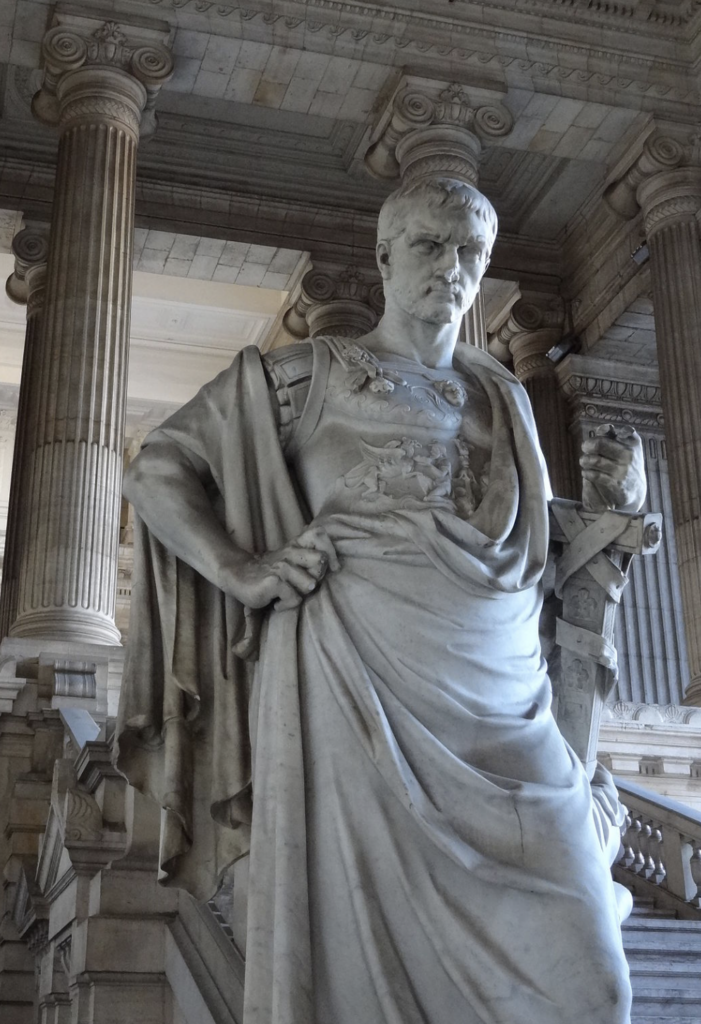
19th-century statue of Ulpian in the neoclassical Palais de Justice in Brussels, Belgium (Wikimedia Commons)
Around this time, according to Cassius Dio, the Praetorians also clashed with the Roman people for three days of fighting with many losing their lives. When the Praetorians began to lose, they began setting parts of the city on fire. A truce was reached, for fear of the city burning down.
Cassius Dio, who was made consul for the second time by Alexander Severus in A.D. 229, was also at odds with the Praetorians who had threatened his life such that the Emperor, who valued Dio’s council and friendship, insisted that Dio live away from Rome for his own safety, in Campania. It is at around this time, when The Hearts of Heroes takes place, that Cassius Dio ends his history and removes himself from public service, not only due to his ailing health, but also because of the threat posed by the Praetorians.
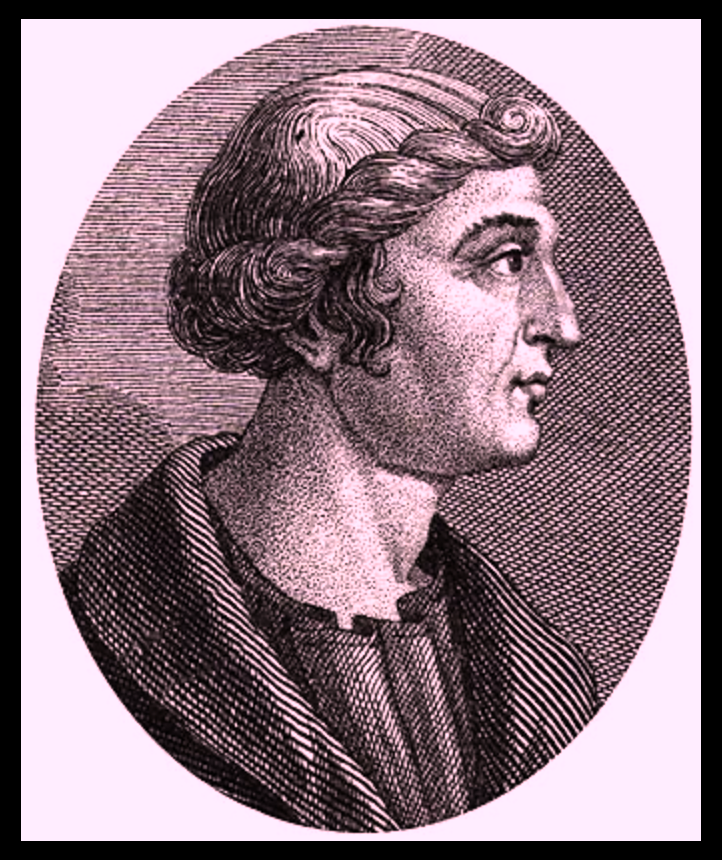
17th Century Illustration of Cassius Dio
It was now that Alexander Severus was to face his greatest threat: War.
In the year A.D. 231, Alexander Severus received dispatches from the Roman governors of Syria and Mesopotamia that a new Persian king by the name of Artaxerxes (Ardashir I) had killed the client Parthian king, Artabanus, and was now crossing the borders of the Roman Empire.
Alexander Severus wrote to Artaxerxes to warn him to stay within his own borders or else face defeat as he had at the hands of Septimius Severus and others.
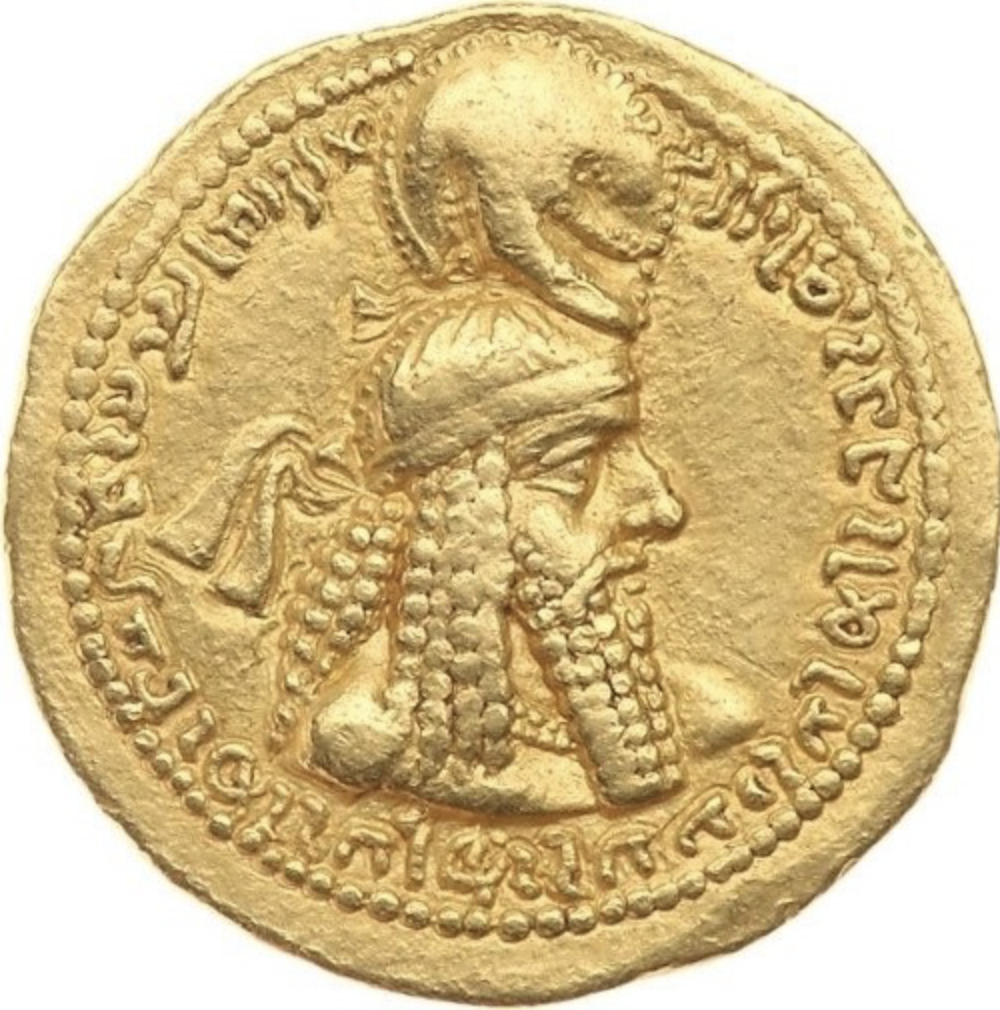
Gold dinar of Artaxerxes (Ardashir I, c. A.D. 230)
But Artaxerxes ignored Alexander’s efforts; believing that the matter would be settled by arms, not by words, he took the field, pillaging and looting all the Roman provinces. He overran and plundered Mesopotamia, trampling it under the hoofs of his horses. He laid siege to the Roman garrison camps on the banks of the rivers, the camps which defended the empire. Rash by nature and elated by successes beyond his expectations, Artaxerxes was convinced that he could surmount every obstacle in his path.
(Herodian, The Roman History, VI 2.5)
Alexander had no choice but to go east to meet the enemy. With his massive army divided into three as they marched against the Persians, attacking them in different regions so that Artaxerxes had to hurry his men from one sector to another to meet them.
It might have been a good strategy had the Roman forces been in a better state of preparedness for the terrain and better disciplined. However, they were all but defeated.
All three Roman armies had been ordered to invade the enemy’s territory, and a final rendezvous had been selected to which they were to bring their booty and prisoners. But Alexander failed them: he did not bring his army or come himself into barbarian territory, either because he was afraid to risk his life for the Roman empire or because his mother’s feminine fears or excessive mother love restrained him.
She blocked his efforts at courage by persuading him that he should let others risk their lives for him, but that he should not personally fight in battle. It was this reluctance of his which led to the destruction of the advancing Roman army. The king attacked it unexpectedly with his entire force and trapped the Romans like fish in a net; firing their arrows from all sides at the encircled soldiers, the Persians massacred the whole army. The outnumbered Romans were unable to stem the attack of the Persian horde; they used their shields to protect those parts of their bodies exposed to the Persian arrows.
Content merely to protect themselves, they offered no resistance. As a result, all the Romans were driven into one spot, where they made a wall of their shields and fought like an army under siege. Hit and wounded from every side, they held out bravely as long as they could, but in the end all were killed. The Romans suffered a staggering disaster; it is not easy to recall another like it, one in which a great army was destroyed, an army inferior in strength and determination to none of the armies of old. The successful outcome of these important events encouraged the Persian king to anticipate better things in the future.
(Herodian, The Roman History, VI 5.8-5.10)
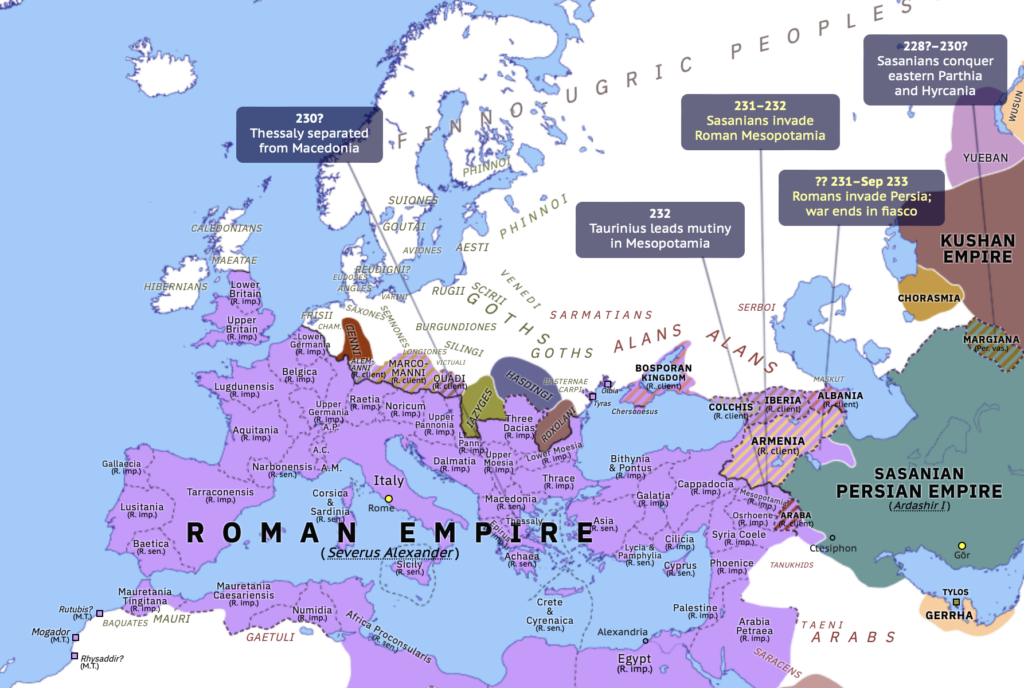
Map of Roman Empire during Roman-Persian War under Alexander Severus A.D. 230-233 (Omni Atlas)
Though it was not a total defeat of the Romans, the events could be considered a complete failure on the part of Alexander Severus, for in shunning the battlefield – either by his own cowardice, or because of his mother’s over-protectiveness – the Emperor had lost the respect of the army.
As it turned out, he fell far short of his great uncle, Septimius Severus, who had begun the dynasty and who had conquered the east and the Parthians so decisively.
Alexander, Julia Mamaea, and his retinue returned to Antioch to recuperate. They tried to console the troops with lavish distributions of money to try and regain their good will, but it was to no avail. Even though Artaxerxes was withdrawing for the moment, the damage was done.
Then, in A.D. 233, messages arrived from the governors in Illyria that the German tribes had crossed the Rhine and Danube frontiers and were plundering Roman territories. The governors insisted that the Emperor bring his armies to meet the threat immediately.
Although he loathed the idea, Alexander glumly announced his departure for Illyria. Necessity compelled him to go, however; and so, leaving behind a force which he considered strong enough to defend the Roman frontiers, after he had seen to the forts and the walls of the camps with greater care and had assigned to each fort its normal complement of troops, the emperor marched out against the Germans with the rest of his army.
(Herodian, The Roman History, VI 7.5)
However, when he finally arrived, rather than meet the Germans in battle, Emperor Alexander Severus sent an embassy to the Germans with a peace settlement. Herodian tells us that “the avaricious Germans are susceptible to bribes and always ready to sell peace to the Romans for gold.”
Consequently, Alexander undertook to buy a truce rather than risk the hazards of war.
The soldiers, however, were not pleased by his action, for the time was passing without profit to them, and Alexander was doing nothing courageous or energetic about the war; on the contrary, when it was essential that he march out and punish the Germans for their insults, he spent the time in chariot racing and luxurious living.
(Herodian, The Roman History, VI 7.9-7.10)
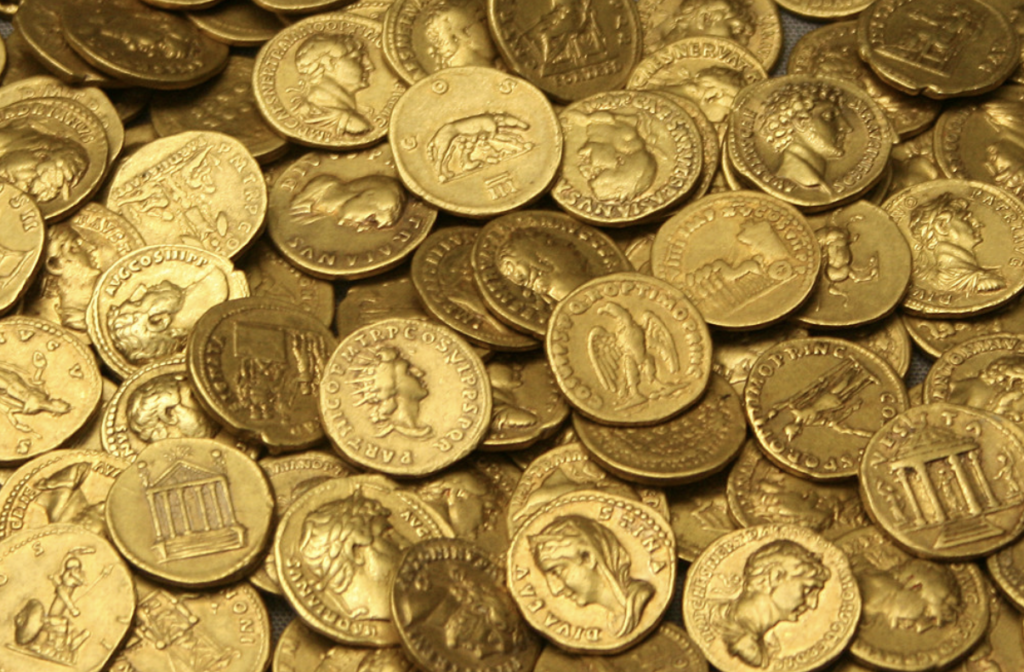
Roman Aurea
Was Alexander Severus truly terrified of battle? Was his mother, Julia Mamaea, so fearful of losing him that she prevented him from fighting? Whatever the reason, the troops were no longer loyal to their emperor who had fallen short of all expectation.
In the end, while on the German frontier at Mogontiacum (Mainz), the men of the legions decided to back one of their own, a decorated legionary by the name of Maximinus. They robed him in imperial purple and declared him ‘Emperor’. Alexander Severus’ troops abandoned him. Herodian describes his end:
Trembling with fear, Alexander was scarcely able to retire to his quarters. Clinging to his mother and, as they say, complaining and lamenting that she was to blame for his death, he awaited his executioner. After being saluted as emperor by the entire army, Maximinus sent a tribune and several centurions to kill Alexander and his mother, together with any of his followers who opposed them.
When these men came to the emperor’s quarters, they rushed in and killed him with his mother; they also cut down those whom he had honored or who appeared to be his friends. Some, however, managed to flee or to hide for the moment, but Maximinus soon rounded up these fugitives and put them to death.
Such was the fate suffered by Alexander and his mother after he had ruled fourteen years without blame or bloodshed so far as it affected his subjects. A stranger to savagery, murder, and illegality, he was noted for his benevolence and good deeds. It is therefore entirely possible that the reign of Alexander might have won renown for its perfection had not his mother’s petty avarice brought disgrace upon him.
(Herodian, The Roman History, VI 9.6-9.8)
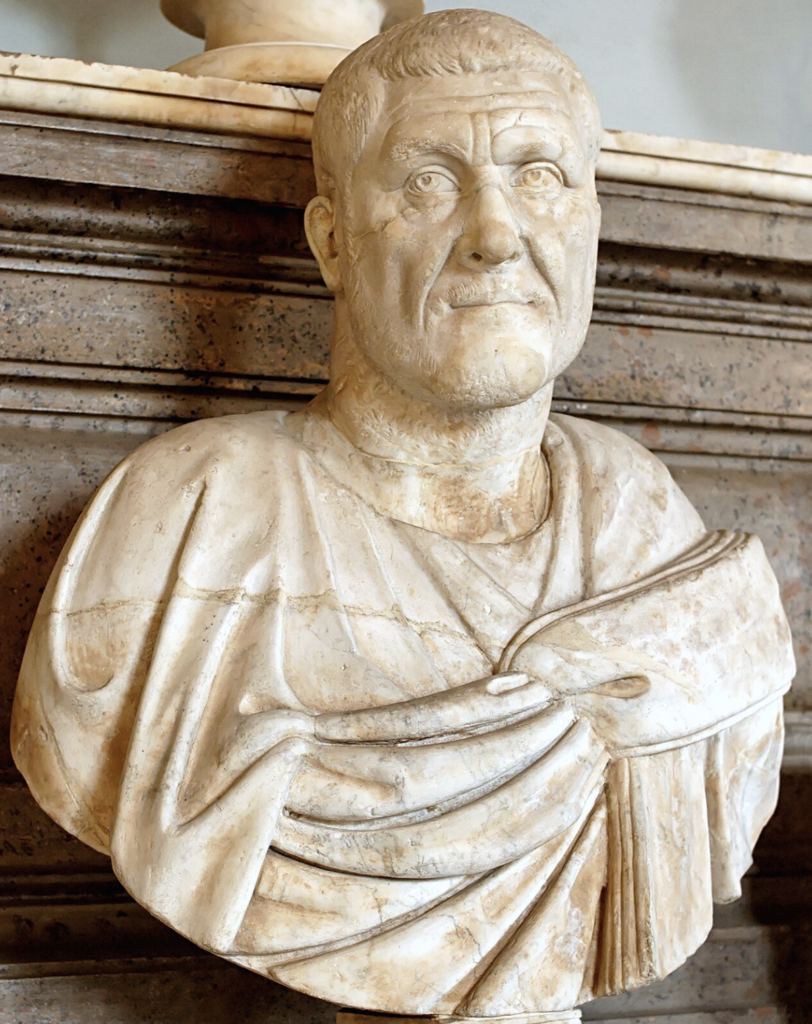
Maximinus Thrax – The Legionary Emperor (reigned A.D. 235-238)
In A.D. 235 Alexander Severus and his mother, Julia Mamaea, were slain by the men of the legions whose loyalty had been lost. The Severan dynasty was at an end. What had, at first, been the start of a period of hope, a new ‘golden age’, had turned into a titanic disappointment with a tragic, but not unexpected, finale.
Maximinus Thrax (A.D. 235-238), a Thracian, became the first legionary to be Emperor but he was a soldier, and not up to the politics of the role. He was tyrannical and prone to cruelty. He ignored Rome from the outset and the Senate turned on him, electing Gordian I to replace him. When he marched on Italy and was besieging Aquilea, Maximinus’ troops turned on him and murdered him and his son. Like Macrinus, he was just another upstart left for dead in the dust of the Empire.
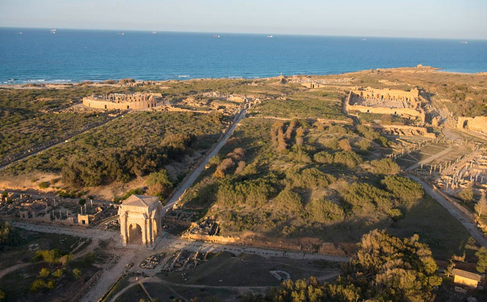
Aerial view of the ruins of Leptis Magna – North African home of Septimius Severus who founded the dynasty
And so we come to the end of our time with the Severans, in fiction, and in history. It has been a fascinating journey getting to know this family at the peak of Rome’s might.
The Severan period is marked by several things, including a strong military with the successful completion of major campaigns that extended the Empire’s territory to its greatest extent, especially the Parthian campaign of Septimius Severus. The period saw curbed Praetorian power (at least at the outset) and, conversely, one of the most brutal Praetorian Prefects in Gaius Fulvius Plautianus. It was a period that saw some of the strongest, most powerful and intelligent women in the history of Ancient Rome in Empress Julia Domna, Julia Maesa, and Julia Mamaea.
The dynasty might have lasted longer, and Septimius Severus’ hard work not been lost, had it not been for the weakness of his heirs: his son’s Caracalla and Geta, and his great-nephews Elagabalus and Alexander Severus.
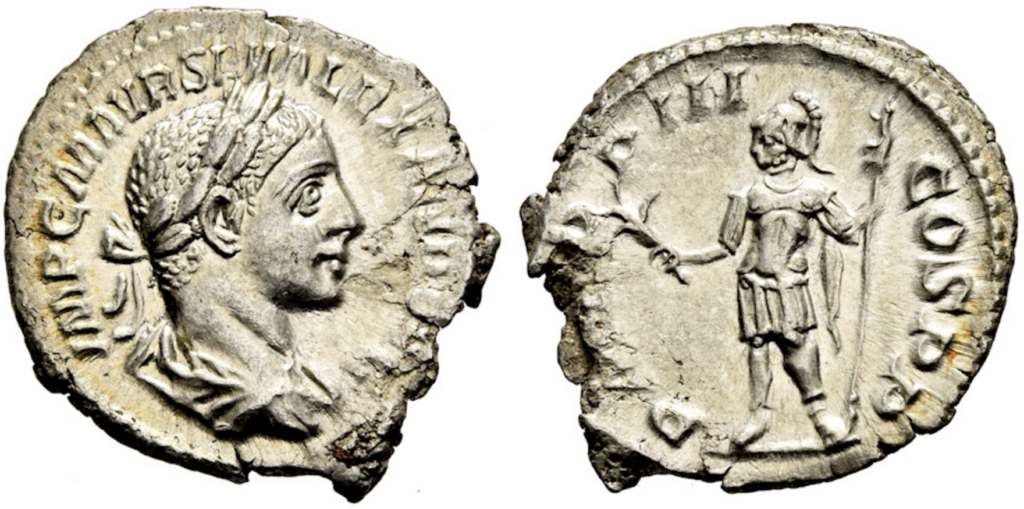
Silver Denarius of Alexander Severus (A.D. 222-235)
Was Alexander Severus’ end brought about by his cowardice, his mother’s avarice for wealth, or her deep fears for her son’s safety which manifested in an overprotectiveness that did more harm than good? Or is power at such lofty heights so precarious that one slip can send one over the cliff?
It seems like there is merit in all of the reasons given above. Just as with the fall of the Roman Empire, there is not one cause alone for its end, but rather a series of events and failures that led to its demise.
Perhaps the Severan dynasty is Rome’s end in microcosm. As Edward Gibbon wrote:
The contemporaries of Severus, in the enjoyment of the peace and glory of his reign, forgave the cruelties by which it had been introduced. Posterity, who experienced the fatal effects of his maxims and example, justly considered him as the principal author of the decline of the Roman Empire.
(Edward Gibbon, Decline and Fall of the Roman Empire, X, vol.1)
In the end, it seems that, despite the foundations of a dynasty laid by Septimius Severus, none of his heirs were up the task of treading the tightrope between strong and judicious rule and tyranny.
This period in Rome’s history was certainly not perfect, but it has much to teach us, including the lesson that, just as with empires, families too rise and fall…
Thank you for reading.
That concludes our blog series on The World of The Hearts of Heroes. We sincerely hope that you enjoyed it and found it informative. If you have missed any of the articles in this seven-part series, you can read them all on one page by CLICKING HERE.
If you are interested in reading the two main sources for this period, you can read Cassius Dio’s text in translation by CLICKING HERE, and Herodian’s text HERE.
If you would like to read more about the Severan dynasty and their period in Rome’s history, we urge you to explore the articles in the ‘Article Archive’ on the Eagles and Dragons Publishing website. We also highly recommend the book The Severans: The Changed Roman Empire by eminent historian, Michael Grant as a very accessible read that explores this period of immense change in the history of Rome.
The Hearts of Heroes: A Novel of the Roman Empire is available ebook, paperback and deluxe hardcover editions from all major online retailers, independent bookstores, brick and mortar chains, and your local public library.
CLICK HERE to buy a copy and get ISBN#s for the edition of your choice.
If you are new to the Eagles and Dragons historical fantasy series, you can start your epic adventure with the award-winning, #1 bestselling prequel, A Dragon among the Eagles which is set during the Parthian campaigns of Emperor Septimius Severus.