Salvete readers and history-lovers!
Welcome back to The World of The Hearts of Heroes in which we are taking a brief look at the research for the seventh book in the Eagles and Dragons series set in the Roman Empire.
In Part I, we looked at the life and work of the historian, Cassius Dio, who is the main source for the Severan period. If you missed that post, you can read it by clicking HERE.
In Part II, we’re going to be taking a brief look at one of the settings in The Hearts of Heroes, the Roman civitas of Viroconium Cornoviorum, at modern Wroxeter in England.
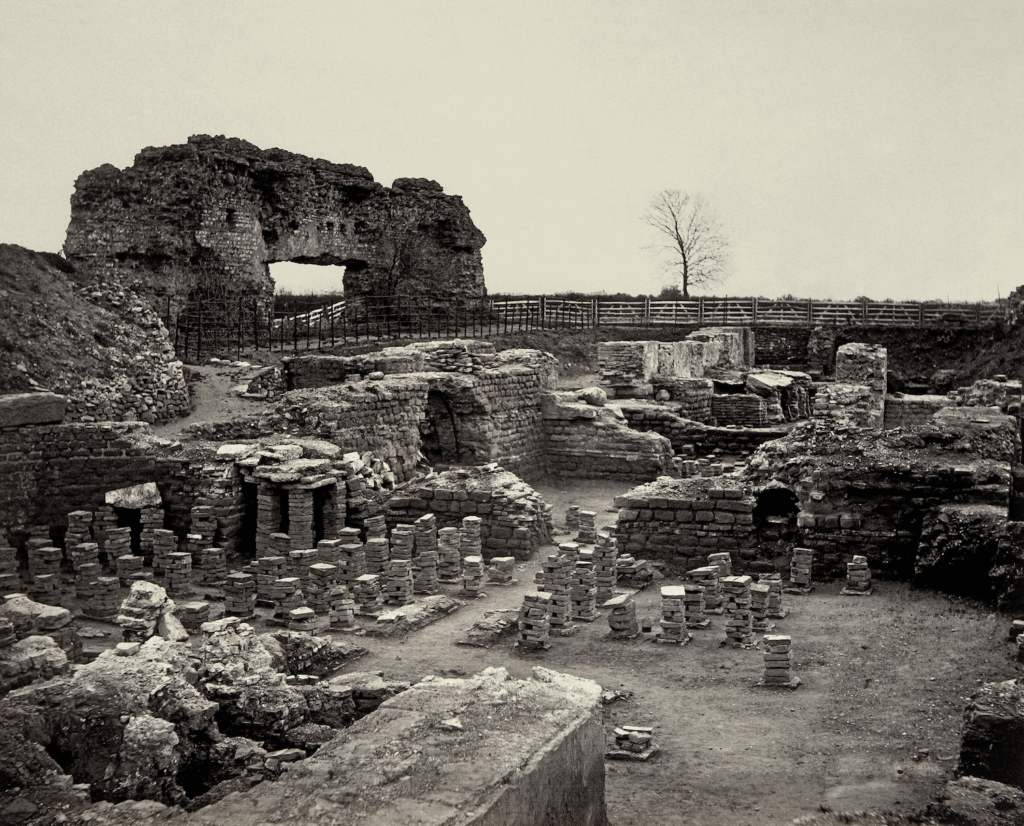
Roman ruins at Viroconium Cornoviorum; photograph 1859 (Wikimedia Commons)
Britain is a land that is packed with Roman remains from one end to the other. There are roads, villas, baths, walls, towers, fortlets and legionary fortresses and more. And there are cities. Well, the remains of them, anyway.
In Roman Britain there were, more or less, twenty civitates, the formal administrative districts with large settlements at their heart. These evolved into cities or towns.
Viroconium Cornoviorum was, at its height, the fourth largest civitas in the province of Britannia.
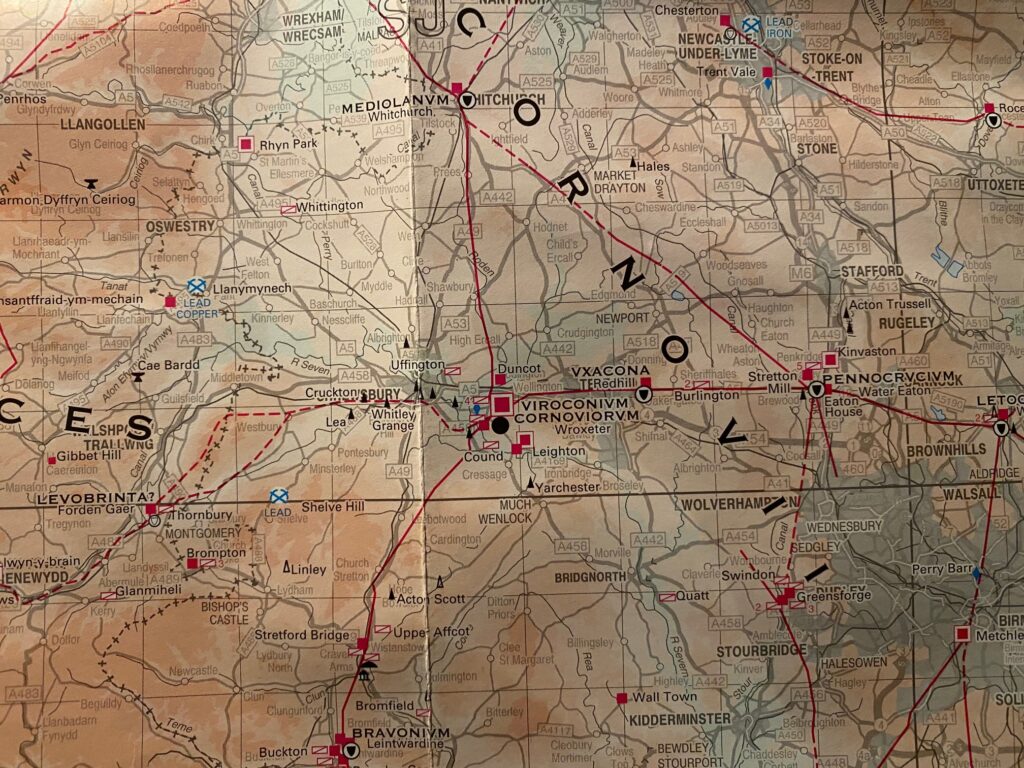
Viroconium Cornoviorum (Ordnance Survey Map of Roman Britain)
I first visited Viroconium (Wroxeter Roman City), which is about five miles from Shrewsbury, in the year 2000 when doing research on archaeological sites linked to the Arthurian period of sub-Roman Britain (more on that later). I was awed by the massive remains of the great bathhouse and fascinated by the reconstructed Roman townhouse as I strolled the grounds in a quiet and sunny green field along the River Severn.
It was much quieter then than it would have been at its peak. I knew for certain that, after the research for my dissertation, the site would someday end up in one of my novels.
But how did that Roman city come to be? Why was it so important? How was it that that silent, sun-kissed field I visited near the border of England and Wales had been one of the busiest places in Roman Britain?
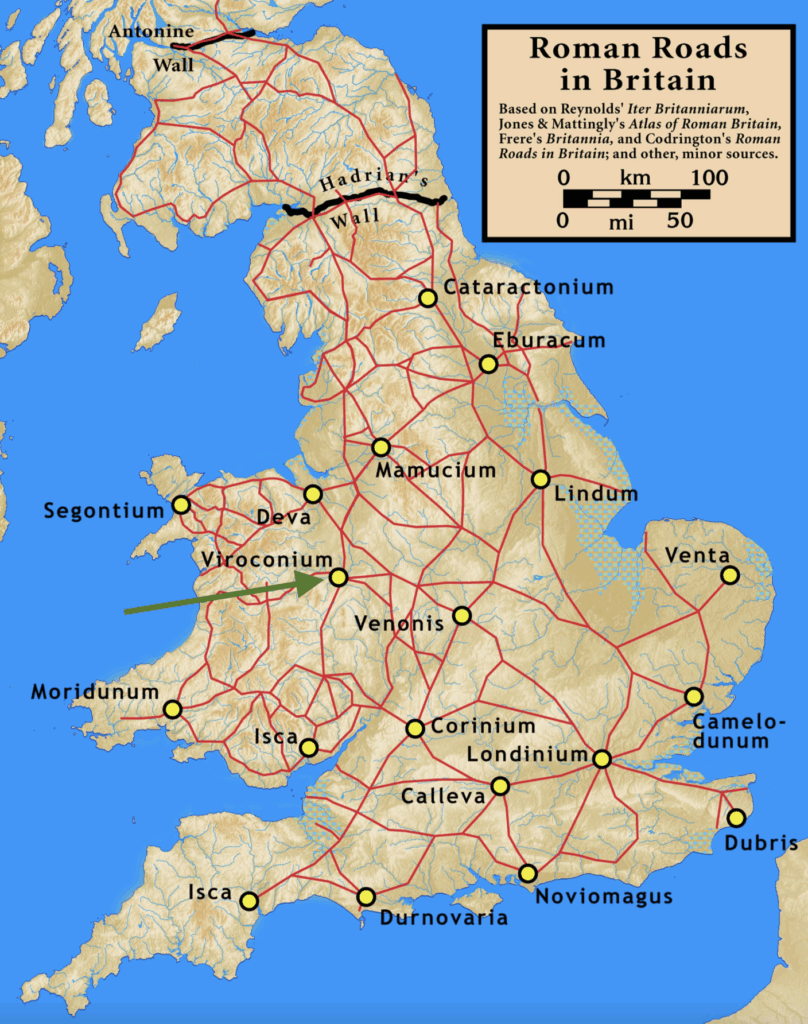
Roads in Roman Britain (Wikimedia Commons) – with Viroconium shown
Viroconium Cornoviorum is located on a site overlooking a ford of the River Severn. It has good views in all directions. It was located at the western terminus of Wattling Street, one of the major roads of Roman Britain which ran all the way from the port of Dubris (Dover) to southeast. It was also on the route between the legionary fortresses of Deva (Chester) to the north, and Isca (Caerleon) and Glevum (Gloucester) to the south.
Strategically and economically, this was an important location.
Viroconium Cornoviorum was located in the lands of the Cornovii tribe whose tribal capital was at a nearby hillfort known as ‘The Wrekin’. It did not, however, begin as a city. Like other civitates in Roman Britain, it had military origins.
Viroconium was first established in the early years of the Roman conquest of Britain, which began in A.D. 43 under Emperor Claudius, as a frontier outpost guarding a crossing of the River Severn. As the invasion advanced northward, Viroconium became a forty-acre legionary fortress, built between A.D. 52-57.
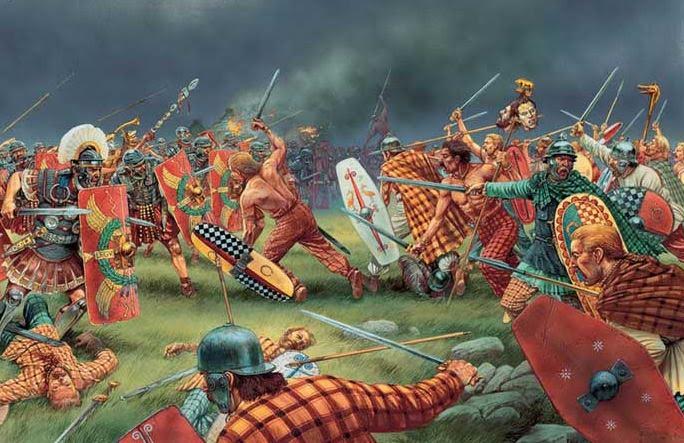
The first legion to build, and be based at, Viroconium was the famed XIV Gemina Martia Victrix first established by Julius Caesar in 57 B.C. This legion took part in the invasion of Britain in A.D. 43, the assault on the Isle of Anglesey in A.D. 60, and played a major role in putting down the Boudiccan Revolt in A.D. 60-61.
When the XIVth legion’s work was finished, Viroconium was garrisoned by the XX Valeria Victrix legion which had also taken part in the invasion of Britain in A.D. 43. This legion was based there from about A.D. 59-90 before it moved to quarters at the fortress of Deva (Chester).
Viroconium remained under military rule from A.D. 47 until A.D. 90.
As frequently happened, a civilian settlement, a vicus, grew up around the fortress. This settlement included canabae, which literally means ‘booths’, and this referred to the stalls where soldiers could get food, drink, and sex.
Viroconium was starting to transition into a city, a hub of activity on the burgeoning road network that was spreading out across Britannia.
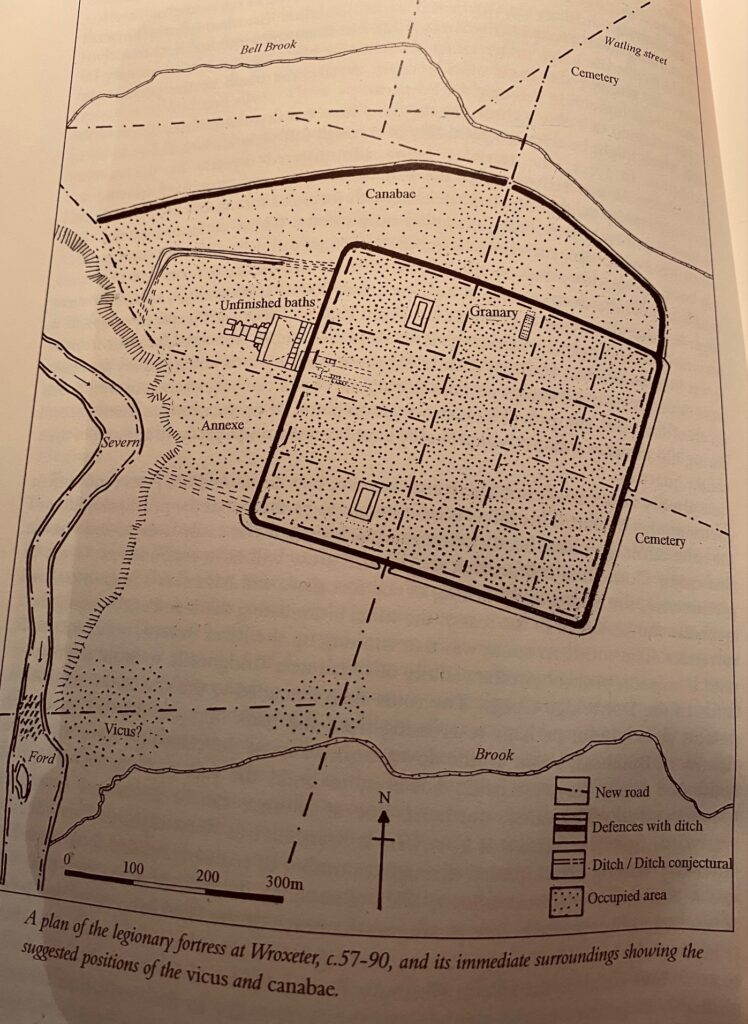
Plan of the Legionary Fortress at Viroconium c. A.D. 57-90 (from
As the front lines moved farther north, and Viroconium found itself safer, it transitioned smoothly from military to civilian life. The military defences were torn down when the army left, but the grid of the fortress remained. New roads were created and extended beyond the walls to encompass the growing city. The population fluctuated, and the city grew and, eventually, it became the fourth largest city in Roman Britain with the former via Principalis of the fortress becoming the main thoroughfare and heart of the new city.
It also became an important trading centre, largely due to its location at the intersection of two major routes, and grew to cover an area of about 180 acres.
But if Viroconium covered such a vast area of land, how is it that so little can be seen today? It appears more like a country setting than a former Roman metropolis.
Archaeologists have concluded that of the 180 acres occupied by Viroconium, only about 3 of those were covered by grand public buildings and, of those, about eighty percent has been excavated.
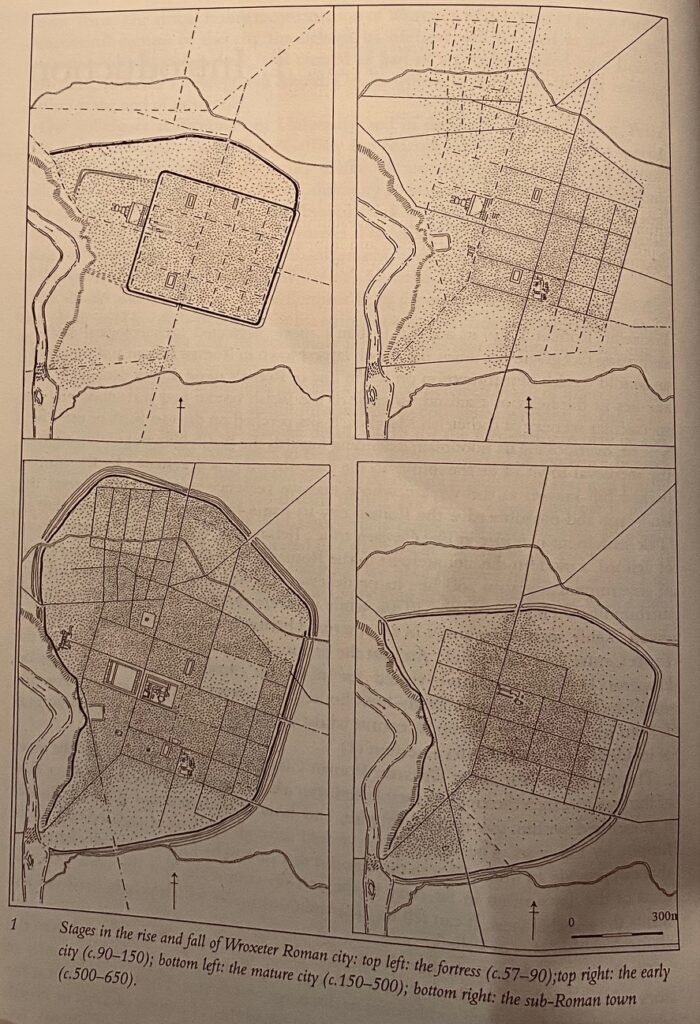
Stages of Viroconium Cornoviorum from c. A.D. 57 to c. A.D. 500 (from Wroxeter: Life & Death of A Roman City; White and Barker) – the bottom left (c. A.D. 150-500) is Viroconium in The Hearts of Heroes.
Viroconium Cornoviorum really experienced a boom when, in A.D. 122 Emperor Hadrian visited the city and ordered the building of a massive forum, as well as baths and a basilica. Some historians believe he showed an interest in Viroconium because it was the westernmost civitas of the Empire.
The structures which Hadrian had built in Viroconium brought increased trade and activity to the city with the new forum serving as the tribal administrative centre, judiciary, and market of Viroconium Cornoviorum. This was built on the site of the former principia, the legionary headquarters building.
There was also a long colonnade built along the main road, which was Watling Street, with the great bathhouse opposite on the other side of the street. This bathhouse is in addition to the earlier, unfinished bathhouse which lay beneath part of the new forum.
As far as civilian settlement, archaeologists have discovered the remains of two later insulae, apartment-like structures, as well as a mansio which was a sort of hotel and supply station along Watling street for off duty soldiers, couriers etc.
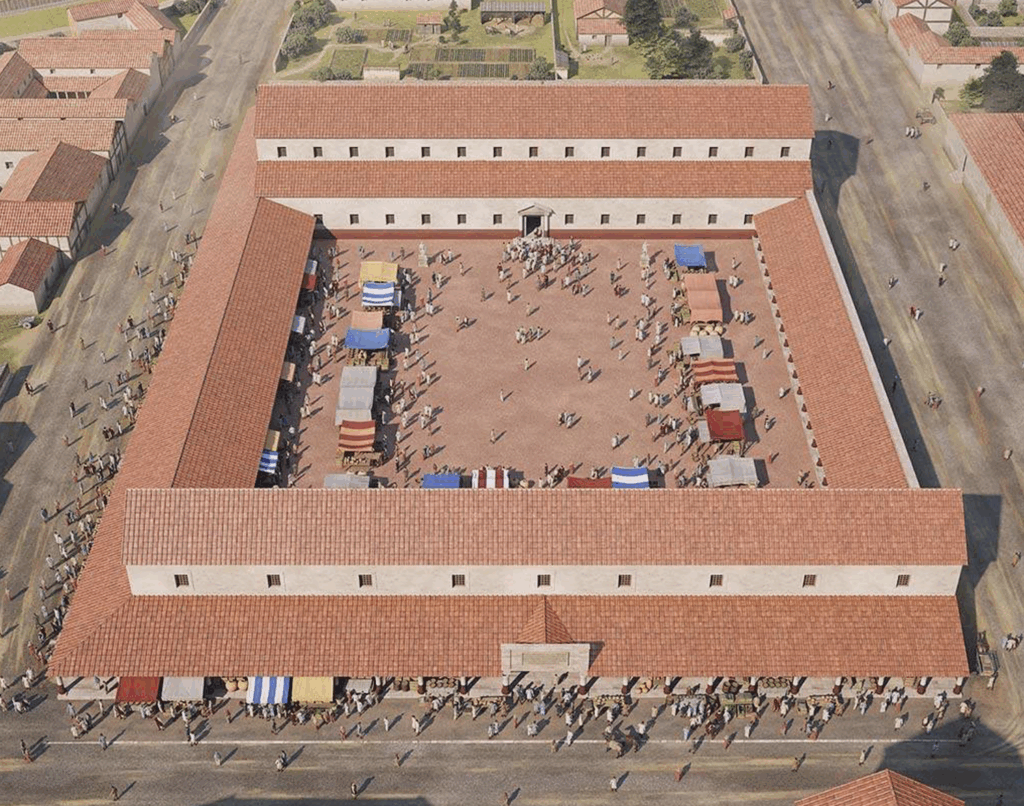
Artist Impression of the Forum of Viroconium Cornoviorum (English Heritage)
Civilian houses have also been found in Viroconium which have narrow entrances fronting onto main streets, but which are long. These are presumed to be the houses of craftsmen and artisans with stores or workshops on the ground floor (they discovered raw materials for their trades) and family living accommodation on the upper floor.
But it is the grand public buildings that really stand out at Viroconium, and this civic centre straddled either side of Watling street. It is no wonder that it became the fourth largest civitas in Britannia, for it had a forum, baths, a basilica, a water supply, roads, the colonnade for shelter, and public temples.
The bath and basilica complex, in addition to the regular rooms of a public bath, also had a 74 meter pool and palaestra, a large exercise ground.
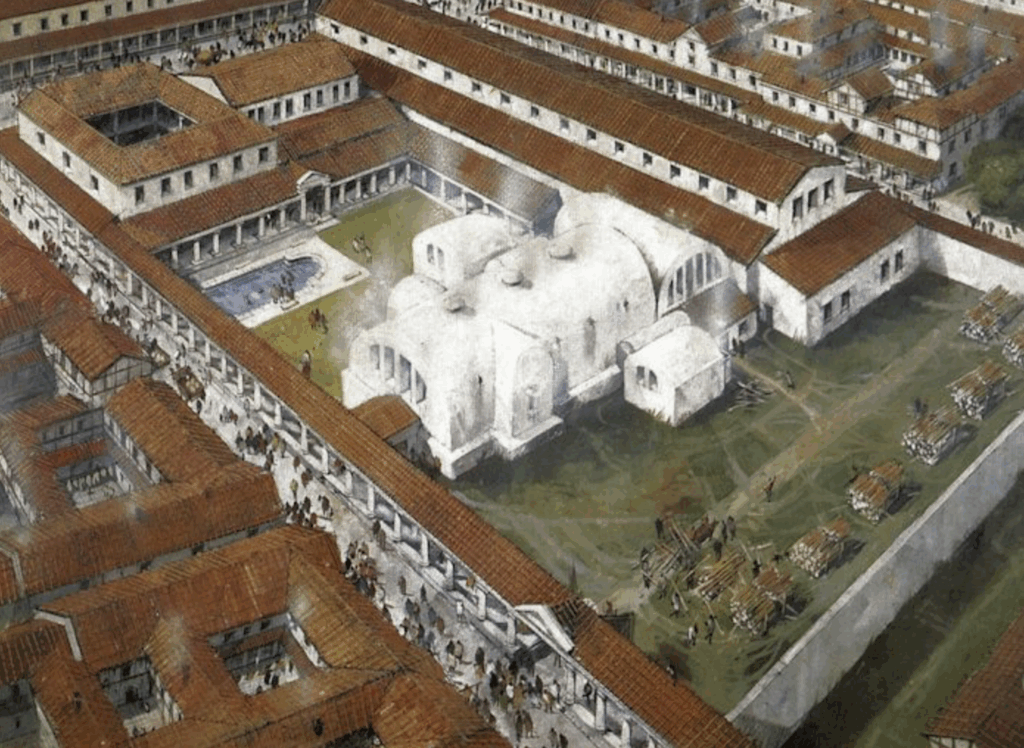
Artist Impression of public baths and main thoroughfare (English Heritage)
The forum, which was the first major public building built at Viroconium Cornoviorum was very large with a courtyard that was 74×64 meters surrounded by a colonnade with shops and offices on one side, and the basilica on the other side. This was the commercial, administrative, and judicial centre of the city. The forum was also home to the sacellum (shrine), the curia (council chamber), aerarium (treasury), and the tabularium (records office).
In addition to the main forum, Viroconium also had a forum boarium, a livestock market. This would have meant that livestock farmers would have come from miles around to buy and sell their stock, contributing to the economic success of the city.
When it comes to the temples and shrines, in addition to some small ones to local deities, the remains that archaeologists have discovered indicate some small scale temples to Jupiter and to Venus or Epona. There may also have been some dedicated to Vesta and Mithras.
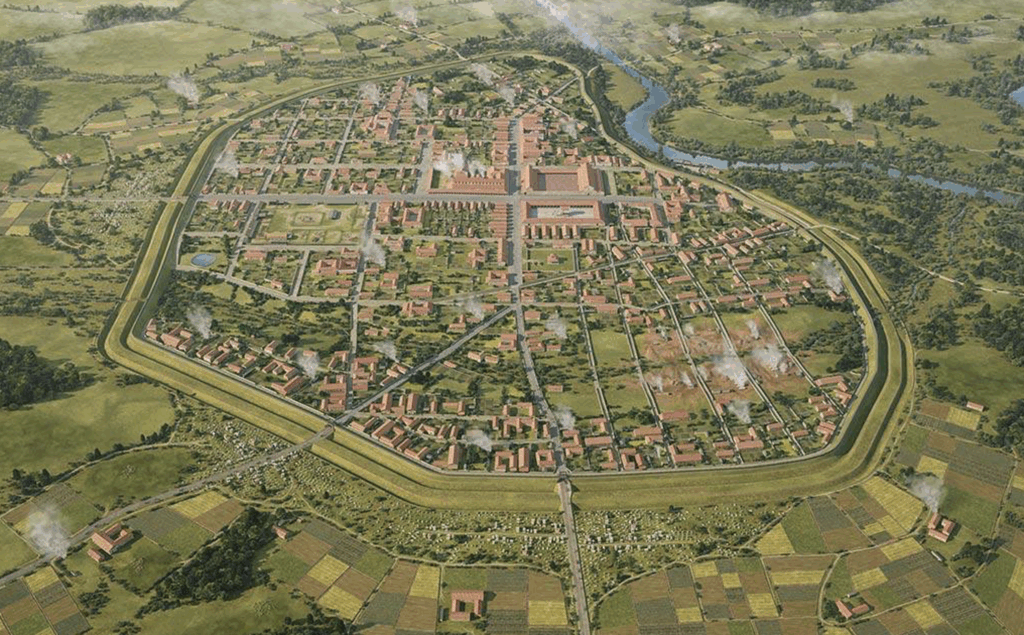
Artist Impression of Viroconium Cornoviorum at its peak, aerial view toward the southeast (English Heritage)
Prosperity and peace lasted for well over two hundred years for the people of Viroconium Cornoviorum once the Pax Romana had settled on Britannia. But, as history tells us, most things come to an end.
In A.D. 383 when Magnus Maximus set out for Gaul with his troops to make his play for the imperial throne, the Cornovii, and Viroconium itself, may have come under attack by Picts from the north or the Irish from across the sea. Saxon invasions had also begun to the southeast until finally, in A.D. 410, Emperor Honorius supposedly wrote to the Britons to tell them to see to their own defences. Rome was leaving.
This was the start of the sub-Roman period in Britain, also commonly referred to as the ‘Dark Ages’.
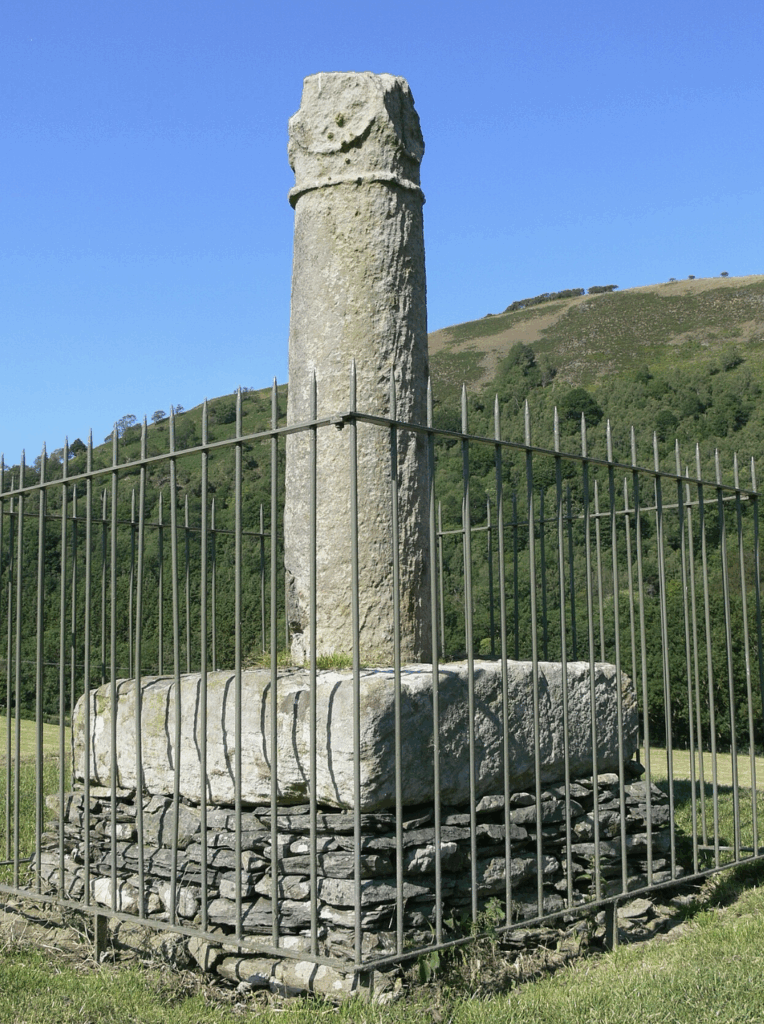
The Pillar of Eliseg, Denbighshire, Wales
It was at this time that archaeology shows a strengthening of Viroconium’s defences, and an increased military presence. Viroconium Cornoviorum transitioned into the capitol of the Kingdom of Powys after Rome’s departure.
The basilica and parts of the former baths were still in use, with simpler wattle constructions built on top. There were, it is believed, some public buildings, but the grandest structure appears to have been a private residence or palace built into the former Roman structures.
Enter the ‘Arthurian’ connection.
This private residence or palace at Viroconium, once the fourth largest city in Roman Britain, was built and lived in by the new ‘tyrant’ or ruler of Powys. One very strong theory is that this man was none other than the Vortigern of Arthurian legend whose name is inscribed on the Pillar of Eliseg, just across the border in Wales.
The Pillar of Eliseg, ancient monument to the Kings of Powys, references both the Roman past and Vortigern by name:
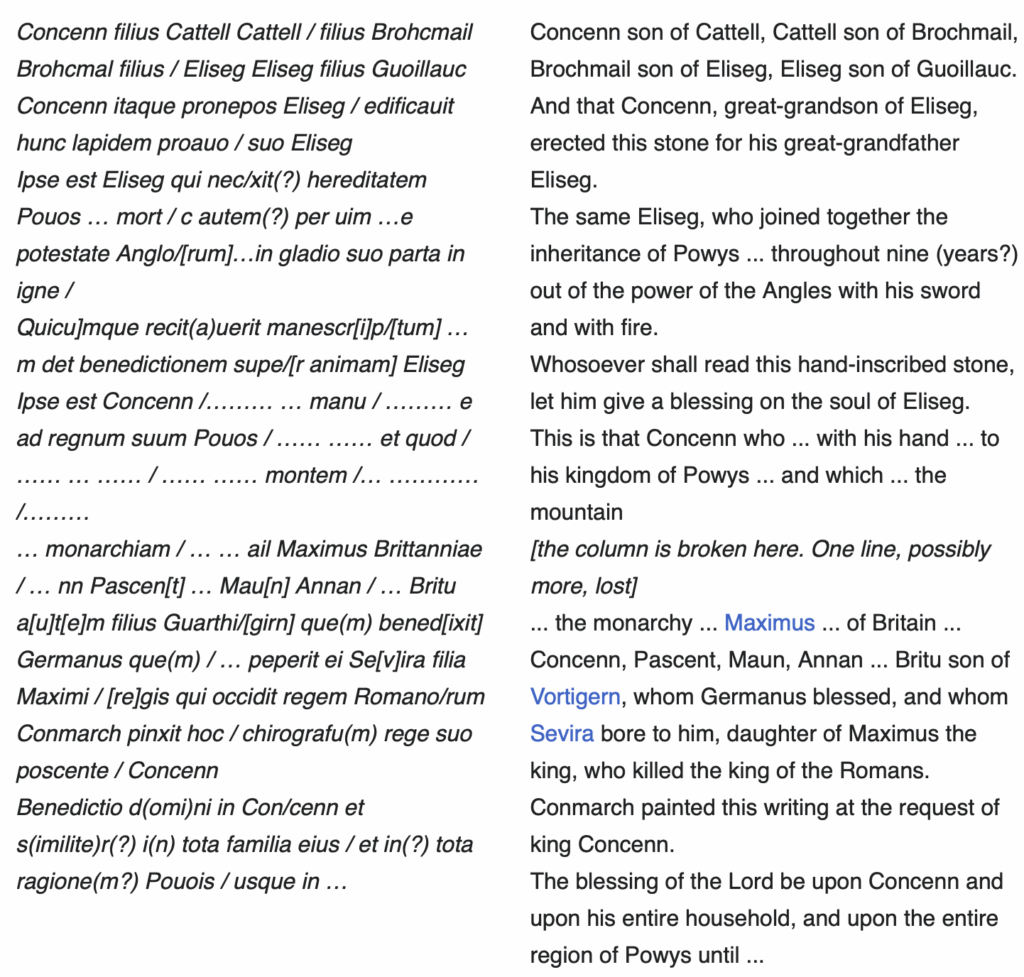
Side by side translation of the inscription on the Pillar of Eliseg (Wikimedia Commons)
This last bit of history from Viroconium’s legendary past is what brought me to the site, but little did I know that it opened the door to an understanding of one of the greatest cities of Roman Britain.
In studying Rome, and sites like Viroconium Cornoviorum, it strikes me how fleeting the greatness of cities and civilizations can be, how longevity cannot be taken for granted. That is one of the tragic lessons the Roman Empire has to teach us.
A once great city that was filled with life and vitality, that experienced economic prosperity, and had a thriving population that enjoyed over two hundred years of peace can, in the end, be transformed back into a quiet green field beside a river.
Carpe Diem, folks. Carpe Diem.
Thank you for reading.
If you are interested in reading more about the history and archaeology of Viroconium, I highly recommend the book Wroxeter: Life & Death of a Roman City by Roger White and Philip Barker. You can get a copy of that book by CLICKING HERE.
The Hearts of Heroes: A Novel of the Roman Empire is available ebook, paperback and deluxe hardcover editions from all major online retailers, independent bookstores, brick and mortar chains, and your local public library.
CLICK HERE to buy a copy and get ISBN#s for the edition of your choice.
If you are new to the Eagles and Dragons historical fantasy series, you can start your epic adventure with the award-winning, #1 bestselling prequel, A Dragon among the Eagles.