Greetings, Readers and History-lovers!
Welcome back to The World of The Hearts of Heroes. We hope you’ve enjoyed the blog series thus far. A lot of research goes into every Eagles and Dragons series novel, and we’re thrilled to share it with you!
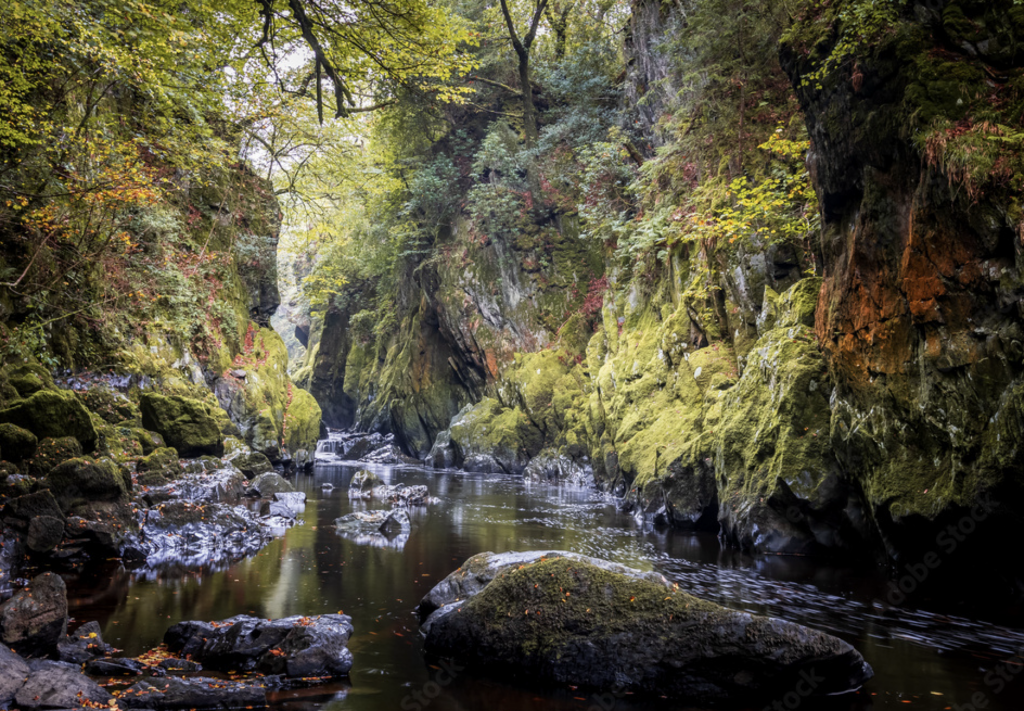
If you missed Part IV on Ffos Anoddun, the Fairy Glen of Wales, you can read that article by CLICKING HERE.
In Part V, we’re taking a look at another of the important settings in The Hearts of Heroes, a place of mystery, violence, and of exile in history, and in our story.
Join us as we explore the Isle of Anglesey and Rome’s involvement on the island…
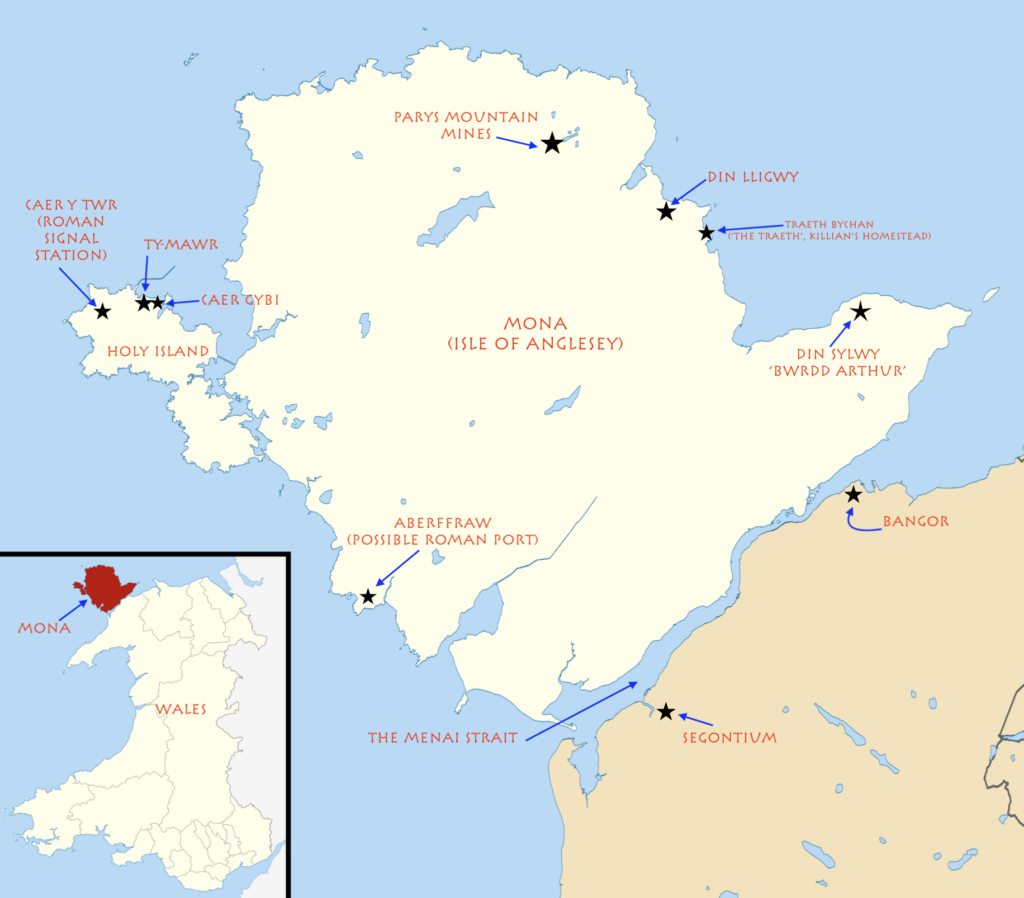
Some of the known Romano-British sites on Anglesey
The Isle of Anglesey, or Ynys Môn as it is named in Welsh, is a large island off the northwest coast of Wales. It lies just across the Menai Strait which runs between the island and the mainland for approximately 24 kms from Caernarfon to Bangor. The island itself is roughly 33×36 kms, and also includes Holy Island just off its west coast.
To the Romans, Anglesey was simply known as ‘Mona’.
Today, the Isle of Anglesey is known mainly for tourism along its beautiful coastlines. It is also known for mining. But these two things belie the violent history of the island, a history that revolves mainly around the Romans.
The people who lived on pre-Roman Mona were thought to be part of the Ordovices tribe who inhabited central and northwestern Wales, including the mountainous region of Snowdonia. That said, those living on Mona, on the other side of the Menai Strait, may have considered themselves a separate tribe.
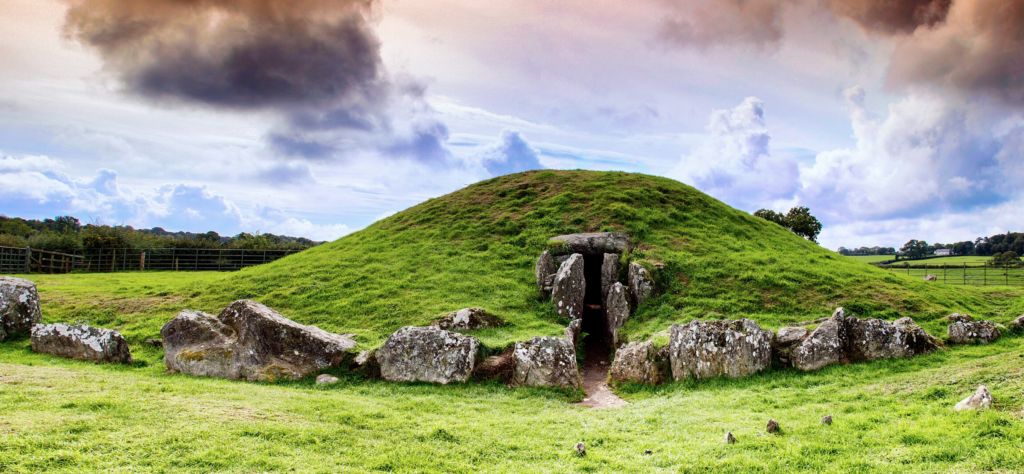
Bryn Celli Ddu burial chamber, pre-Roman, Anglesey (Wikimedia Commons)
Pre-Roman Anglesey had sacred groves of trees, burial chambers, cairns, standing stones, and sacred wells. There was also a copper mining and metalworking industry at Parys Mountain and places such as Llyn Cerrig Bach which some believe to have been a religious centre.
Religion appears to have been important on Anglesey, and one interesting find from different parts of the island are carved stone heads dotted with small holes. These are thought to have been used in religious rituals.
Most importantly, at least to history, Anglesey is thought to have been the religious power centre of the Druids in Britain.
When Rome began its invasion of Britannia in earnest under Emperor Claudius in A.D. 43, it was only a matter of time before the legions swept north and the fighting reached the tribes of Wales, including on Anglesey.
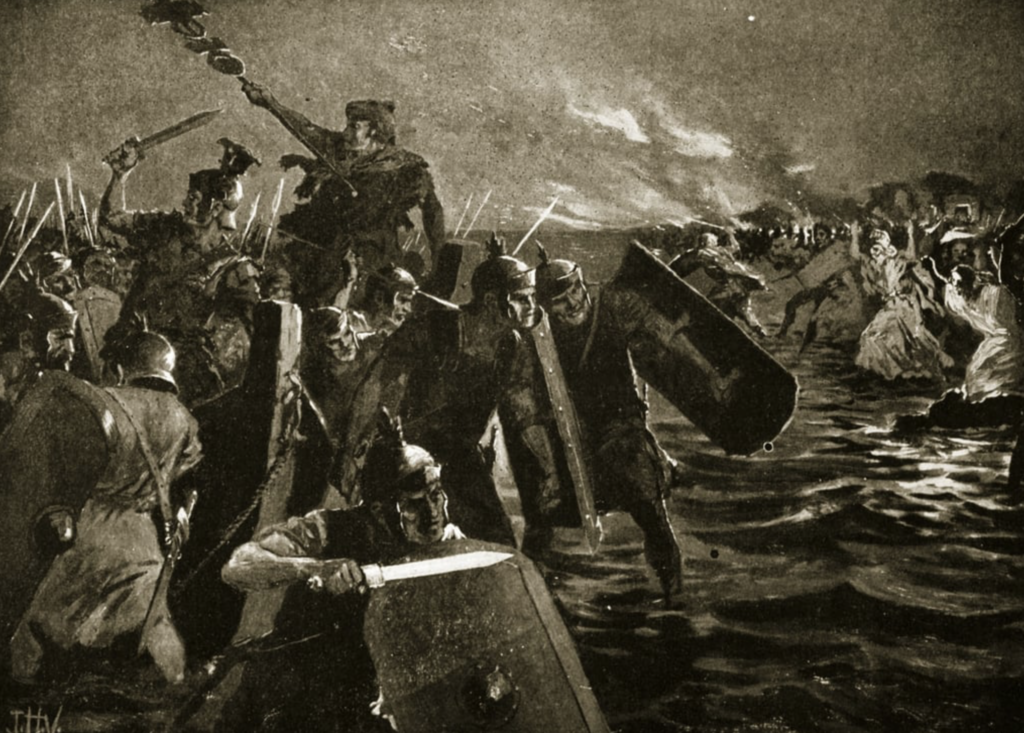
The Roman Attack on Anglesey – by John Harris Valda (Wikimedia Commons)
On the beach stood the adverse array, a serried mass of arms and men, with women flitting between the ranks. In the style of Furies, in robes of deathly black and with dishevelled hair, they brandished their torches; while a circle of Druids, lifting their hands to heaven and showering imprecations, struck the troops with such an awe at the extraordinary spectacle that, as though their limbs were paralyzed, they exposed their bodies to wounds without an attempt at movement. Then, reassured by their general, and inciting each other never to flinch before a band of females and fanatics, they charged behind the standards, cut down all who met them, and enveloped the enemy in his own flames. The next step was to install a garrison among the conquered population, and to demolish the groves consecrated to their savage cults: for they considered it a duty to consult their deities by means of human entrails. — While he was thus occupied, the sudden revolt of the province was announced to Suetonius.
(Tacitus, Annals, Book XIV)
There were two major Roman assaults on Mona. The first, described above by Tacitus, was led by Governor Gaius Suetonius Paulinus in A.D. 60. Paulinus’ assault included the XIV Gemina Martia Victrix legion, previously stationed at Viroconium, and auxiliary units of Batavian light infantry, Batavian horse, and other cavalry units.
Despite the differences between the fragmented and warring tribes of Britain at the time, Paulinus recognized the Druids, and the British religion which they represented and administered, as something the tribes could rally around. Druid priests, though supposedly elusive and less numerous than they had been in Gaul, were a source of strength for the Britons. They even educated the children of noble British families. Earlier on, the emperors Augusts and Claudius both passed edicts against Druidism because of its seditious nature.
As the religious centre of the Druids in Britain, Anglesey became a target for the Romans who may have believed it was at the heart of the British resistance.
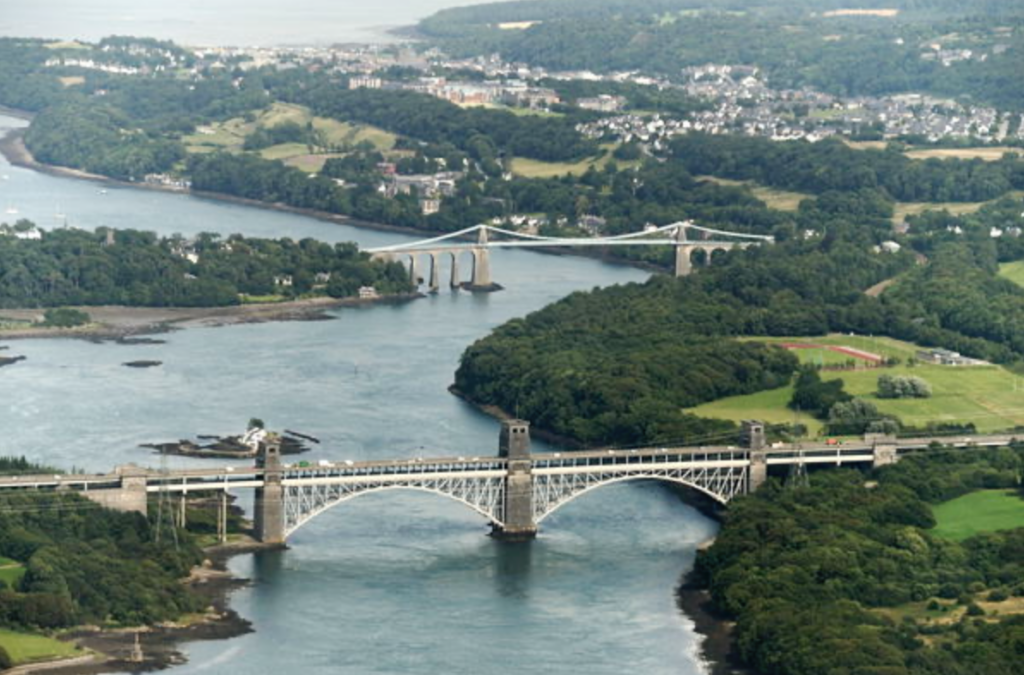
Aerial view of the Menai Strait where the Romans likely crossed.
During the winter, the Romans built a fleet of flat-bottomed boats which they would use to take the troops across the Menai Strait that summer while the cavalry forded in the shallows and the light Batavian troops swam. It is believed that the Roman amphibious assault was met not only by the Ordovices, but also by warriors of the Decangli and Silures tribes who were waiting on the other side.
As can be seen in the quote from Tacitus above, what appears to have caused the superstitious Roman troops even more concern were the crazy women, dressed in black, with wild hair shrieking and waving torches, and the Druids with their arms raised as they called on their gods.
But Paulinus urged his men forward, despite their fear, and they cut through the Celts in a bloody massacre after which they burned the bodies. The Romans spread across Mona, rounding up the Druid priests and prisoners and burning the sacred groves where they believed human sacrifices had taken place.
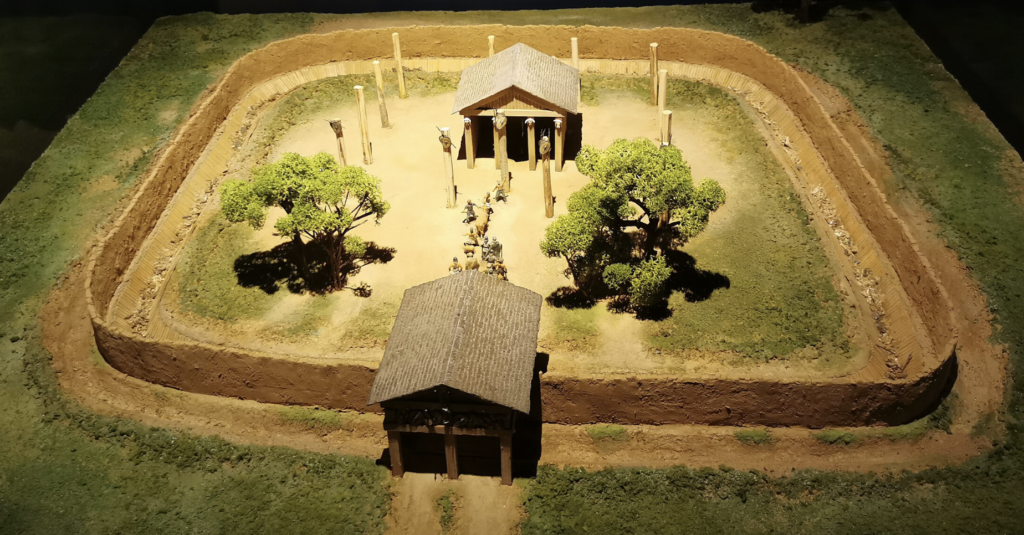
Reconstruction of a Celtic ‘nemeton’, the sort of sanctuary or ‘sacred grove’ that might have existed on Anglesey
However, before the island could be fully subdued, and before the flames had cooled, Paulinus received dispatches from the mainland informing him of a major uprising.
Boudicca of the Iceni tribe had begun a rebellion.
Boudicca led her army against the Romans; for these chanced to be without a leader, inasmuch as Paulinus, their commander, had gone on an expedition to Mona, an island near Britain. This enabled her to sack and plunder two Roman cities, and, as I have said, to wreak indescribable slaughter. Those who were taken captive by the Britons were subjected to every known form of outrage. The worst and most bestial atrocity committed by their captors was the following. They hung up naked the noblest and most distinguished women and then cut off their breasts and sewed them to their mouths, in order to make the victims appear to be eating them; afterwards they impaled the women on sharp skewers run lengthwise through the entire body. All this they did to the accompaniment of sacrifices, banquets, and wanton behaviour, not only in all their other sacred places, but particularly in the grove of Andate. This was their name for Victory, and they regarded her with most exceptional reverence.
Now it chanced that Paulinus had already brought Mona to terms, and so on learning of the disaster in Britain he at once set sail thither from Mona. However, he was not willing to risk a conflict with the barbarians immediately, as he feared their numbers and their desperation, but was inclined to postpone battle to a more convenient season. But as he grew short of food and the barbarians pressed relentlessly upon him, he was compelled, contrary to his judgment, to engage them. Boudicca, at the head of an army of about 230,000 men, rode in a chariot herself and assigned the others to their several stations. Paulinus could not extend his line the whole length of hers, for, even if the men had been drawn up only one deep, they would not have reached far enough, so inferior were they in numbers; nor, on the other hand, did he dare join battle in a single compact force, for fear of being surrounded and cut to pieces. He therefore separated his army into three divisions, in order to fight at several points at one and the same time, and he made each of the divisions so strong that it could not easily be broken through.
(Cassius Dio, The Roman History, LXII)
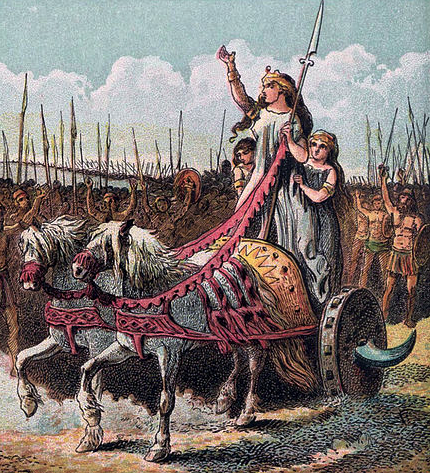
Artist impression of Boudicca and her daughters rallying the troops from her war chariot
We won’t go into all of the details of the Boudiccan rebellion here, suffice it to say that it was a bloody affair that saw the destruction of the Roman settlements of Camulodunum (Colchester), Verulamium (St. Alban’s), and Londinium (London).
Governor Paulinus, leaving a few cohorts behind on Mona, rushed from there to the fortress at Deva (Chester) and then marched down Watling Street with his XIVth legion men, as well as veterans of the XXth legion, including 2,500 evocati, 2,000 auxiliary infantry, and 500 cavalry. The Roman force met Boudicca’s along the Roman road…
At first, the legionaries stood motionless, keeping to the defile as a natural protection: then, when the closer advance of the enemy had enabled them to exhaust their missiles with certitude of aim, they dashed forward in a wedge-like formation. The auxiliaries charged in the same style; and the cavalry, with lances extended, broke a way through any parties of resolute men whom they encountered. The remainder took to flight, although escape was difficult, as the cordon of wagons had blocked the outlets. The troops gave no quarter even to the women: the baggage animals themselves had been speared and added to the pile of bodies. The glory won in the course of the day was remarkable, and equal to that of our older victories: for, by some accounts, little less than eighty thousand Britons fell, at a cost of some four hundred Romans killed and a not much greater number of wounded. Boudicca ended her days by poison…
(Tacitus, Annals, Book XIV)
Despite being massively outnumbered the Romans, under Paulinus’ command, were victorious. The rebellion, however, was not without cost. Something like 80,000 Roman citizens and allies were slain in a few weeks. After the victory, Suetonius Paulinus was recalled to Rome by Emperor Nero who granted him a triumph and later a consulship.
But that is not the end of the story for Mona.
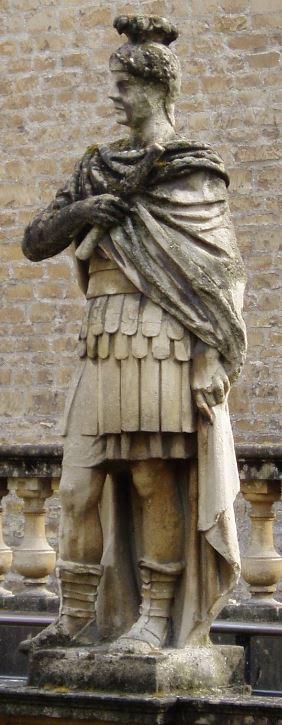
Agricola – Statue at Roman Baths, Bath, England
The second Roman assault on the island of Mona came about seventeen years after the end of the Boudiccan rebellion, in the year A.D. 78, when Gnaeus Julius Agricola, an apprentice of Governor Paulinus, arrived as the new governor of the province.
This second campaign against the island was precipitated by the massacre of a Roman cavalry squadron by the Ordovices in the Snowdonia region. As the new governor, Agricola knew that he needed to make a statement and, though the campaigning season was nearly over, he decided to take decisive action.
Tacitus, who was actually Agricola’s son-in-law, describes the events:
…when Agricola arrived in the middle of summer; at a time when the Roman soldiers, supposing the expeditions of the year were concluded, were thinking of enjoying themselves without care, and the natives, of seizing the opportunity thus afforded them. Not long before his arrival, the Ordovices had cut off almost an entire corps of cavalry stationed on their frontiers; and the inhabitants of the province being thrown into a state of anxious suspense by this beginning, inasmuch as war was what they wished for, either approved of the example, or waited to discover the disposition of the new governor. The season was now far advanced, the troops dispersed through the country, and possessed with the idea of being suffered to remain inactive during the rest of the year; circumstances which tended to retard and discourage any military enterprise; so that it was generally thought most advisable to be contented with defending the suspected posts: yet Agricola determined to march out and meet the approaching danger. For this purpose, he drew together the detachments from the legions, and a small body of auxiliaries; and when he perceived that the Ordovices would not venture to descend into the plain, he led an advanced party in person to the attack, in order to inspire the rest of his troops with equal ardor. The result of the action was almost the total extirpation of the Ordovices; when Agricola, sensible that renown must be followed up, and that the future events of the war would be determined by the first success, resolved to make an attempt upon the island Mona, from the occupation of which Paullinus had been summoned by the general rebellion of Britain, as before related. The usual deficiency of an unforeseen expedition appearing in the want of transport vessels, the ability and resolution of the general were exerted to supply this defect. A select body of auxiliaries, disencumbered of their baggage, who were well acquainted with the fords, and accustomed, after the manner of their country, to direct their horses and manage their arms while swimming, were ordered suddenly to plunge into the channel; by which movement, the enemy, who expected the arrival of a fleet, and a formal invasion by sea, were struck with terror and astonishment, conceiving nothing arduous or insuperable to troops who thus advanced to the attack. They were therefore induced to sue for peace, and make a surrender of the island; an event which threw lustre on the name of Agricola, who, on the very entrance upon his province, had employed in toils and dangers that time which is usually devoted to ostentatious parade, and the compliments of office.
(Tacitus, The Life of Agricola, XVIII)
The final Roman conquest of Mona was complete.
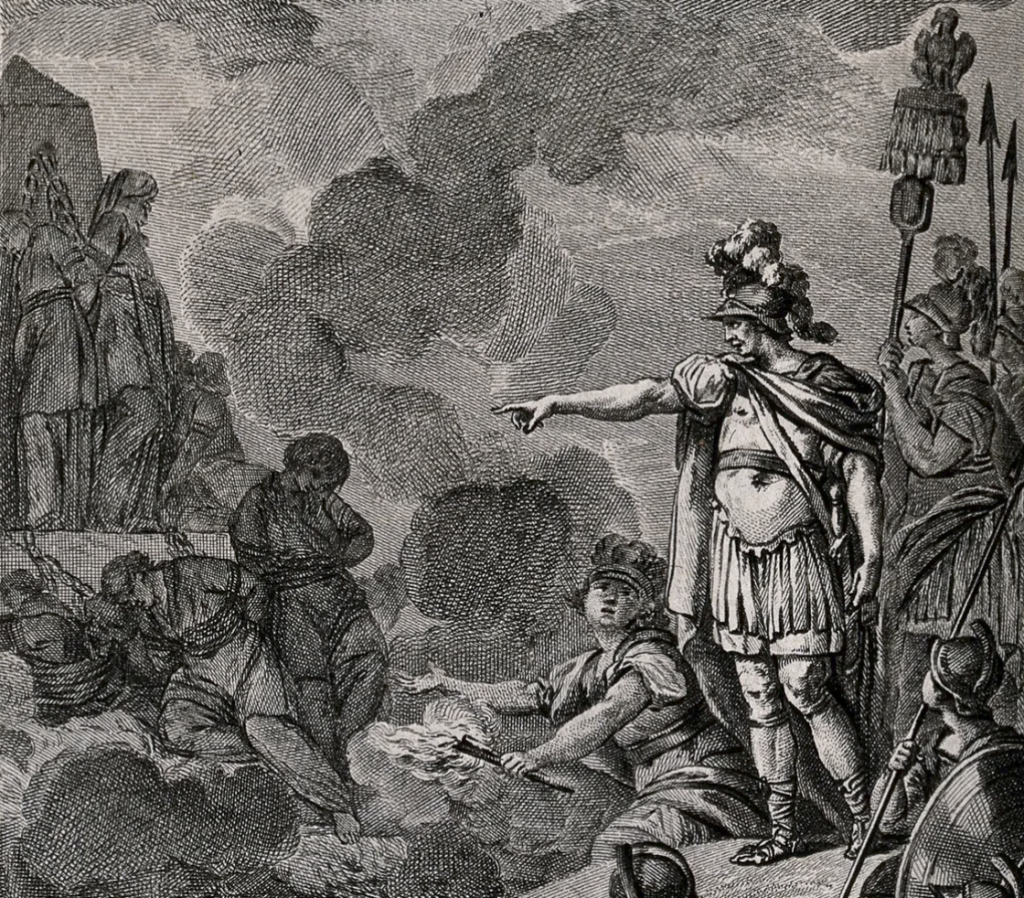
After the Roman conquest, what did life look like for the Britons who survived and continued to inhabit the island of Mona?
Well, it seems that, apart from the distinct lack of an overt Druid presence (if any had survived, that is) life may have carried on much the same as it always had once things settled, with mining and small farmstead activities continuing under Roman military occupation. During the third and fourth centuries A.D., the Pax Romana settled on the land, across Mona and the rest of Britannia. A distinct Romano-British culture began to form.
Today, though there are Roman sites scattered all over mainland Wales, it is not so on the Isle of Anglesey. Archaeological excavations to date have revealed just a few sites.
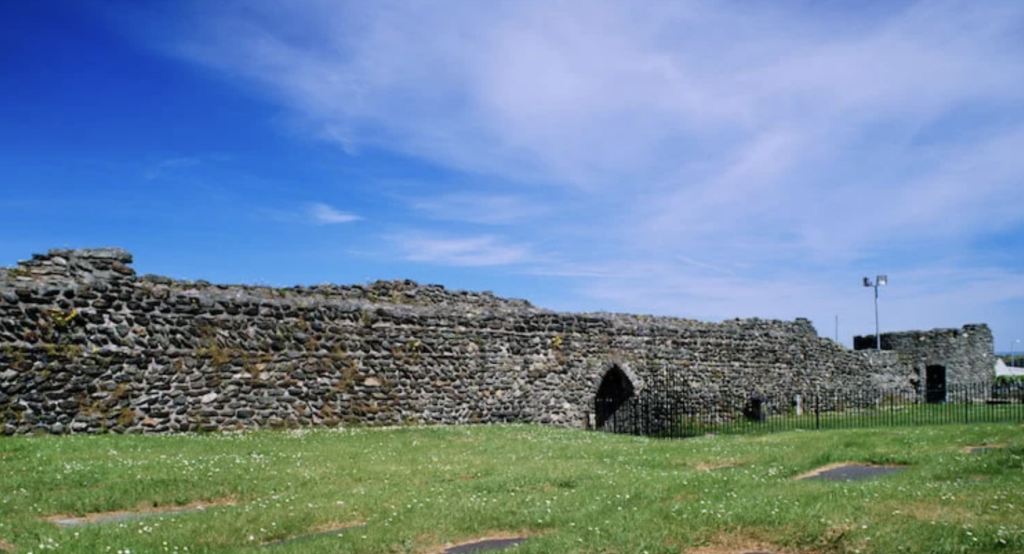
Remains of Roman fortlet walls at Caer Gybi
At Caer Gybi, near Holyhead on Holy Island, the largest modern settlement on Anglesey, there was a Roman fortlet on a natural harbour there which was built c. A.D. 300. It had 4 m high walls and three circular towers, and measured about two-hundred and thirty by one-hundred and fifty feet. This may have been a base for Roman war ships and the construction coincides with the time of the Saxon Shore forts in the south of Britannia.
At Caer y Twr, on Holyhead Mountain, which was the highest point on Holy Island, there are the remains of a Roman signal station which, logically, served the fortlet and port at Caer Gybi.
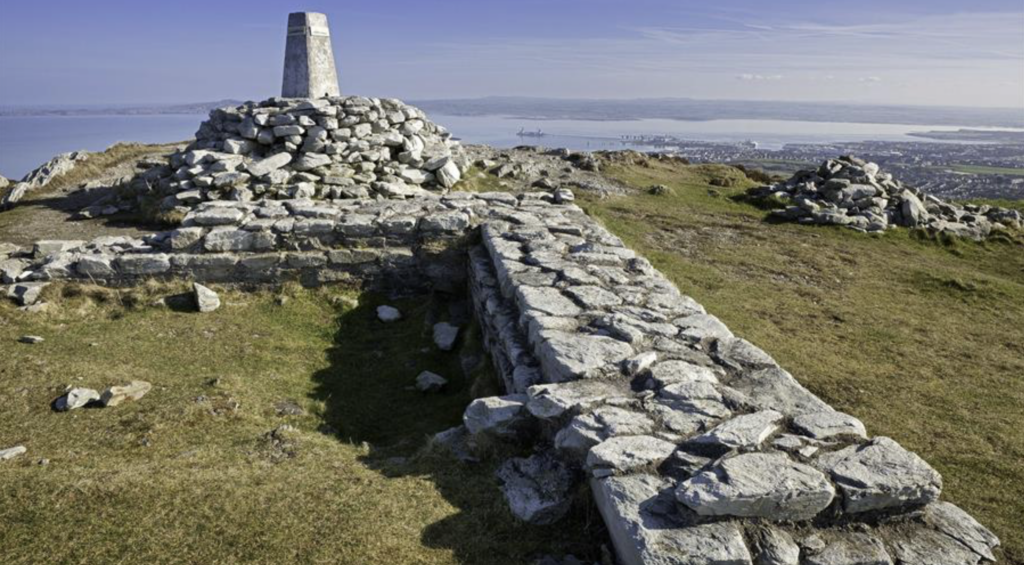
Caer y Twr – Remains of the Roman watchtower on Holyhead Mountain
Another possible Roman sea port and fortlet is thought to have been located at Aberffraw in the southwest corner of Anglesey. This site dates to the first century A.D. and archaeology indicates two phases of occupation which may coincide with the two Roman assaults on Anglesey. There were ditches and Roman defences, but most of the remains are beneath the modern village. Roman pottery has also been found on the site.
Apart from these three sites, there are no other known Roman military sites on Anglesey. The island was, relatively speaking, not that large, and it was already served – or, overseen – by the cohort of five hundred men of the Cohors I Sunicorum stationed at Segontium on the other side of the Menai Strait at what is now Caernarfon. The garrison at Segontium was responsible for the security and defence of north Wales, especially against Irish raiders during the Pax Romana.
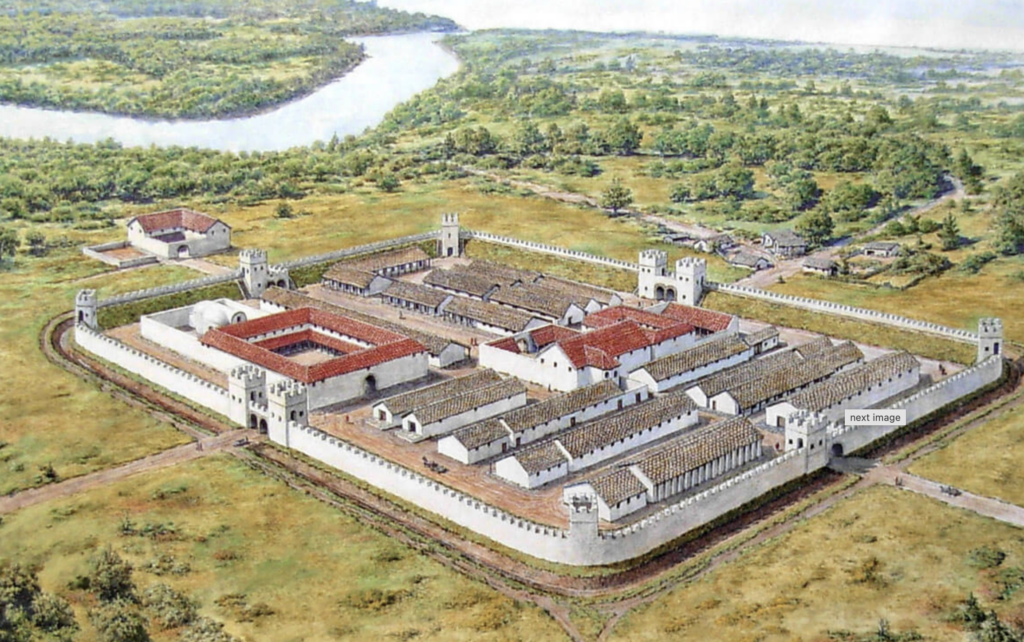
Artist impression of the fort of Segontium from the east, c. 250 A.D. (J. Banbury)
There is a bit more in the way of Romano-British remains on Anglesey. This hints at the life of the Ordovices who carried on with their lives during the period of Roman peace.
On the northeast coast of Anglesey, the fourth century A.D. settlement of Din Lligwy, whose occupation went back to the pre-Roman Iron Age, continued to be in use. This was a walled settlement on a low hill with good views all around. There are the remains of round and rectangular huts and a great deal of Roman pottery has been found on the site, as well as the remains of iron smelting and smithing activities which appear to have used coal from the mainland of Britannia. In addition to the smelting activities, farming was also carried out here.
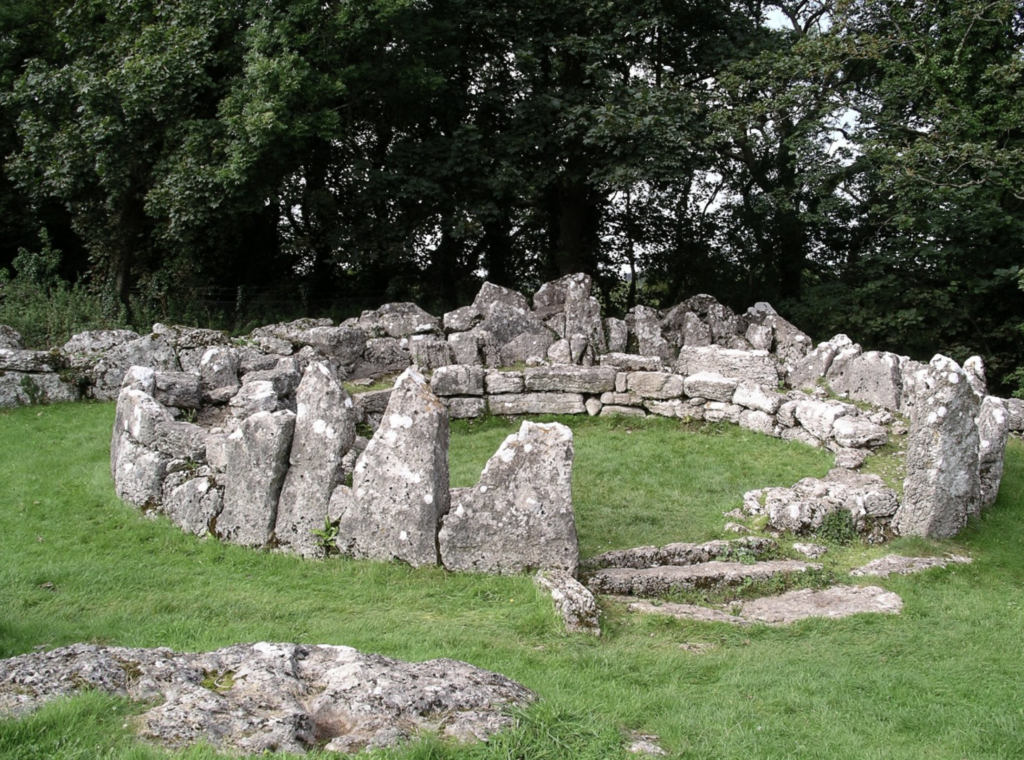
Foundations of roundhouse:hut at Din Lligwy, Anglesey
On the southeast coast of Anglesey, not far from the magnificent Medieval castle of Beaumaris, is the ancient hillfort of Din Sylwy, also known as Bwrdd Arthur, or ‘Arthur’s Table’. This Iron Age hillfort was occupied by the Ordovices long before the Romans came and played, it is supposed, a role in the Roman assaults on Anglesey. It has an area of about seven hectares and was surrounded by a limestone wall with two gates or entrances.
What is interesting about Din Sylwy is it’s association with the legendary British freedom fighter, ’Arthur’, whom we have come to know as ‘King Arthur’. Local lore has it that Arthur met at this roughly round site with his men, or that he had fought there.
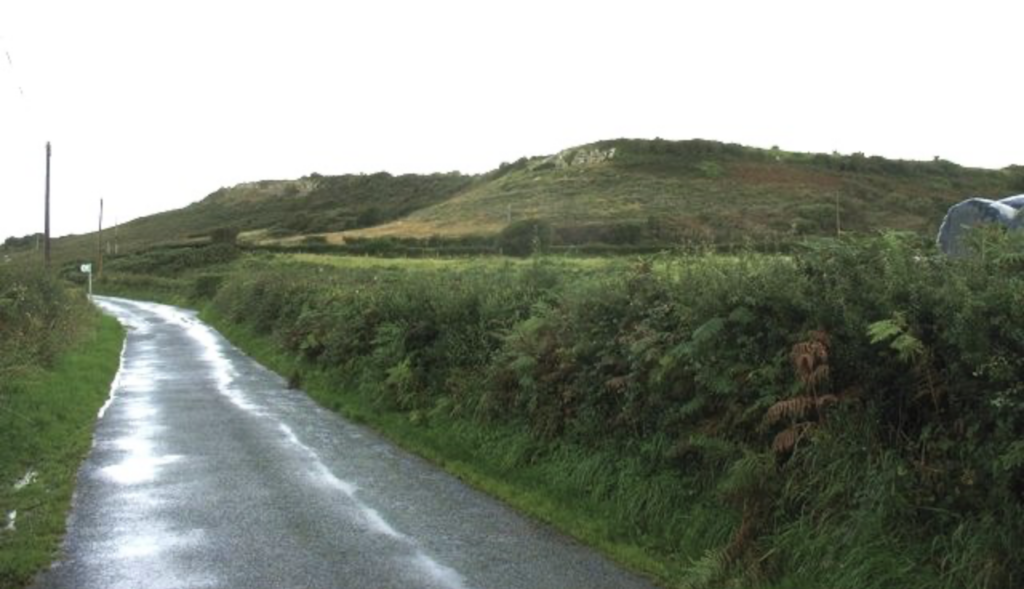
Din Sylwy – Bwrdd Arthur (‘Arthur’s Table’)
A large Romano-British settlement known as Ty-Mawr was located at Holyhead on Holy Island, below the Roman signal station at Caer y Twr. This site contained the remains of about twenty circular Iron Age huts, though there may have been as many as fifty. It is one of the best preserved hut groups in all of Wales and was occupied into the third and fourth centuries A.D. Some of the huts or roundhouses may have been as much as ten meters wide. Finds at Ty-Mawr included items of daily life such as quern stones for grinding grain, spindles, mortars, pottery, and coins. Also found there was copper from the mines at Parys Mountain on Anglesey.
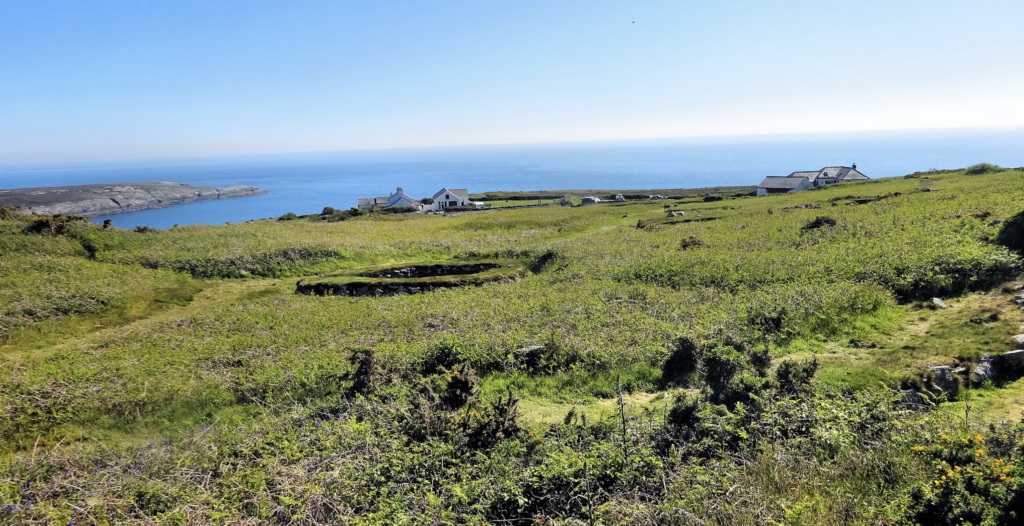
Foundations of Celtic Iron Age huts:roundhouses at Ty-Mawr
Lastly, we have the copper mines at Parys Mountain, or ‘Trysclwyn’ as it was originally known.
These mines are thought to have been in use for up to four thousand years and been of great import to the British Bronze Age. Some even suppose that the mining operations at Parys Mountain may have helped to finance the Druids and their resistance to the Roman invasion.
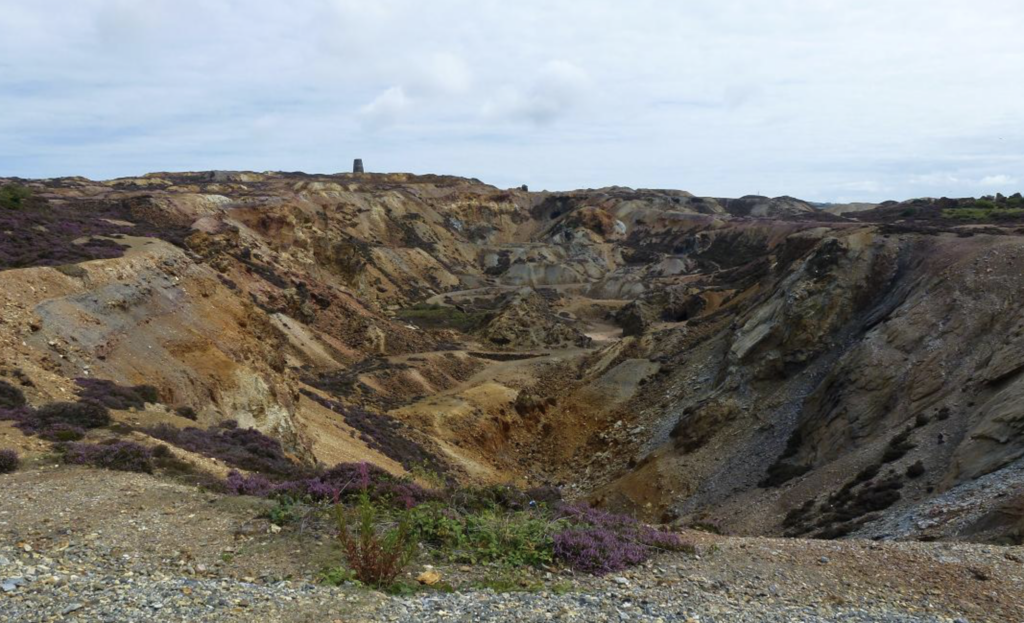
Parys Mountain Mines, Isle of Anglesey
After the Roman invasion, the copper mines at Parys Mountain continued to be used with the copper being shipped to smaller villages on Anglesey where it was smelted before being transported to ports such as Aberffraw to go to the mainland. One Roman-era copper ingot or ‘cake’ was found stamped with ‘SOCIO-ROMAE-NATSOL’, presumed to be an official stamp of the Roman copper trade on Mona.
If the Romans remained interested in Mona after the invasion, the copper mines were no doubt one of the main reasons.
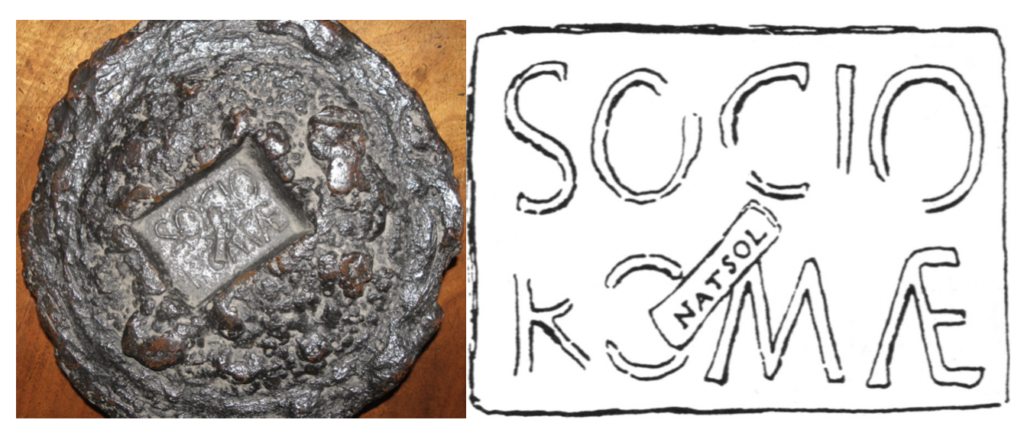
Roman-era copper ingot or ‘cake’ with official stamp of the Roman copper trade on Mona.
In The Hearts of Heroes, the Isle of Anglesey, Roman Mona, provides the setting for some of the story which takes place in the year A.D. 229. At this time, the fortress at Segontium would have been there for almost two hundred years, the Ordovices would have recovered from the violence of Rome’s initial assaults on the island, and life would have settled into the Pax Romana.
This was a cycle that was common throughout the history of Rome as it expanded, violent beginnings leading to periods of peace and prosperity.
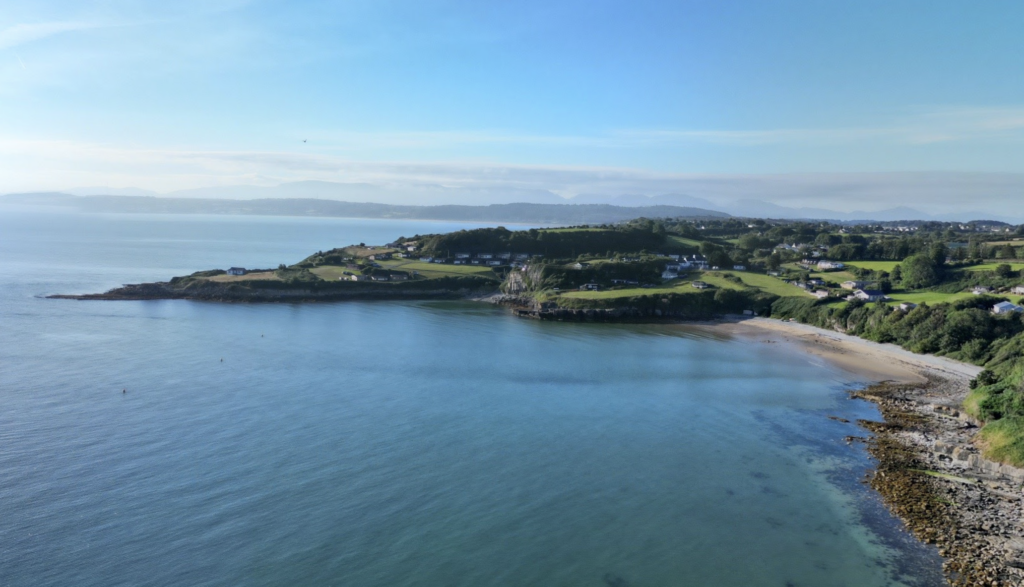
Traeth Bychan – ‘The Traeth’, site of homestead of Killian in The Hearts of Heroes
The people of Mona, however, like the rest of Britannia, were left to their own devices when Rome, under Emperor Honorius, pulled out of the province in the fourth century. The people of Mona continued to mine and to farm, but they were also faced with an increase in Irish raids without the protection of Rome.
It was not until the arrival of Cunedda ap Edern, Lord of the Gododdin, the descendants of the Votadini, that the Irish were driven out for good.
And so, the history of Anglesey continued in a cycle of blood and peace, its ebb and flow like the sparkling sea that surrounded it.
Thank you for reading.
We hope you’ve enjoyed this article about Rome and the Isle of Anglesey.
Tune in for Part VI in The World of The Hearts of Heroes when we will be looking at the the famed Lady Chapel of Glastonbury Abbey.
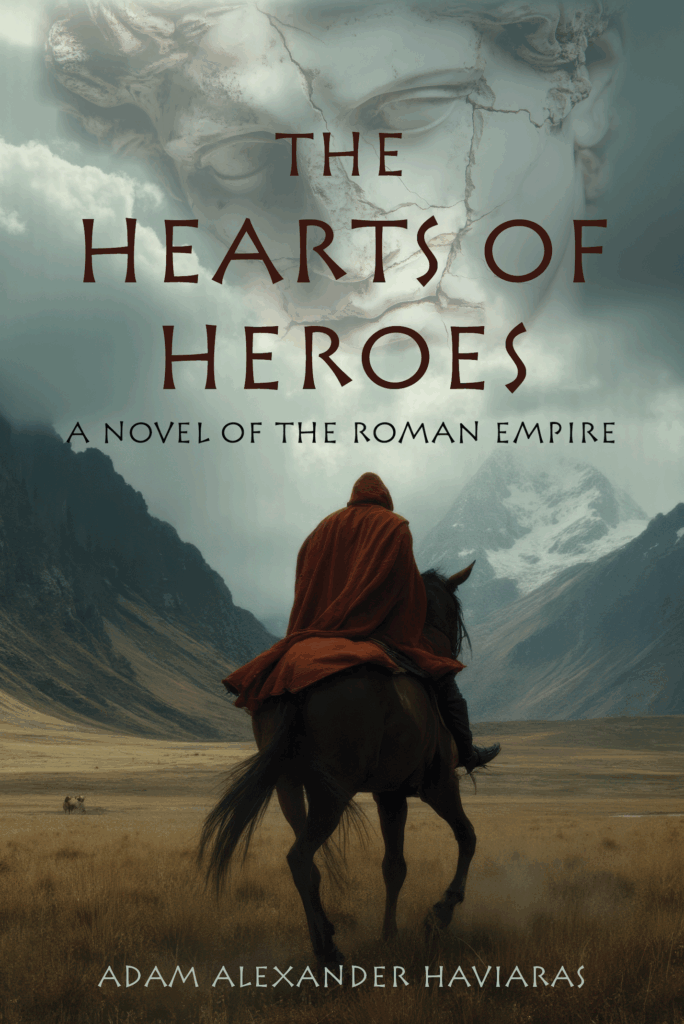
The Hearts of Heroes: A Novel of the Roman Empire is available ebook, paperback and deluxe hardcover editions from all major online retailers, independent bookstores, brick and mortar chains, and your local public library.
CLICK HERE to buy a copy and get ISBN#s for the edition of your choice.
If you are new to the Eagles and Dragons historical fantasy series, you can start your epic adventure with the award-winning, #1 bestselling prequel, A Dragon among the Eagles.