Greetings Readers and History-Lovers!
Welcome to the first post in our blog series about the newest Eagles and Dragons series novel, The Lord of Annwn: A Novel of the Otherworld.
In this five-part series, we will be looking at some of the research into the myths, mythological figures, people and archetypes from Greek, Roman, and Celtic Mythology that appear in the story.
We’re thrilled that you are here to join us on this adventure into the past!
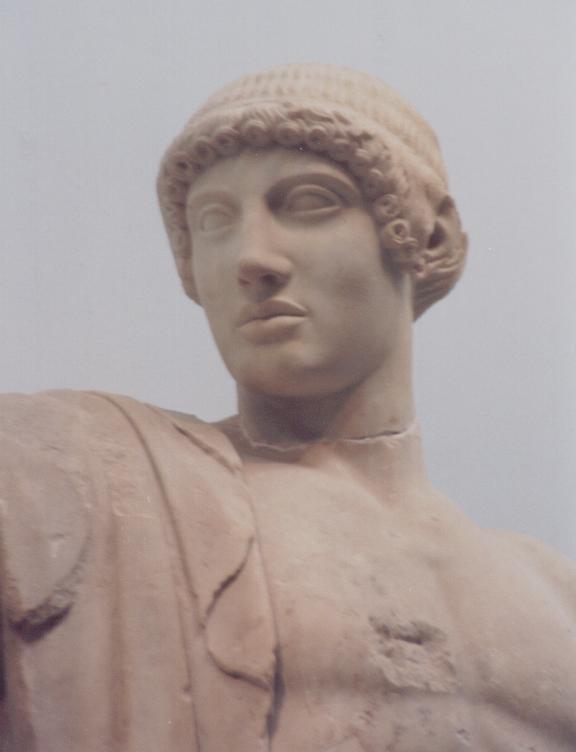
Here I am minded to make a glorious temple, an oracle for men, and hither they will always bring perfect hecatombs, both those who live in rich Peloponnesus and those of Europe and all the wave-washed isles, coming to seek oracles. And I will deliver to them all counsel that cannot fail, giving answer in my rich temple.
(Hymn To Pythian Apollo, 244-253)
Fans of the Eagles and Dragons series will already know that Apollo – one of the twelve Olympian Gods for both Greeks and Romans – plays a major role in the entire series. He is the light and the voice behind all that happens to the main protagonist, Lucius.
In The Lord of Annwn, however, we are visiting an episode much farther back in time in the myth of Apollo. It is perhaps one of the more famous episodes in the story of this god, one which led not only to his punishment and exile in the Vale of Tempe, but also to the foundation of the most famous oracle in the ancient world, the Oracle of Delphi.
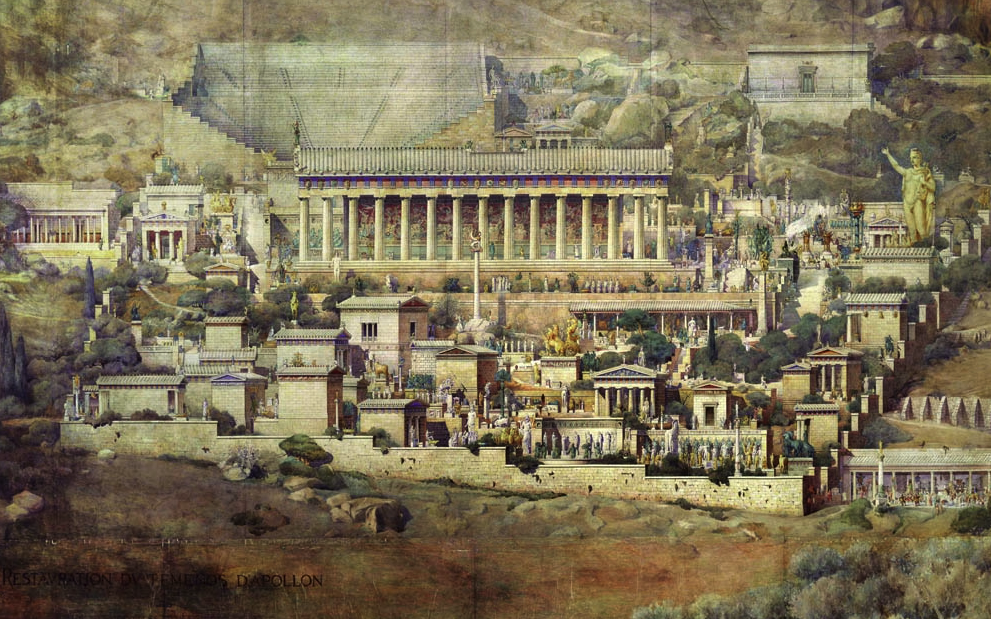
Speculative illustration of ancient Delphi by French architect Albert Tournaire.
Apollo was, of course, the god of prophecy and divination, the patron of music and the arts, and the leader of the Muses and, because of Homer’s inspired tales, he became known as ‘Phoebus Apollo’, the Shining One, often identified with the sun god, Helios.
But Apollo was also a god of healing, often called ‘Paeon’, as well as the archer-god would could bring plague and death. It was Homer who gave him the names of ‘Far-Shooter’ and ‘Lord of the Silver Bow’.
Angered in his heart he strode from the peaks of Olympus, carrying on his shoulders his bow and covered quiver, and the shafts clashed on the shoulders of the angry god, moving in fury. He came as night comes down. Settling far from the ships he let fly an arrow, and terrible was the clash that rose from his silver bow…
(Homer, Iliada, I.44-53)
Much earlier in Apollo’s life, however, after Leto gave birth to him on Delos, when he was immediately fed nectar and ambrosia instead of his mother’s milk, he set off into the world, declaring:
The lyre and the curved bow shall ever be dear to me, and I will declare to men the unfailing will of Zeus.
(Hymn to Delian Apollo, 131-132)
The young Apollo then roamed ‘the wide-pathed earth’ with his lyre and his bow, looking for a place to establish his oracle. His search eventually led him to a place called Crisa ‘beneath snowy Parnassus’ where ‘a cliff hangs over it from above, and a hollow, rugged glade runs under’.
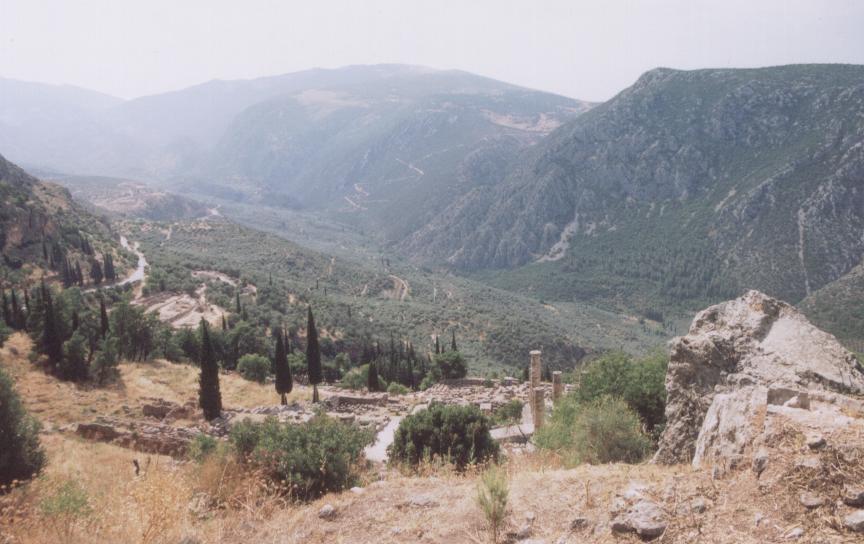
It is this event – Apollo’s arrival at the spot where he decides to establish his oracle – that we explore in our story. When Apollo arrives on the slopes of Parnassus, he finds that there is already a great, dark, power dwelling there.
The subsequent battle came to represent a great battle between the Light and the Darkness, with the Light being victorious, but at a cost.
Before Apollo arrived in this place – the future site of Delphi – there was already a more ancient, oracular power there on behalf of Gaia, the primordial earth goddess who emerged out of the Chaos of creation. Living in the earth at the site of Gaia’s oracle was the great serpent or dragon, Python (or ‘Pytho’).
A great battle was imminent, but there are a couple different versions of the story. In one, after ranging over the earth searching for a place to establish his oracle, Apollo finally arrives at Crisa, the future site of Delphi. He clashes with Python, and slays her (or ‘him’, Python is referred to as both male or female in different tellings).
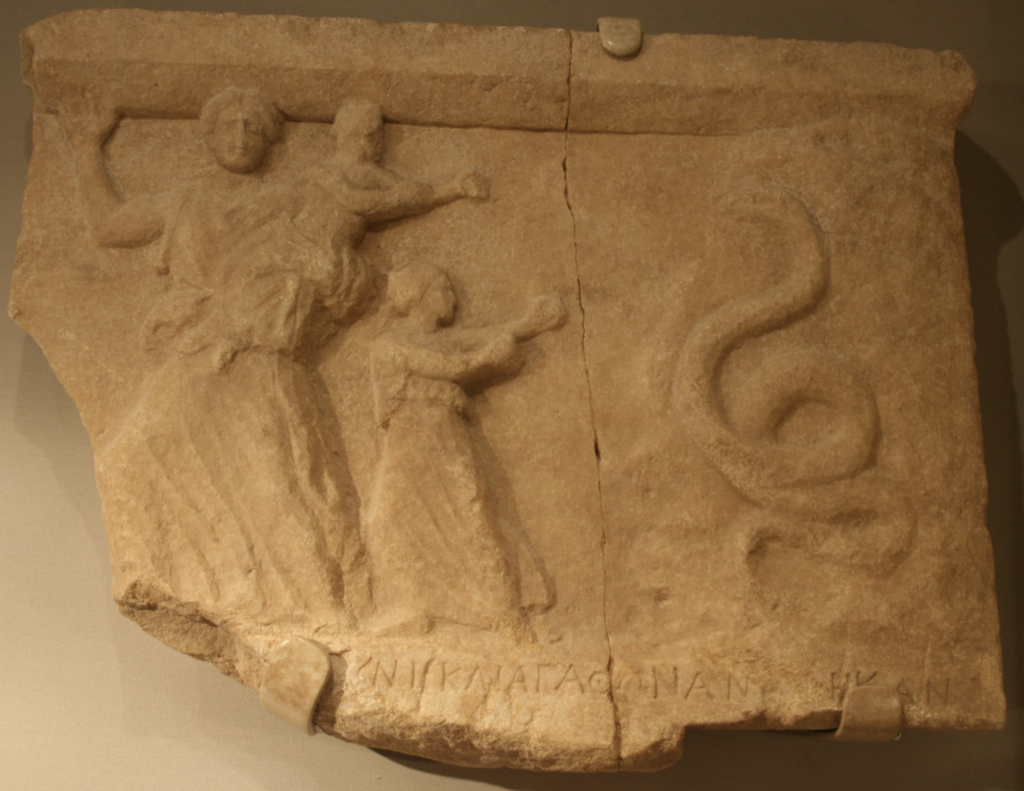
Relief of Leto and her children fleeing from Python, 4th-3rd century B.C.
In another version of the story by the 1st century A.D. Roman writer, Hyginus, Apollo has hunted Python down to punish her for pursuing his mother, Leto, when she was pregnant with him and his twin sister, Artemis, to prevent her from finding a place to give birth. Python was, in this version, acting at the behest of Hera, Queen of the Gods, who was jealous of Zeus’ affair with Leto.
It is this version of the myth that is explored in The Lord of Annwn.
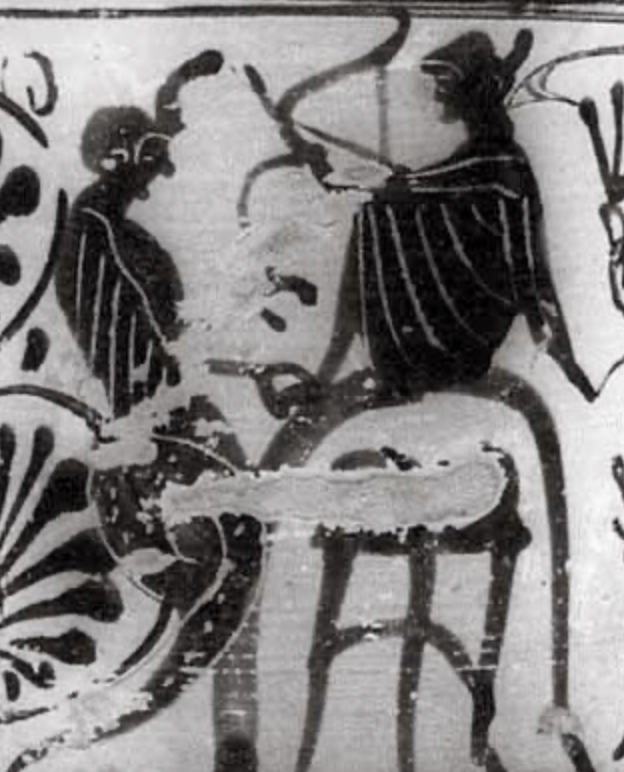
Apollo, seated on the omphalos stone of Delphi beside the Delphic tripod, fires arrows at Python (c. 470 B.C.)
But near by was a sweet flowing spring, and there with his strong bow the lord, the son of Zeus, killed the bloated, great she-dragon, a fierce monster wont to do great mischief to men upon the earth, to men themselves and to their thin-shanked sheep; for she was a very bloody plague…
…Then she, rent with bitter pangs, lay drawing great gasps for breath and rolling about that place. An awful noise swelled upon unspeakable as she writhed continually this way and that amid the wood: and so she left her life, breathing it forth in blood. Then Phoebus Apollo boasted over her:
‘No rot here upon the soil that feeds man! You at least shall live no more to be a fell bane to men who eat the fruit of the all-nourishing earth, and who will bring hither perfect hecatombs’…
…Thus said Phoebus, exulting over her: and darkness covered her eyes. And the holy strength of Helios made her rot away there; wherefore the place is now called Pytho, and men call the lord Apollo by another name, Pythian; because on that spot the power of piercing Helios made the monster rot away…
(Hymn to Pythian Apollo, 334-374)
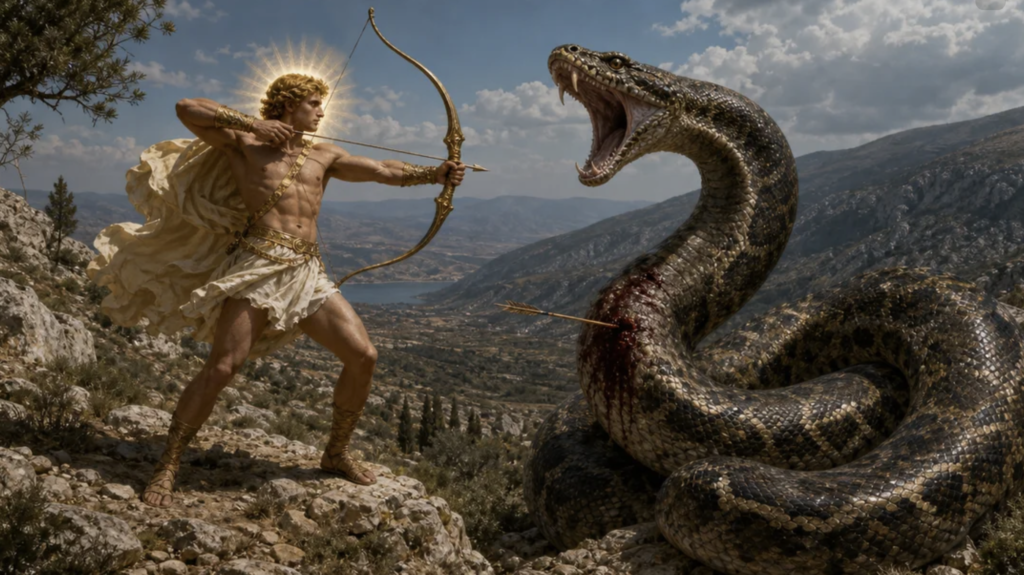
Apollo slaying Python at Delphi
Thus, Apollo took over the oracular power at Delphi where, historically, the Pythian Games – one of the four Crown Games of Ancient Greece – were held in honour of this event, some say established by the Lord of the Silver Bow to commemorate Python.
The spring mentioned in the text above is the sacred Castalian Spring where the priestesses of Delphi, including the Pythia, the Oracle, as well as pilgrims would cleanse themselves before entering the sanctuary of Apollo. It was beside the spring that Python finally died and her corpse rotted in the light of the sun.
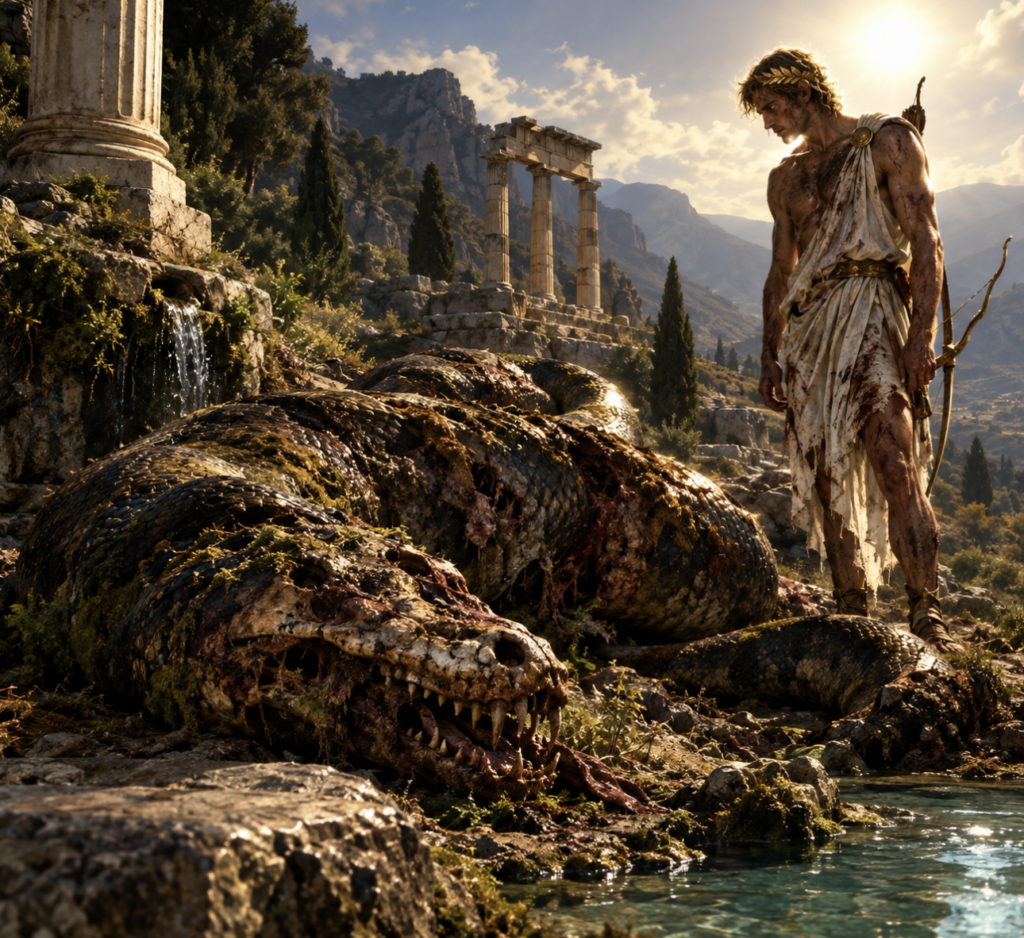
Apollo looking on the body of Python where it begins to rot beside the Castalian spring at Delphi.
After slaying Python, however, Apollo was not, in some versions, allowed to rest on his laurels, so to speak. As punishment for the act of slaying Python, according to Aristonous and Aelian, Zeus ordered Apollo to the Vale of Tempe for a purifying exile before he could return and establish his oracle.
In later years, the Vale of Tempe became the haunt of Apollo and the Muses, and it was where the laurels were cut for the victory crowns for the Pythian Games. Additionally, it was also where Eurydice was bitten by the serpent before Orpheus, Apollo’s son, went to find her in the Underworld.
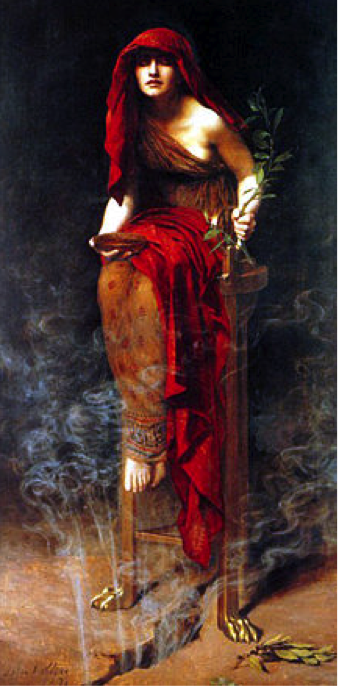
The Pythia
Either before or after his exile and purification, Apollo turned his thoughts to the foundation of the oracle and sanctuary he was taking over:
Then Phoebus Apollo pondered in his heart what men he should bring in to be his minsters in sacrifice and to serve him on rocky Pytho. And while he while he considered this, he became aware of a swift ship upon the wine-like sea in which were many men and goodly, Cretans from Knossos, the city of Minos, they who do sacrifice to the prince and announce his decrees… These men were sailing in their black ship for traffic and for profit to sandy Pylos and to the men of Pylos. But Phoebus Apollo met them: in the open sea he sprang upon their swift ship, like a dolphin in shape…
…Then, far-working Apollo answered then and said: ‘Strangers who once dwelt about wooded Knossos but now shall return no more each to his loved city and fair house and dear wife; here shall you keep my rich temple that is honoured by many men. I am the son of Zeus; Apollo is my name: but you I brought here over the wide gulf of the sea, meaning you no hurt; nay, here you shall keep my rich temple that is greatly honoured among men, and you shall know the plans of the deathless gods, and by their will you shall be honoured continually for all time…
(Hymn to Pythian Apollo, 388-501)
The Cretan priests undertook their charge from Apollo with great care and dedication for, on the slopes of Parnassus, in the place known as Crisa, and Pytho, they established the most famous and respected oracle of the ancient world where the high priestess, the Pythia, uttered her prophecies on Apollo’s behalf from the heart of his temple.
If you have never been to Delphi, it is well worth a journey across the world to see it, experience it, and feel it. People did so in the ancient world, and they still do to this day.
It is one of the most dramatic and magical sites of Ancient Greece, and it all started with the battle between Apollo and Python.
If you would like to learn more about Delphi, the Oracle, and it’s importance in ancient history, you can read the following articles:
Delphi: Visiting the Sanctuary of a God
The Delphic Maxims: An Ancient Light in the Dark
and
Delphi: Walking Sacred Ground
Thank you for reading.
We hope you’ve enjoyed this first post in The World of The Lord of Annwn blog series. Stayed tuned for Part II in which we will look at liminal places in Celtic myth and legend.
To download a free copy of the Homeric Hymns, including the Hymn to Delian Apollo, and the Hymn to Pythian Apollo quoted above, CLICK HERE.
The Lord of Annwn: A Novel of the Otherworld is now available ebook, paperback and deluxe hardcover editions from all major online retailers, independent bookstores, brick and mortar chains, and your local public library.
CLICK HERE to buy a copy and get ISBN#s for the edition of your choice.
If you are new to the Eagles and Dragons historical fantasy series, you can start your epic adventure with the award-winning, #1 bestselling prequel, A Dragon among the Eagles.