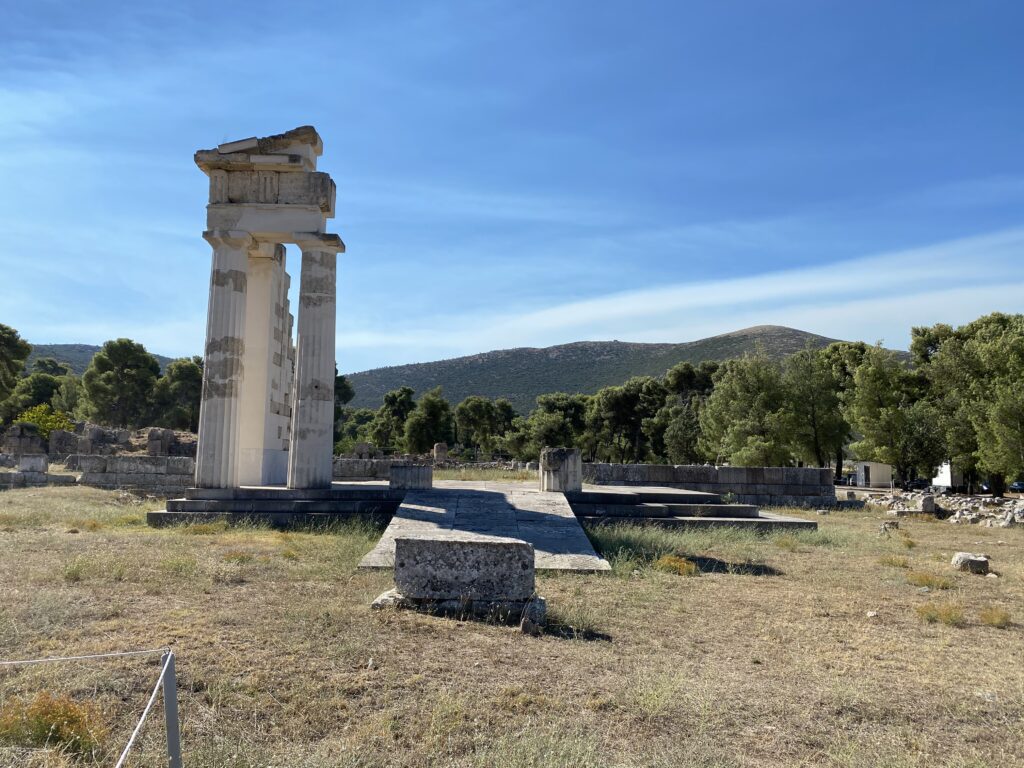
NEW VIDEO TOUR! – The Sanctuary of Asklepios: A Meditative Walk Through the Archaeological Site at Ancient Epidaurus

Greetings History-Lovers!

Today, Eagles and Dragons Publishing is pleased to announce the release of a new video tour on our YouTube and Rumble channels.

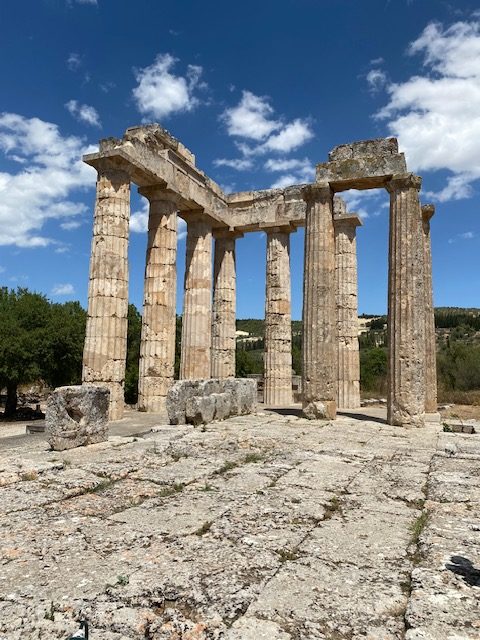
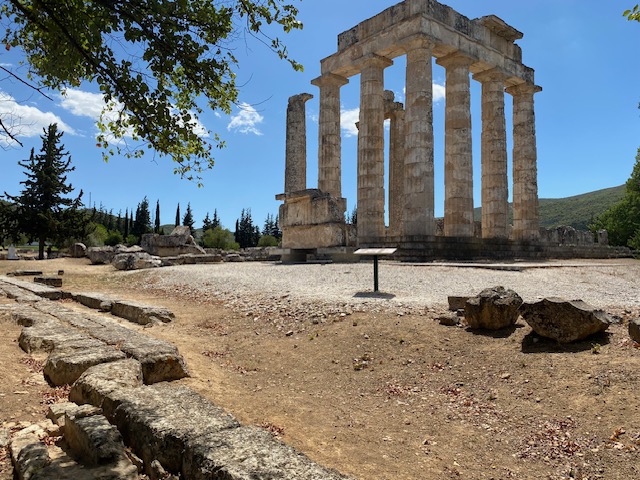
The Sanctuary of Asklepios lies on the Argolid plain, with Mt. Arachnaio and Mr. Titthion to the north. The former was said to have been a home of Zeus and Hera, and the latter, whose gentle slopes lead down to the plain, was said to have been where Asklepios was born.

To the south of the sanctuary is Mt. Kynortion, where there was a shrine to Apollo, Asklepios’ father. Farther to the south are the wooded slopes of Mt. Koryphaia, where the goddess Artemis is said to have wandered. 

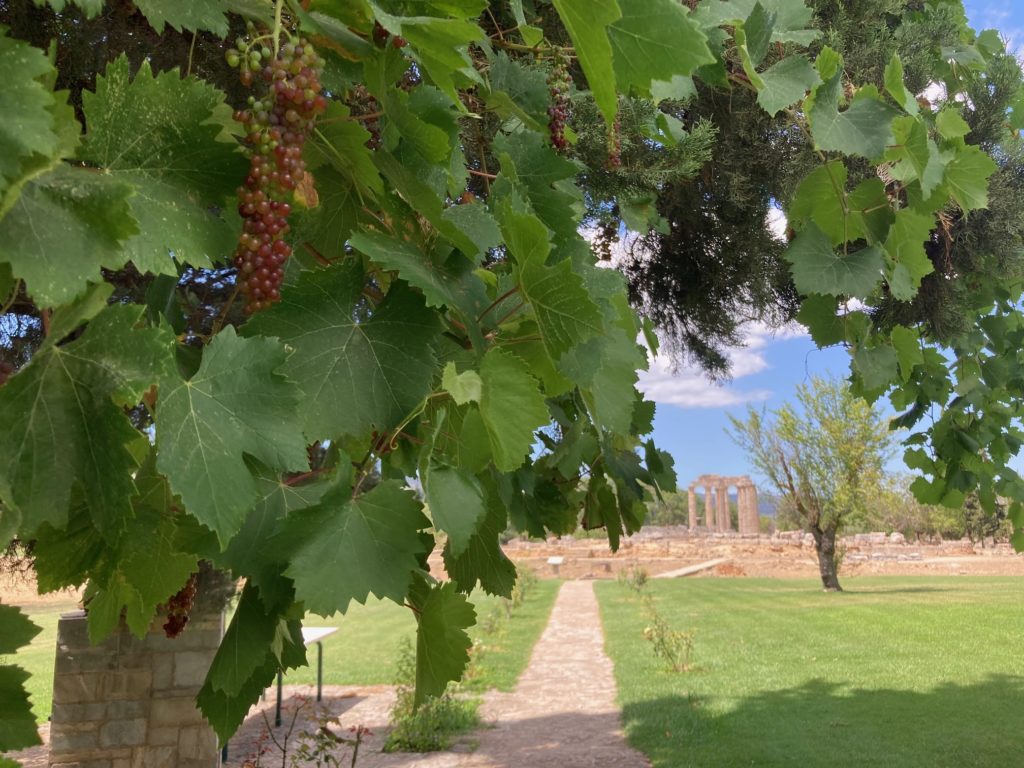
This is a land of myth and legend, a world of peace and healing, green and mild, dotted with springs. The sanctuary was actually called ‘the Sacred Grove’.

Asklepios, as a god of healing, was worshiped at Epidaurus from the 5th century B.C. to the 4th century A.D. According to archaeologists, it was the sick who turned to Asklepios, people who had lost all hope of recovery – the blind, the lame, the paralyzed, the dumb, the wounded, the sterile – all of them wanting a miracle.

We hope you enjoy this calming, meditative journey through the ruins of the Sanctuary of Asklepios at Ancient Epidaurus!

After the video, be sure to check out our popular articles on Ancient Epidaurus at the links below:

The Ancient Theatre of Epidaurus

Epidaurus: Place of Dreams and Healing

Also…

Don’t forget to check out our video tour of the Ancient Theatre of Epidaurus.

Lastly…

If you are planning on visiting Ancient Epidaurus, you can get amazing, discounted deals on tours and tickets with our travel partners at Viator by CLICKING HERE.

*If you love Greek Mythology and Ancient History, then be sure to check out the Eagles and Dragons Publishing AGORA on Etsy at the link below for a wide range of history-related books, gifts, clothing, housewares and more. CLICK HERE to shop now.

More video tours are coming soon, so be sure to SUBSCRIBE on YouTube or Rumble so you don’t miss any.

Thank you for watching!

Facebooktwitterpinterest

The World of An Altar of Indignities – Part VIII – The Panathenaea of Ancient Athens

Greetings Readers and History-Lovers!

Welcome back to The World of An Altar of Indignities, the blog series in which we take a look at some of the research that went into our latest novel set in Ancient Rome and Athens.

If you missed Part VII on Herodes Atticus, you can read that by CLICKING HERE.

In Part VIII, we’re going to be exploring the great event that is at the heart of An Altar of Indignities: the Panathenaic Festival of Ancient Athens.

Not only does this ancient festival provide the backdrop for all of the chaos that ensues in the book, but it is the very reason The Etrurian Players find themselves in the city of the Goddess Athena in the first place.

We hope you enjoy…

Painting of ‘Golden Age’ Athens by Leo von Klenze (1846)

The Panathenaic Festival, or the ‘Panathenaea’, was a religious festival held at Athens in honour of the city’s patron goddess, Athena. It took place from about the twenty-third to the thirtieth day of the Attic month of Hekatombaion, which was mid-July to mid-August. It promoted unity among all Athenians, and eventually among all Greeks.

The Panathenaea was the most important religious festival of ancient Athens. There were annual and quadrennial celebrations of the festival in the form of the ‘Lesser’ and ‘Greater’ Panathenaea.

The ‘Lesser’ Panathenaea was held every year and appears to have been a slimmed-down version of the larger festival, though still a time of great import on the Attic calendar.

The ‘Greater’ Panathenaea – that which takes place in An Altar of Indignities – was held every four years, and included an array of religious ceremonies, athletic competitions, cultural events, poetry and music competitions, and of course the great Panathenaic Procession immortalized on the Parthenon Frieze (the ’Parthenon Marbles’), sculpted under the direction of Phidias.

Recreation of the west pediment statue group of the Parthenon showing the competition for Athens between Athena and Poseidon (Acropolis Museum)

And they that held Athens, the well-built citadel, the land of great-hearted Erechtheus, whom of old Athena, daughter of Zeus, fostered, when the earth, the giver of grain, had borne him; and she made him to dwell in Athens, in her own rich sanctuary, and there the youths of the Athenians, as the years roll on in their courses, seek to win favour with sacrifices of bulls and rams…

(Homer, Iliad, Book II, 549-550)

Before we get into the timeline of events that made up the Greater Panathenaea, let’s discuss what we know about the origins of the festival.

In mythology, it is supposed that the Panathenaea was founded by Erechtheus (continued by his son, Erichthonius), King of Athens, seven hundred and twenty-nine years before the first Olympiad which was held in 776 B.C.E. This first festival may have been called the ‘Athenaea’.

Later, after the sunoikismos under King Theseus of Athens, the amalgamation of the villages of Attica, it became known as the ‘Panathenaea’.

Historically, the Athenian ‘tyrant’, Peisistratos, and the ‘archon’ of the period, Hippoclides, are credited with the reorganization of the Panathenaic Games in 566 B.C.E.

The festival grew to symbolize Athenian unity and cultural excellence. It also became a stage for Athens to assert its influence within the Greek world, as foreign dignitaries and representatives from allied states participated in the festivities. The Panathenaea evolved into a multifaceted event blending religious devotion, athletic competition, musical performance, and civic pride.

It is believed the Panathenaea were held until about 410 C.E.
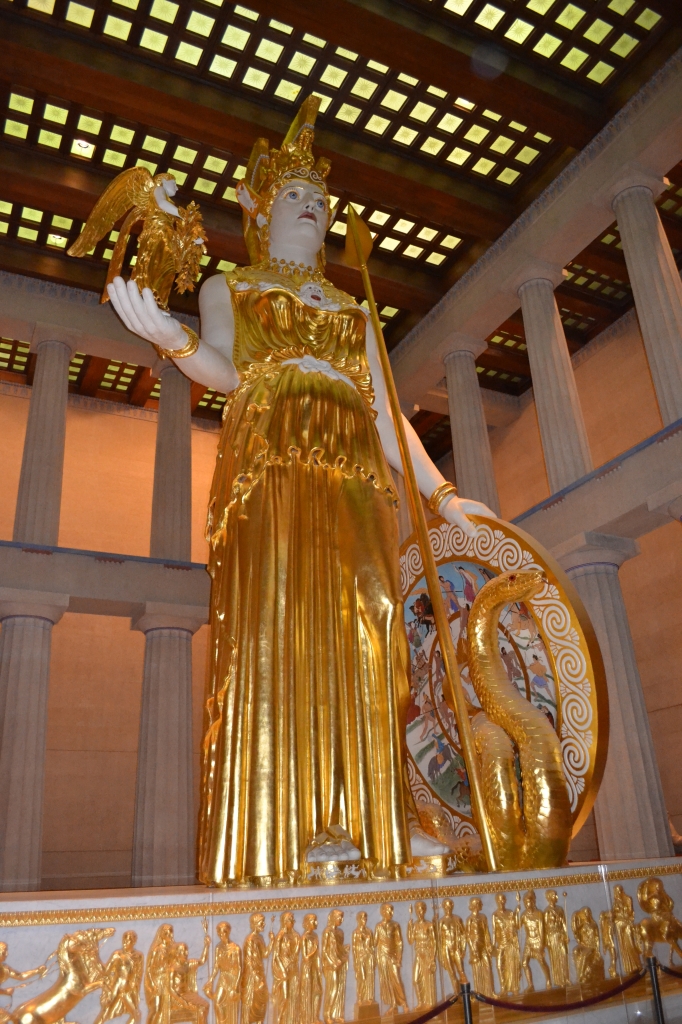
Statue of Athena – Full-sized recreation in the Nashville Parthenon

The Panathenaea was something of a beacon for the Greek world, just as the Goddess Athena was.

For Athenians, the Panathenaea was more than a religious celebration; it was a manifestation of their identity. The festival underscored their devotion to Athena, the goddess who safeguarded their city, and reinforced communal bonds through shared rituals and competitions. It was an occasion for political expression, with the display of Athens’ military and cultural supremacy.

The festival also offered a platform for social stratification. While the elite funded and organized events, the entire populace participated in the procession, showcasing Athenian democracy in action. Moreover, the Panathenaea fostered a sense of pan-Hellenic unity, attracting participants and spectators from across the Greek world.

Phidias Showing the Frieze of the Parthenon to his Friends (1868) by Sir Lawrence Alma-Tadema

The Panathenaic Festival, and especially the Greater Panathenaea, was an enormous and costly undertaking. During the Classical period, Greeks from around the Mediterranean would come to honour the Goddess Athena and to compete in everything from athletic and equestrian events to music and poetry competitions.

And it wasn’t just men who competed. There were also categories for boys, with divisions for paides (12-15 years), ageneioi (16-20 years), and andres (men over 20).

From inscriptions on artifacts, we know that there were prizes for winners, second place runners-up, and even others down the line, depending on the event. For musical contests, for example, a golden crown and money (valued around 1500 drachmae) was given to the winner, but also up to sixty amphorae filled with valuable Attic olive oil in red and black ware Panathenaic vases. Second place winners could receive a smaller sum of money, plus six amphorae of oil.

Some events were more richly-rewarded too. For example, the winner in the chariot race received money and one hundred and forty Panathenaic amphorae of olive oil! Another inscription indicates that a winner in the athletic races, however, could receive 1450 amphorae of olive oil and 2700 drachmae!

These amounts would likely have varied over time, but it is clear that victors could suddenly find themselves quite wealthy.

Panathenaic amphora depicting the Goddess Athena

But what was the Panathenaea actually like? Was there an order to the events?

Despite the perhaps chaotic atmosphere in the city, and the excitement that no doubt pulsed through participants and attendees, the Panathenaea appears to have been highly organized and reverent, as befitted the goddess whom the festival honoured.

Let’s take a brief look at the eight days of events during the Greater Panathenaea…
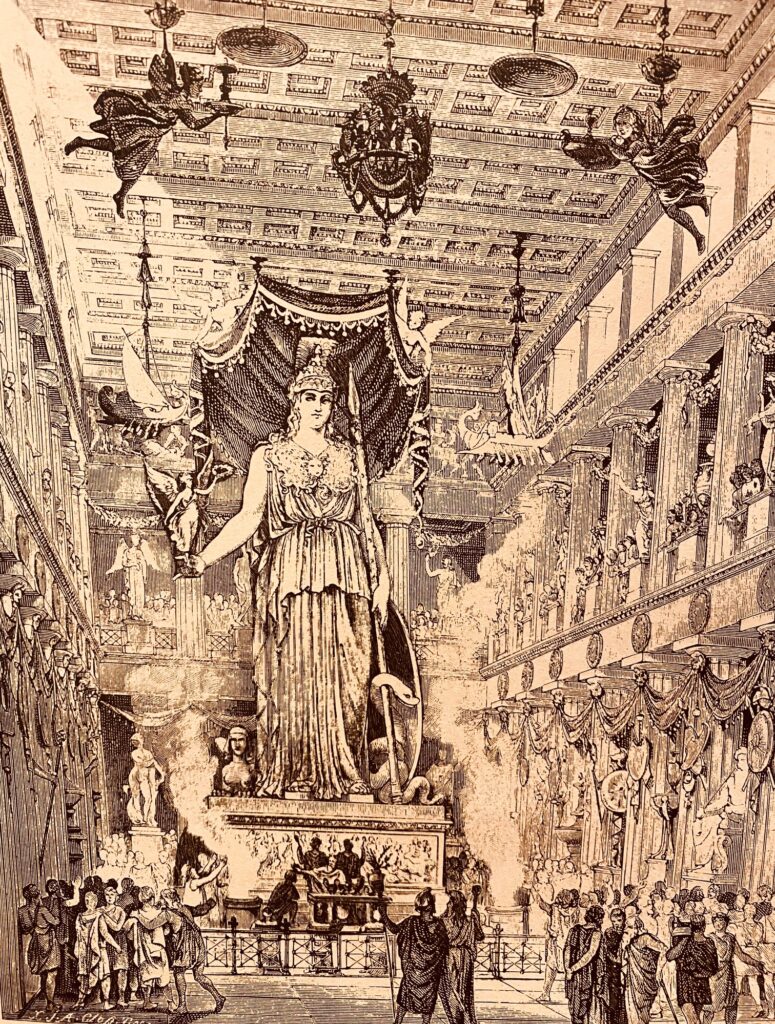
Artist impression of what the interior of the Parthenon might have looked like during the Panathenaea

There can be little doubt that, as this was primarily a religious festival, every day would have included offerings and sacrifices to the gods, and especially to Athena, whom the festival honoured.

Day one of the festival was reserved for the musical and rhapsodic contests, and these were reserved only for the Greater Panathenaea.

Musical contests were instrumental and would have included musicians playing the aulus, which was a single or double reed pipe, and the cithara, which was sort of stringed lyre. In addition to contests for playing these instruments, there were also competitions of citharody, which was singing to the aulus and cithara.

The rhapsodic contest, introduced to the festival by Peisistratos, consisted of dramatic recitations of Homeric poetry from the Iliad and Odyssey. There were also poetry competitions with readings of Homer, Pindar, and Hesiod.

These contests were most often held in the odeon built by Pericles, which was beside the theatre of Dionysus, on the southern slopes of the Acropolis.

Ancient depiction of a musician playing the aulos

Day two of the festival was reserved for the athletic competitions for boys and youths, and these would have been held in the Panathenaic stadium which was located on the other side of the Ilissos river, between the hills of Ardittos and Agras.

Day three consisted of the athletic contests for men over twenty years of age. These would also have taken place in the stadium.

Some of the events that made up the athletic contests included the stade race, the pentathlon, wrestling, boxing and pankration.
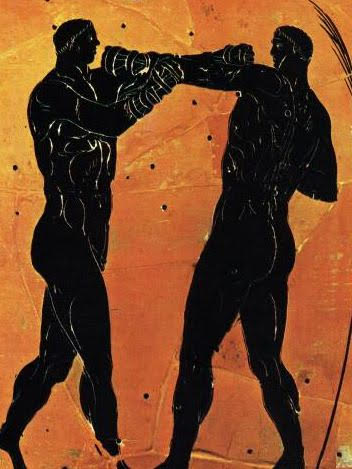
Vase depicting Ancient Greek boxers

On day four, the highly popular equestrian events took place, and these would have included four-horse (tethrippon) and two-horse (synoris) chariot races, as well as horseback riding races, javelin throwing from horseback, and the apobates races which involved athletes jumping in and out of moving chariots at high speed. The latter is believed to be the oldest equestrian event, tradition assigning its introduction to Erechtheus.

The equestrian events would have taken place in the Panathenaic stadium and in the hippodrome to the south of the city.

The equestrian events highlighted the wealth and prestige of the participants, as owning and training horses was a costly endeavour. However, amateurs were also encouraged to participate, and their prizes are thought to have been the highest, the thinking being that they would then put the funds into horse breeding afterward.

Panathenaic amphora depicting a synoris, or two-horse chariot

Day five was when the tribal contests took place.

The first of the tribal contests was the Euandria, a procession in which leaders from tribes of Athens chose twenty-four (same number as in a theatrical chorus) of the tallest and best-looking of their tribe, and arrayed them in colourful, festive garments. They competed with the same number from an opposing tribe. This appears to have been a sort of ancient ‘manliness’ contest that emphasized qualities like physical fitness, strength, and overall excellence, things that were prized by Ancient Greek society, and closely tied to notions of citizenship and civic pride in Classical Athens.

The other tribal event was the Pyrrhic Dance. This was a sort of war dance performed again by twenty-four men from each of the tribes. It was a martial dance that symbolized readiness for battle and which was closely associated with military training, patriotism, and the worship of Athena, Goddess of War and Wisdom. The dancers wore armour, including helmets and shields, and they may also have carried swords or spears. It would have required strength, agility, and coordination, all attributes of a skilled warrior.

The Pyrrhic Dance – painting by Lawrence Talma-Tadema

On the night before the sixth day of the Panathenaea, a sacred event known as the ‘Pannychis’ took place on the Acropolis of Athens. This involved a night of songs, offerings, prayers and thanksgivings by the high-ranking priestesses who expressed joy for the birth of the Goddess Athena. Younger priestesses also danced in honour of the goddess, and toward the morning, choruses of youths and men sang songs to honour Athena.

The night of the Pannychis led into the most important and sacred day of the Panathenaea, on the 28th day of Hekatombaion. This was the day of the Panathenaic Procession, the hecatomb sacrifices at the great altar of Athena on the Acropolis, and subsequent distribution of meat to the people. There may also have been a torch race on this day.

The central event of the Panathenaea, however, was the procession which was immortalized on the Parthenon frieze on what is now known as the ‘Parthenon Marbles’.

Horsemen of the Panathenaic Procession, from The Parthenon Frieze

This was a massive event with many Athenians and non-Athenians involved. There were priestesses and priests, past and present victors in the games (athletic and artistic), as well as magistrates and other officials. There were Athenian women, and young girls who danced, and others who led sacrificial animals that had been adorned with garlands and gold-tipped horns for the goddess. There were young boys, and elders carrying sacred olive branches, military officers, soldiers and musicians and representatives of the various demes of Athens. And then there were the horsemen of the Panathenaea who are so magnificently represented on the Parthenon frieze.

The procession was not only a great show of worship for the Goddess Athena, but it was also an event in which Athenians showed their civic pride and military might.

The Peplos scene from the Parthenon Frieze

The centrepiece of the Panathenaic procession was the peplos of the goddess. This was an enormous, beautiful garment woven and embroidered for the goddess’ statue by the ergastinai, the sacred weavers, who were accompanied by priestesses. This sacred peplos of the goddess was suspended like a sail from the mast of a massive ship that supposedly moved through the streets by way of some ingenious mechanism that made it appear to sail on land. This Panathenaic ship may normally have been kept on a platform on the Hill of Agras beside the Panathenaic Stadium when not in use.

The sacred weavers, or ergastinai, from the Peplos scene of The Parthenon Frieze

The organization of the Greater Panathenaic procession was, no doubt, a massive task, and organizing all of the people and animals involved would have required a lot of planning. Gathering all of them for the start of the procession would have required a large space. The marshalling of everyone involved in the procession happened just inside the great Dipylon Gate of the city, at the Keramikos, the location of the potters’ district and cemetery, near where the River Eridanos entered the city.
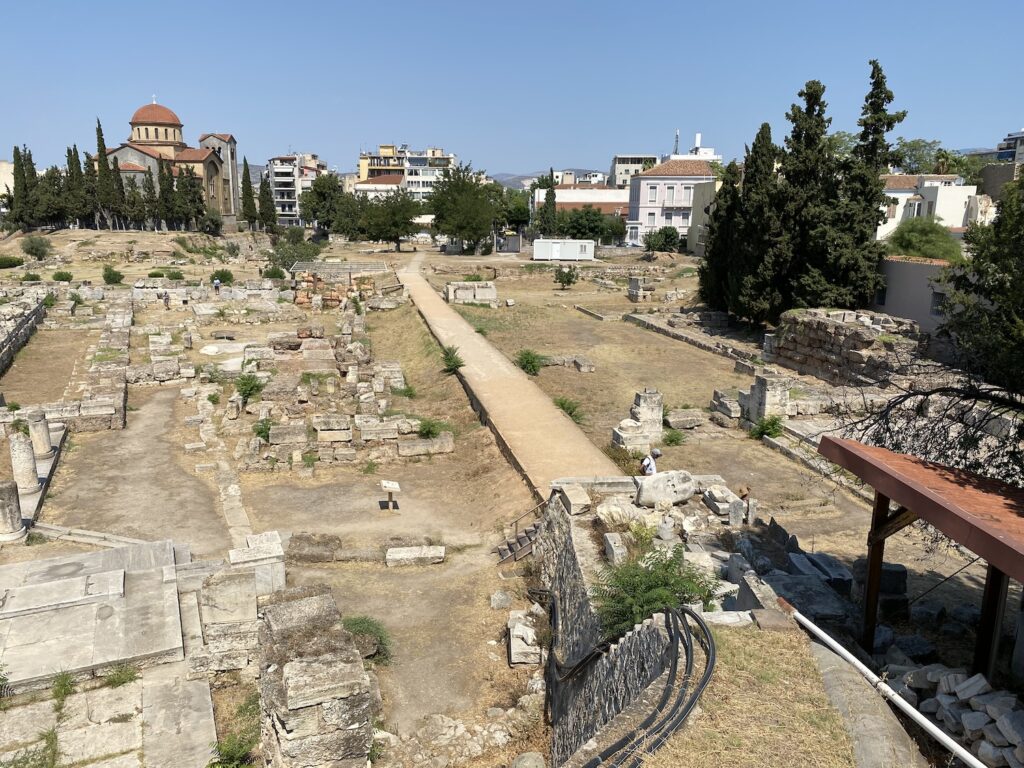
The Dipylon Gate and Keramikos – marshalling area for the Panathenaic Procession

Once everyone was had marshalled for the procession in the early morning hours, they were arranged in a specific order and processed along the Panathenaic Way, from the Dipylon Gate, through the ancient agora and up to the staircase that led to the great propylaea onto the Acropolis itself. Along the way, offerings were made at altars to the gods, including Athena Hygiaea.

When the procession arrived on the Acropolis and the sacred peplos was offered to the goddess, it would have been time for the sacrifices. This involved the sacrifice of a hundred oxen – what is known as a hecatomb – at the great altar of Athena located on the Acropolis between the Parthenon and the Erechtheum.

The sacrificial oxen in the Panathenaic Procession – from The Parthenon Frieze

One can imagine the sacrifices, including the butchering, took the better part of the sixth day of the Panathenaea. During this time, the meat was apportioned out to each deme of the city to be distributed to the people.

On the seventh day of the Panathenaea, there were boat races that took place at Piraeus, the port of Athens. These were in honour of Poseidon and Athena who had both competed for patronage of that proud city. As Athens was a mighty sea power, this event also played an important part in displaying the city’s military might.

Finally, on the eighth day of the Greater Panathenaic Games, the prizes were given to the winners and runners-up from all competitions, making some of them very wealthy and famous as a result. There were then feasts and celebrations into the night.
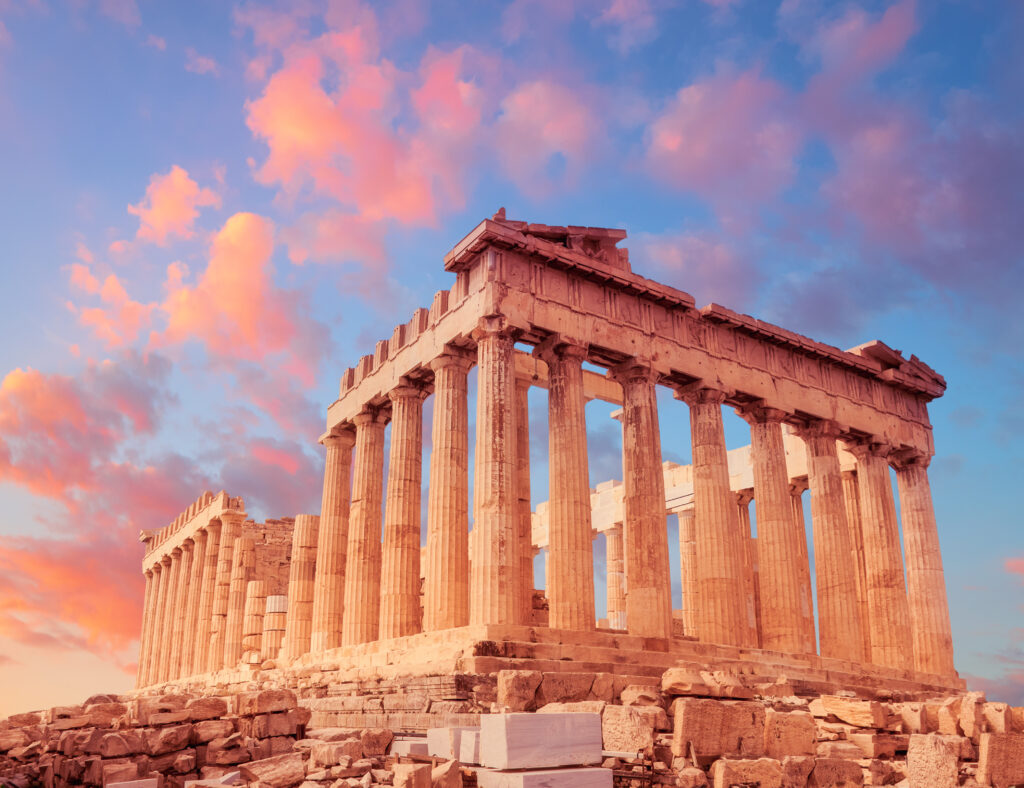
Parthenon temple on a sunset with pink and purple clouds. Acropolis in Athens, Greece

One can imagine the excitement that gripped the city during the Panathenaea. Civic pride would have been at an all-time high, the city sparkling and adorned in honour of Athena. Greeks from across the Greek world would have come to Athens for the event, to watch, to compete, to trade, and to pay their respects to the goddess.

We have had but a brief look at the Panathenaea in this article, but in An Altar of Indignities, we get to experience the excitement and grandeur of the Panathenaea like never before, and the reader gets fully immersed in the central event, the Panathanaic Procession, along with all of its participants.

And how does an Etrurian theatre troupe fit in to this majestic festival of Ancient Athens?

You’ll have to dive into the book to find out!

Thank you for reading.
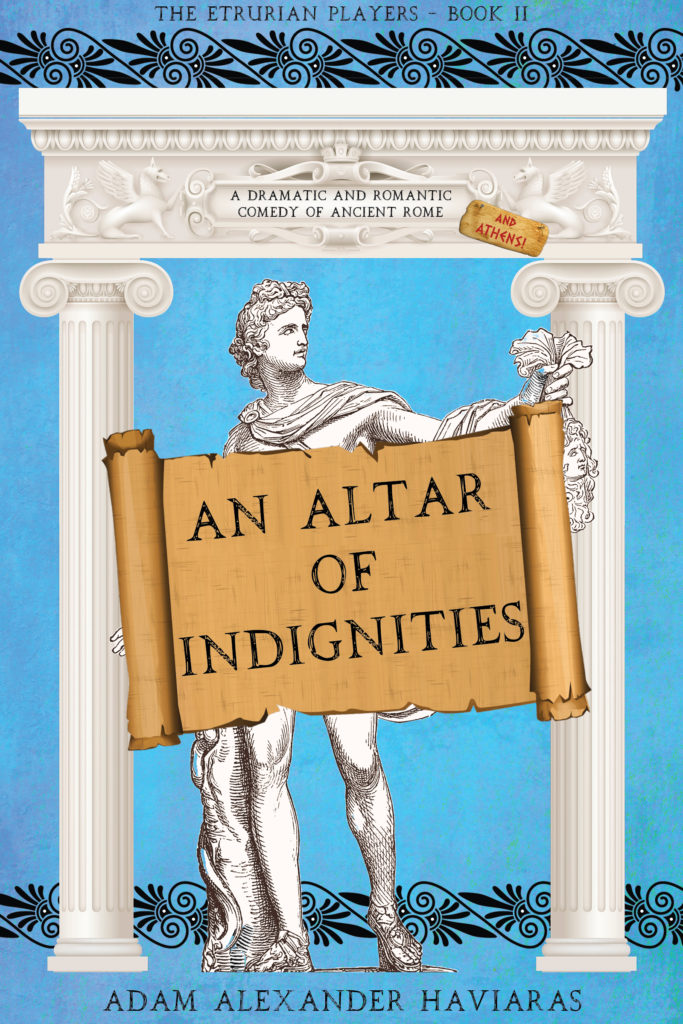
An Altar of Indignities: A Dramatic and Romantic Comedy of Ancient Rome and Athens is now available in hardcover, paperback, and ebook editions from all major online retailers, independent bookstores, brick and mortar chains, and your local public library.

CLICK HERE to buy a copy and get ISBN#s information for the edition of your choice.

Facebooktwitterpinterest

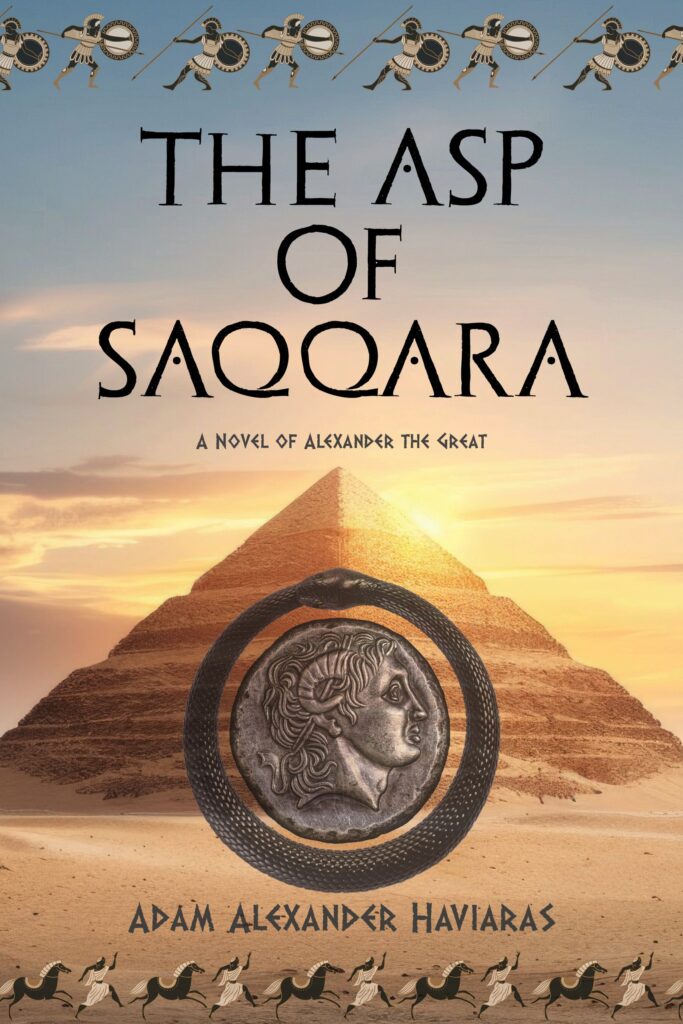
New Release! – The Asp of Saqqara: A Novel of Alexander the Great

Greetings Readers and History-Lovers!

Today, Eagles and Dragons Publishing is thrilled to announce the launch of an all new title and series set during one of the most exciting periods in ancient history: the campaigns of Alexander the Great.

This book is unlike any other work that we’ve previously released. It’s the first book that Adam has written from a first person perspective, and it is in the form of a fictional memoir that gives readers an intimate look at one of the most epic journeys in history.

We are proud to announce the launch of The Asp of Saqqara: A Novel of Alexander the Great, Book I in the ‘Killing a God’ series.

It is the story of an assassin, the son of a god, and an epic journey into the unknown…

Would you kill a god to save your family?

On the fringes of the great necropolis of Saqqara, Hanbal, son of Akil, has always lived a life of peace and plenty on his family’s horse farm. That is, until the hordes of King Darius’ Persian army arrive and the people of Egypt find themselves persecuted and enslaved, and their ancient gods disrespected.

When Hanbal’s family and fortune are destroyed by the invaders, he takes up the mantle of an assassin, one who fights from the shadows for the people of Egypt.

Then, one day, hope springs out of the west at the coming of Alexander of Macedon and his army. The land of Egypt is liberated and the people welcome their new pharaoh with open arms.

That hope, however, turns to bitter disappointment for Hanbal the day that two Athenian spies appear at his door with an ultimatum…

He must kill Alexander of Macedon or else lose his wife and children to pain and death.

Can Hanbal save his family? Can he bring himself to kill the king who has liberated his homeland? Or will he be swept away in a river of blood to the ends of the Earth?

Only the Gods know…

We are thrilled to release this latest novel, and we hope that you all enjoy it!

The Asp of Saqqara is now available in ebook, paperback, and deluxe hardcover editions from all major online retailers, independent bookstores, brick and mortar chains, and your local public library.

It is available for a limited time for the special launch price of 1.99!

CLICK HERE to buy a copy, get ISBN# information for the edition of your choice, and check out all new merchandise related to this epic new release!

You can also purchase the ebook directly from Eagles and Dragons Publishing by clicking HERE.

We’re so excited to share this exciting new adventure in the ancient world with you!

Thank you for reading!

Facebooktwitterpinterest

The World of An Altar of Indignities – Part VI – The Hill of Ardittos and the Temple of Artemis Agrotera

Happy New Year, and welcome back to The World of An Altar of Indignities, the blog series in which we look at some of the research that went into our latest novel set in the Roman Empire.

If you missed Part V on the Roman Agora of Athens, you can read that by CLICKING HERE.

In Part VI, we’re going to be exploring two ancient sites that are not really known to the average tourist but which were important in the world of ancient Athens: the Hill of Ardittos, and the Temple of Artemis Agrotera.

We hope you find it interesting…

In deciding to set An Altar of Indignities in Athens, I came to discover a history of the neighbourhood of Pangrati which I had not been aware of. Our family home is located in Pangrati, where I had been coming for over twenty-five years, and yet it was the research for this dramatic and romantic comedy of ancient Rome and Athens that helped me to truly discover its ancient past.

Pangrati is located on the lower slopes of Mount Hymettos, just the other side of the sacred Ilissos river which now runs from the shadow of the Temple of Olympian Zeus and then curves around beneath the modern streets of Ardittou and Vasileos Konstantinou. It is a neighbourhood of local families who have inhabited it for generations, and who now share their streets with artists and immigrants. The streets are lined with apartment blocks where people and drying laundry hang over the edges of run-down balconies watching the world go by and listening to the chorus coming from the weekly farmer’s markets, or laiki as they are called.

To me, however, beneath the grubby veneer of graffiti, trash, and construction dust, I can now see the rich and wondrous history of this ancient neighbourhood. And I don’t mean the beautiful curves of the massive Panathenaic stadium at Pangrati’s edge, first built by Lycurgus in 339 B.C.E, which we mentioned in Part III of this blog series.

Rather, I mean the mysterious hills of Agras and Ardittos that flank the stadium in the Ilissos river valley, particularly, the Hill of Ardittos, and the Temple of Artemis Agrotera beside it.

These are the two sites we will focus on.

The Panathenaic Stadium at the edge of Pangrati, with the Hill of Ardittos on the right

The hill of Ardittos in Athens lies directly beside the Panathenaic Stadium, to your right as you stand before the ancient athletic monument, between Archimidous and Arditou streets. It is about two-hundred and thirty-five meters high and can only really be accessed from behind the stadium at the entrance on Archimidous street.

The Hill of Ardittos is a small green oasis in the middle of the chaotic city, and it is often overlooked, despite its guarded stance beside the Panathenaic Stadium. Its pathways and slopes are dotted with massive agave plants and eucalyptus, cacti, pine, olive, almond, cypress and carob trees where crows – the birds of Apollo – keep a watchful eye.

Admittedly, I had walked by the hill many times over the years, simply noting its ancient slopes, the gnarled vegetation and the rocks protruding from beneath the soil. To be sure, the fence around it dissuaded me before, even as I walked by the hill on my way to the Temple of Olympian Zeus and the neighbourhood around the Acropolis, the Plaka.

Ardittos is a community park where locals jog, walk their dogs, workout, make-out, sneak a peek of paid events in the stadium, or just hold to a little peace at the heart of the city.

If you can find your way there through the steep and winding roads and pathways of Pangrati, you are rewarded with magnificent views of the stadium, the Acropolis, and the Olympeion, the Temple of Olympian Zeus.

View of the Acropolis from the Hill of Ardittos (photo source: ekathimerini.com – Irene Anastasiadis)

Apparently, Ardittos was named after a hero of ancient Athens named, Arditis. In ancient times, there were several sanctuaries in the vicinity, along the shores of the Ilissos, including sanctuaries of the Nine Muses, Pan, and Herakles.

But the Hill of Ardittos itself was also a religious and legal centre. It is believed that there were temples to Pan, Hecate, and Hera on or near the hill, but the remains that are visible today are thought to belong to the Temple of Tyche, the Goddess of Luck, who was a daughter of the Titans, Oceanus and Tethys.

Remains of the Temple of Tyche on the Hill of Ardittos (Wikimedia Commons)

Archaeologists and historians believe it possible that the Temple of Tyche on Ardittos was the site of offerings to Demeter and Persephone during the lesser Eleusinian Mysteries when piglets were offered, purified in the Ilissos River beforehand. There were also rites carried out here in honour of Dionysos during the festival of the Anthesteria.

There is no doubt that the Hill of Ardittos holds many mysteries, including a tradition that Herodes Atticus, that great Greco-Roman patron of the city, may even have been buried on it.

As I walk around Pangrati, a part of me doesn’t see the broken marble sidewalks or the apartment buildings that jut up to provide shade from the hot Athenian sun. Rather, I imagine and see the wooded lower slopes of Hymettos thick with pine and cypress, bees flitting about wild thyme, and boar crashing through the scrub while ancient Athenians made their offerings, or herded their goats and sheep on the mountainside.

It must have been beautiful and calm.

Artemis – The Huntress

According to legend, it was not only the Athenians who roamed the wooded slopes of Ardittos, Agras, and Hymettos.

This was also said to be the domain of Artemis Agrotera, the Huntress.

Just the other side of the Hill of Ardittos, there is another site that provides one of the settings for An Altar of Indignities, and that is the Temple of Artemis Agrotera.

Pausanias described the setting in the second century C.E:

The rivers that flow through Athenian territory are the Ilissos and its tributary the Eridanus, whose name is the same as that of the Celtic river. This Ilissos is the river by which Oreithyia was playing when, according to the story, she was carried off by the North Wind. With Oreithyia he lived in wedlock, and because of the tie between him and the Athenians he helped them by destroying most of the foreigners’ warships. The Athenians hold that the Ilissos is sacred to other deities as well, and on its bank is an altar of the Ilissian Muses. The place too is pointed out where the Peloponnesians killed Codrus, son of Melanthus and king of Athens.

Across the Ilissos is a district called Agrae and there is a temple of Artemis Agrotera (the Huntress). They say that Artemis first hunted here when she came from Delos, and for this reason the statue carries a bow. A marvel to the eyes, though not so impressive to hear of, is a race-course of white marble, the size of which can best be estimated from the fact that beginning in a crescent on the heights above the Ilissos it descends in two straight lines to the river bank. This was built by Herodes [Herodes Atticus], an Athenian, and the greater part of the Pentelic quarry was exhausted in its construction.

(Pausanias; Description of Greece, 1.19)

Antiquarian plate of facade of the Temple of Artemis Agrotera (by Stuart and Revett)

When we went in search of the Temple of Artemis Agrotera, it was on a hot Athenian morning when the temperature had already reached a blistering 45 degrees Celsius. Our path took us down the hill from Pangrati to the back of the Panathenaic Stadium, along Archimidous street, and then past the entrance to the Hill of Ardittos. We sweat our way up and down the steep side streets of the ancient district of Agrae until, arriving at Ardittou street, we found a lot where no apartment blocks stood.

We had arrived at the site of the Temple of Artemis Agrotera to find this:

Modern site of the Temple of Artemis Agrotera wit the Acropolis in the background

It was indeed a shock to behold this, but before we go any further, here is bit of history of the once-graceful temple that stood on this site…

The Temple of Artemis Agrotera was built between 435-430 B.C.E above the left or southern bank of the Ilissos river. But the temple was not only built here because this wood was thought to be the goddess’ first hunting ground.

Apparently, before the great Battle of Marathon in 490 B.C.E, when the Athenians crushed a more numerous invading Persian force, the Athenians made a vow to Artemis Agrotera – they were going on the hunt, after all! – that a goat would be sacrificed to her for every enemy killed in battle. The Athenians slew 6,400 Persian invaders.

Needless to say, the Athenians could not find enough goats to fulfill their vow to the goddess, but 500 goats were offered every year on the anniversary of the battle in early September.

For when the Persians and their followers came with a vast array to blot Athens out of existence, the Athenians dared, unaided, to withstand them, and won the victory. And while they had vowed to Artemis that for every man they might slay of the enemy they would sacrifice a goat to the goddess, they were unable to find goats enough; so they resolved to offer five hundred every year, and this sacrifice they are paying even to this day. 

(Xenophon, Anabasis, 3.2)

Antiquarian plate of the plan of the Temple of Artemis Agrotera (by Stuart and Revett)

The temple to honour Artemis Agrotera, who had helped the Athenians, was built some years later by Callicrates, who also designed the Temple of Athena Nike on the Acropolis, and for which it provided the precedent.

There were no precise, ancient descriptions of the temple of Artemis Agrotera. Thankfully, in the 1750s, two curious architects by the names of James Stuart and Nicholas Revett, went in search of the temple and recorded the details of what they saw, sketching what they could. Thanks to them, we know what the temple looked like.

Antiquarian plate of Temple of Artemis Agrotera architectural details (by Stuart and Revett)

On the southern bank of the Ilissos… stands a little Ionic temple, the mouldings of which differ much from all the examples of that order, hitherto published; their forms are extremely simple, but withal so elegant, and the whole is so well executed, that it may doubtless be reckoned among those works of antiquity which best deserve our attention.

(Stuart and Revett, The Antiquities of Athens, Volume l, 1762, Chapter 2, Page 7)

From Revett and Stuart’s records, it was a simple temple with four Ionic columns on the front porch, or tetrastyle, as well as four at the back. It had a deep pronaos, and a square cella, or inner sanctum, something that is thought to be unique to this temple. There was also a continuous frieze about the temple, fragments of which are now in the Staatliche Museum in Berlin.

There was also a temple precinct created by a low retaining wall, remains of which, along with parts of the temple foundations, are visible on-site today.

As happened with many ancient temples, the Temple of Artemis Agrotera was converted into a Christian basilica in the 5th century C.E. Sadly, it was later destroyed for building materials by the Ottomans when they occupied Athens.

Gouache painting of the Temple of Artemis Agrotera’s ruins (by Stuart)

As you stand on the site today, it is difficult to imagine the temple as it once was, on the edge of the wood, offerings crowding its altars, inside and out. Where the sacred Ilissos once flowed, sparkling in the Athenian sun, cars and mopeds now shake the ground. But you can still stand at the edge of the ancient wall of the temple precinct and gaze across the modern layer of the city to see the Temple of Olympian Zeus with the soaring beacon of the Acropolis beyond. What a site it must have been!

3D recreation of the Temple of Artemis Agrotera with the Temple of Olympian Zeus and the Acropolis in the background (Dimitris Tsalkanis & Chrysanthos Kanellopoulos – www.AncientAthens3d.com)

When you are finished reading this article, be sure to watch our video tour of this archaeological site!

In researching and writing An Altar of Indignities, I came to discover the Hill of Ardittos and the Temple of Artemis Agrotera, and their importance in the mythology and history of the landscape of ancient Athens. Both became settings in the book and the story is the richer for it.

When I make my way around Athens today, I don’t follow the names of streets, but rather use the city’s ancient sites as my markers to guide me to where I want to go. Now, in addition to the stadium, I also have the Hill of Ardittos and the Temple of Artemis Agrotera to guide me on my way.

Thank you for reading.

An Altar of Indignities is now available in ebook, paperback and deluxe hardcover edition from all major online retailers, independent bookstores, brick and mortal chains, and your local public library.

CLICK HERE to buy a copy and get ISBN#s information for the edition of your choice.


Facebooktwitterpinterest

New Video Tour! – The Temple of Artemis Agrotera

Greetings History-Lovers and Hellenophiles!

Eagles and Dragons Publishing is proud to present a new video tour on our YouTube and Rumble pages.

The Temple of Artemis Agrotera was a small Ionic temple that once sat on the hill the other side of the sacred Ilissos river

This is a site that most visitors to Athens never see, and also one which many locals don’t even know about. It is also one of the settings in An Altar of Indignities, Book II in our award-winning series, The Etrurian Players.

This beautiful temple on the lower slopes of Hymettos, beside the Hill of Ardittos, was built by the Athenians between c.435-430 B.C.E. in honour of the Goddess Artemis Agrotera (Artemis the Huntress) in thanks for their mighty victory at the battle of Marathon years before, in 490 B.C.E.

For when the Persians and their followers came with a vast array to blot Athens out of existence, the Athenians dared, unaided, to withstand them, and won the victory. And while they had vowed to Artemis that for every man they might slay of the enemy they would sacrifice a goat to the goddess, they were unable to find goats enough; so they resolved to offer five hundred every year, and this sacrifice they are paying even to this day.

(Xenophon, Anabasis, 3.2)

This temple was of the same order and style as the Temple of Athena Nike on the Acropolis of Athens for both of them were designed and built by the architect, Callicrates.

It occupied a prominent position on the other side of the Ilissos river as Plutarch relayed in the first century C.E…

Across the Ilisos is a district called Agrae and a temple of Artemis Agrotera the Huntress). They say that Artemis first hunted here when she came from Delos, and for this reason the statue carries a bow. A marvel to the eyes, though not so impressive to hear of, is a race-course of white marble, the size of which can best be estimated from the fact that beginning in a crescent on the heights above the Ilisos it descends in two straight lines to the river bank. This was built by Herodes, an Athenian, and the greater part of the Pentelic quarry was exhausted in its construction.

(Plutarch, Description of Greece, 1.19)

In the 5th century C.E. the temple was converted into a Christian basilica. Centuries later, it was destroyed by the Turkish invaders for building materials.

Today, on the edge of the neighbourhood of Pangrati, the temple remains are scant and in sad disrepair, but they still have an echo of Athens’ ancient and sacred past.

Now, without further ado, join us on a short tour of the archaeological site of the Temple of Artemis Agrotera.

*Eagles and Dragons Publishing would like to thank Dimitris Tsalkanis & Chrysanthos Kanellopoulos of Ancient Athens 3D for permitting the use of their amazing 3D renderings of this beautiful temple for the video. Visit their website at: www.AncientAthens3d.com

Facebooktwitterpinterest

New ‘Special Edition’ Hardcover Release for the Holidays!

Salvete Readers and Romanophiles!

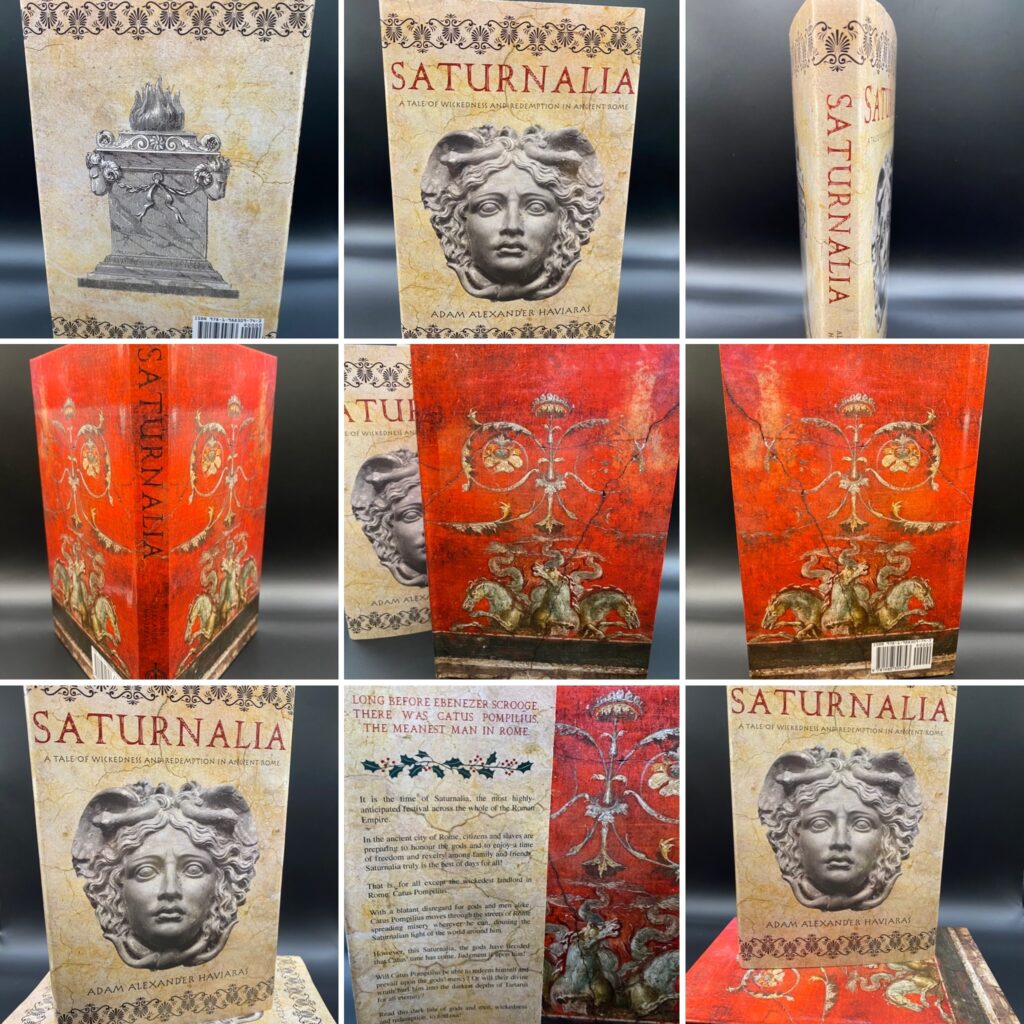
Eagles and Dragons Publishing is thrilled to announce the release of a new, ‘Special Edition’ hardcover of our Roman holiday, fan-favourite, Saturnalia: A Tale of Wickedness and Redemption in Ancient Rome!

This new edition is the perfect gift for the history-lover and fan of Ancient Rome on your list!

It features a beautiful dust jacket with a Gorgon head and acanthus borders on an ancient, Roman plaster background. Underneath the jacket, the hardcover case features a stunning, red fresco from the ruins of Pompeii, giving the book an added feel of antiquity for the holidays.

If you’re looking for a wonderful book for the history lover your life, this is it!

The Saturnalia, Special Edition Hardcover (as well as the ebook, audiobook, and paperback editions) is available from all major bookstore chains, independent shops, and all major on-line stores. Get the ISBN# for the edition of your choice by CLICKING HERE.

Order yours now so that you get it in time for the holidays!

Step into the world of Saturnalia for a Roman Holiday you will never forget!

*PLEASE NOTE: if you are shopping on Amazon, the cover images for the new Special Edition Hardcover are not showing. However, if you order the hardcover, the images above show you what it is like. It’s absolutely beautiful!

Facebooktwitterpinterest

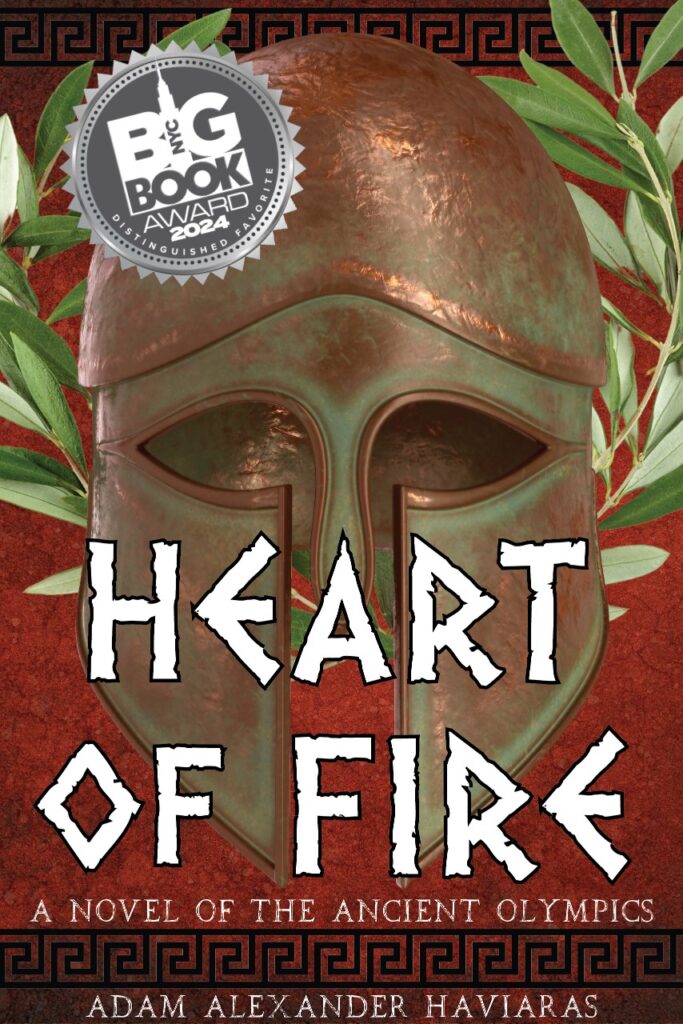
Press Release – Heart of Fire is Victorious in NYC!

Adam Alexander Haviaras receives international recognition

 through the

 NYC BIG BOOK AWARD®!

Stratford, Ontario, Canada — The NYC Big Book Award recognized Heart of Fire: A Novel of the Ancient Olympics in the category of Historical Fiction as a ‘Distinguished Favourite’.

The competition is judged by experts from different aspects of the book industry, including publishers, writers, editors, designers, booksellers, librarians and professional copywriters. Winners are based on overall excellence.

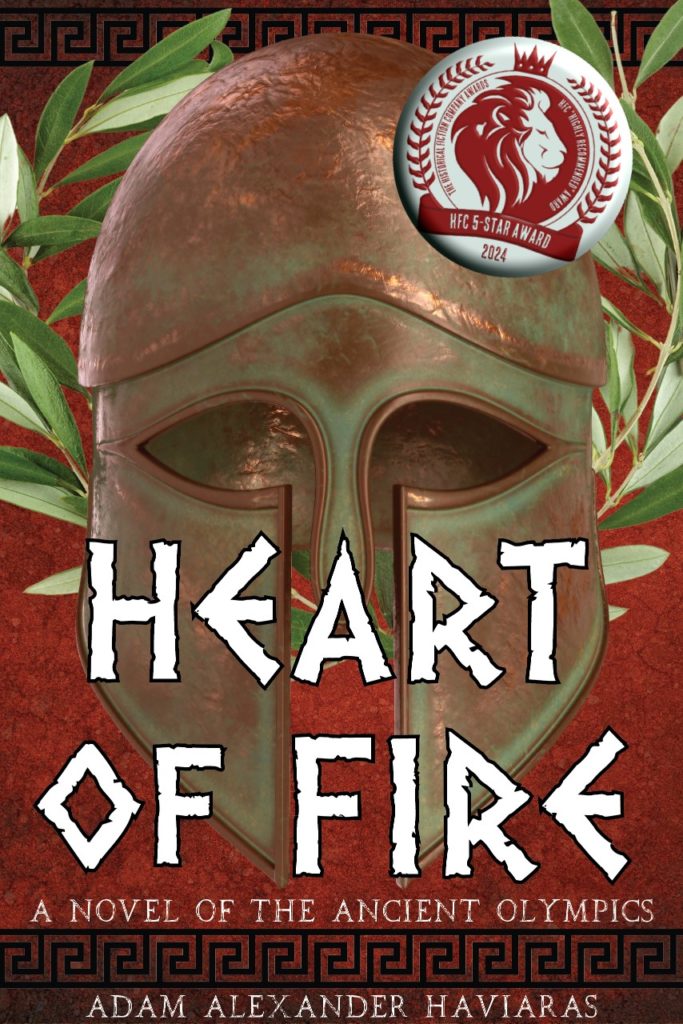
Heart of Fire: A Novel of the Ancient Olympics

A Mercenary… A Spartan Princess… And Olympic Glory…

When Stefanos, an Argive mercenary, returns home from the wars raging across the Greek world, his life’s path is changed by his dying father’s last wish – that he win in the Olympic Games.

As Stefanos sets out on a road to redemption to atone for the life of violence he has led, his life is turned upside down by Kyniska, a Spartan princess destined to make Olympic history.

In a world of prejudice and hate, can the two lovers from enemy city-states gain the Gods’ favour and claim Olympic immortality? Or are they destined for humiliation and defeat?

Remember… There can be no victory without sacrifice.

The NYC Big Book Award received book submissions worldwide. Journalists, well established authors, small and large press, and first time indie authors participated in record numbers.  Entries this year were received from the United States as well as countries such as Australia, Canada, China, Cyprus, France, Germany, India, Ireland, Israel, Italy, Mexico, New Zealand, Scotland, Singapore, Sweden, Switzerland, Taiwan, and the United Kingdom.  Cities represented included Asheville, Beijing, Colorado Springs, Dublin, Hong Kong, Los Angeles, Melbourne, New York, Portland, San Francisco, Singapore, Tel Aviv, and Vancouver were among the entries.

Publishers included Atmosphere Press, Berrett-Koehler Publishers, Beaufort Books, Beyond Words Publishing, Blackstone Publishing, Eagles and Dragons Publishing, Familius Publishing, Flatiron Books, Hachette Go, HarperCollins Leadership, Oceanview Publishing, Old Stone Press, Rowman & Littlefield, Simon & Schuster, Ulysses Press, Watkins Publishing, Westminster John Knox Press to name a few.

“We were delighted to see so many quality publishers and authors from around the world participate this year. I can’t wait to share these books with a global readership,” said awards sponsor Gabrielle Olczak.

To view the list of NYC Big Book winners and distinguished favourites, please visit: https://www.nycbigbookaward.com/

End of Press Release

Click the image to check out Heart of Fire and other books in the 2024 Announcement Issue of the NYC Big Book Award

Here at Eagles and Dragons Publishing we’re thrilled that Heart of Fire has received this award. It really is an honour as this year’s competition involved a great many authors and publishers from around the world!

To commemorate this event, Eagles and Dragons Publishing has designed a special edition ‘Heart of Fire Olympic Hero’ t-shirt which is now available in the Eagles and Dragons Publishing AGORA on Etsy! You can check that out by CLICKING HERE. This elegant, unisex t-shirt is 100% cotton and features the Corinthian helmet and olive crown that grace the cover of the book.

This is the second accolade given to Heart of Fire: A Novel of the Ancient Olympics.

In the Spring of 2024, Heart of Fire also received the prized ‘Highly Recommended’ award from The Historical Fiction Company in another international competition!

To read The Historical Fiction Company’s full 5-Star review of Heart of Fire, CLICK HERE.

Thank you for your support, and thank you for reading!

Heart of Fire is available in e-book, paperback and special edition hardcover from all major online retailers, independent bookstores, brick and mortar chains, and your local public library.

CLICK HERE to buy a copy or get ISBN# information for the edition of your choice.

Remember… There can be no victory without sacrifice.

Thank you for reading…


Facebooktwitterpinterest

Nemea – The Myth and Place

There is one race of men, one race of gods; and from a single mother we both draw our breath. But all allotted power divides us: man is nothing, but for the gods the bronze sky endures as a secure home forever. Nevertheless, we bear some resemblance to the immortals, either in greatness of mind or in nature, although we do not know, by day or by night, towards what goal fortune has written that we should run…

(Pindar, Nemean Ode #6)

For those who love history and archaeology, travelling through Greece is an absolute joy. There is something around every corner, bend in the road, mountain top or valley. History, and its remains, are everywhere.

For me, however, the thing I like the most about this ancient land is how history and mythology are so closely linked, and how they are indelibly tied to the landscape itself.

The Peloponnese is especially rich in this way.

It would take a whole lifetime to visit every historical and archaeological site and landscape that has strong links to the stories of myth and legend from Ancient Greece.

This past summer, we returned to one such place, and I was reminded of how rich and deeply moving this connection between myth, history, and the land can be.

This place is Ancient Nemea.

I first visited Nemea almost twenty years ago, just prior to the 2004 Athens Olympics. At the time, I was unfamiliar with the history and mythology of the site. I was more caught up with this gathering of mysterious ruins set among the undulating vineyards of Nemea’s Wine Country, the largest wine region in Greece where the variety is sometimes known as the ‘Blood of Herakles’.

The myths are as much a part of the Agiorgitiko wine as are the fragrant aromas of raspberry or cherry.

Returning to the site in 2023, I explored the site with a great deal more knowledge of what I was looking at, but also with an awareness of the poignant reason for the creation of the site and the Nemean Games, one of the four Crown Games of Ancient Greece, which were held here.

First, a bit about the myths…

Perhaps the most famous myth related to Nemea is in relation to the first labour of Herakles in which the hero defeated the Nemean Lion. It’s a fantastic and exciting myth, but the Nemean Games were not started in honour of Herakles’ great labour.

In legend, the Nemean Games are related to the ‘Seven Against Thebes’, the group of warriors who went with Polynices to take back Thebes from his brother, Eteocles. On their way to Thebes, the Seven stopped in Nemea where King Lykourgos ruled with his queen, Eurydike.

The king and queen had a newborn son named Opheltes, whom they were told by the Oracle at Delphi that they could not let touch the ground until he could walk.

However, one day, the baby’s nurse, Hypsipyle, was walking with the baby when the Seven stopped in Nemea. The Seven asked where the nearest well was, and so Hypsipyle put the baby Opheltes down on a bed of wild celery while she took the generals to the well.

The baby was set upon the ground in contradiction of the Oracle of Delphi’s warning, and so a snake came along and killed the child.

The Seven saw this as a bad omen and sought to honour the soul of the slain child, and propitiate the Gods by holding funeral games on site.

Thus were the Nemean Games born as funeral games for the deceased child, Opheltes.

The victory crown for the Nemean Games, was a crown of wild celery.

The slaying of the Opheltes by the serpent

The first historical games at Nemea were held in 573 B.C., and they took place every two years. There was no settlement at Nemea, and the games were most often under the auspices of Argos, moving to that ancient city to the south for long stretches of time, except during the period of Macedonian hegemony.

The sanctuary at Nemea was important in the ancient world, but somehow experienced more neglect than others when the Games were moved to Argos. Pausanias, in his second century A.D. tour of Greece, describes the run-down ruins of the site during the Roman period:

In Nemea there is a temple of Zeus Nemeios worth visiting, although the roof has collapsed and there is no longer any statue. Around the temple is a sacred cypress grove. Here was Opheltes, put on the grass by his wet-nurse, killed by the snake, according to the story. The inhabitants of Argos sacrifice to Zeus also in Nemea and choose a priest of Zeus Nemeios. They organize a running contest for men in armour at the festival of the Winter Nemea. So there is the grave of Opheltes, with a stone enclosure around it and inside the enclosure altars. There is also a tumulus as a monument for Lykourgos, the father of Opheltes.

(Pausanias II 15, 2-3)

The Temple of Zeus at Nemea with the great Altar of Zeus in the foreground

Unlike the sanctuary at Ancient Olympia, the archaeological site of Nemea is quiet and uncrowded. You can roam at will where you like without running into any other tourists. It is almost a meditation to visit this place, and that’s good, for the air is heavy with tragedy and toil, and the songs of victory.

The archaeological site is actually two different sites: the Sanctuary of Zeus, and the Ancient Stadium.

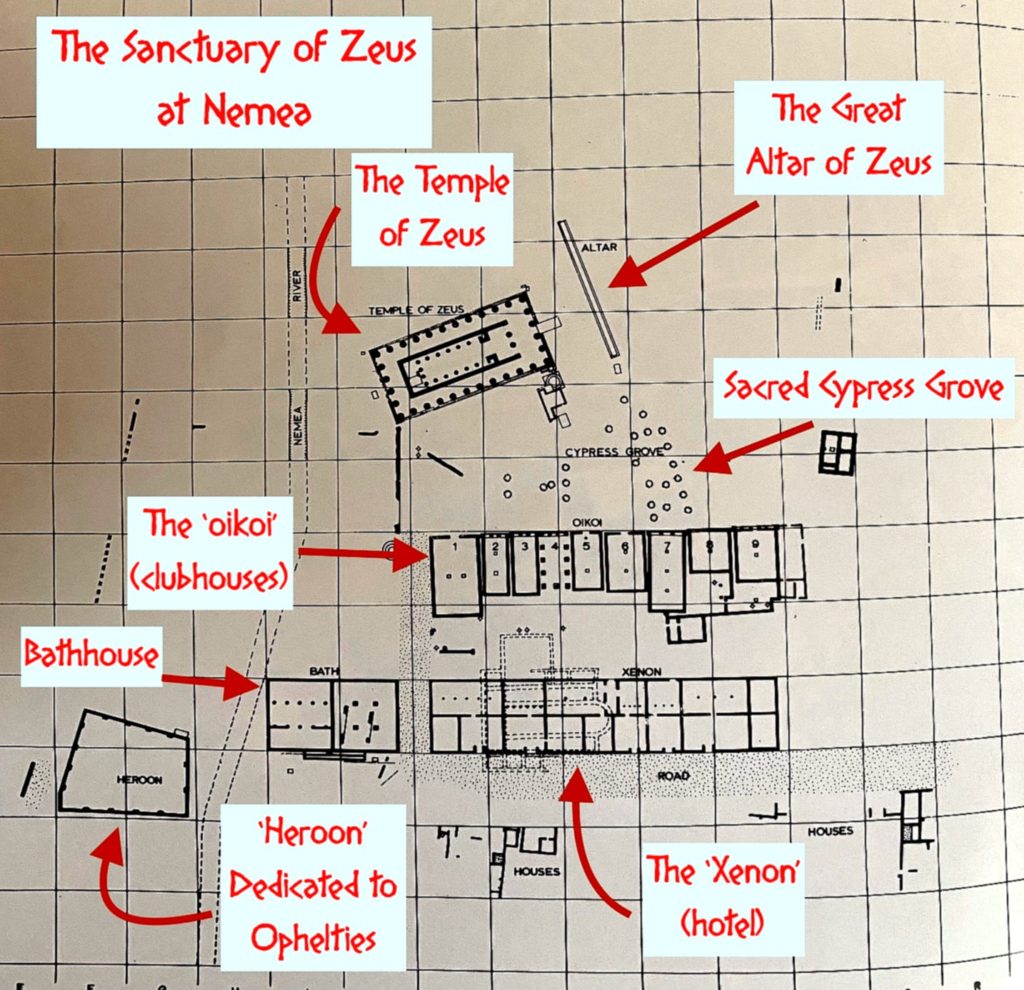
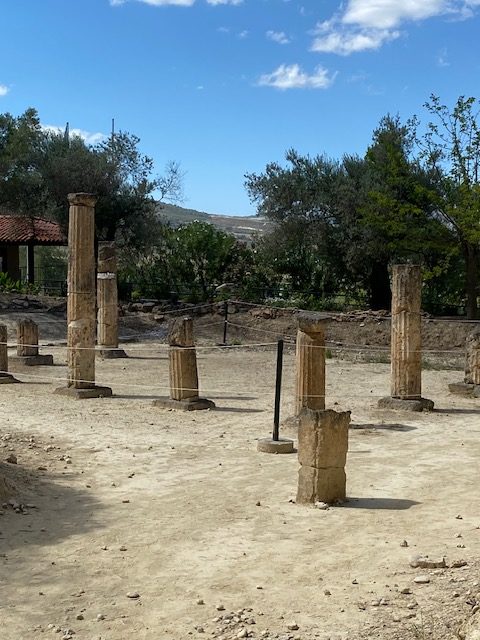
The main site, the Sanctuary of Zeus, where the wonderful museum is located, includes the remains of houses, baths, and a hero shrine or heroon dedicated to the child, Opheltes. It also includes the ruins of the xenon, a sort of ancient hotel for visitors or participants in the Games, and a series of nine oikoi, or ‘clubhouses’ sponsored by specific city-states to house their athletes and coaches during the Games.

The most impressive part of the Nemean sanctuary, however, is the temple of Nemean Zeus which was built c.330 B.C.

The lovingly restored ruins of this temple are truly inspiring and, unlike other sites such as the Parthenon, you can walk through the temple to get a better sense of its scale and its magic. Uniquely, the temple contains the remains of a sunken crypt accessed through the cella, or inner chamber. It is believed the crypt was either used as the site of an oracle, or as a treasury for the sanctuary.

On the east side of the temple is another feature that is unique to Nemea, and Isthmia (an altar to Poseidon), and that is a very long altar to Zeus where athletes and trainers swore their oaths and made sacrifices prior to the competitions. This altar dates to the fifth century B.C.

When we visited the site this time, we were armed with a 4K video camera and so, rather than tell you about all the minute details of the sanctuary, we can now show you in the video Nemea – A Tour of the Sanctuary of Zeus

After roaming the Sanctuary of Zeus, we got in the car and drove the very short distance down the road to the second part of the archaeological site of Ancient Nemea, the Stadium.

This site is much smaller than the sanctuary, taking less time to visit, but it is well worth it.

Participants in the Nemean Games would have sworn their oaths and made their offerings to Zeus at the long altar in the sanctuary before processing to the stadium for the actual athletic competitions.

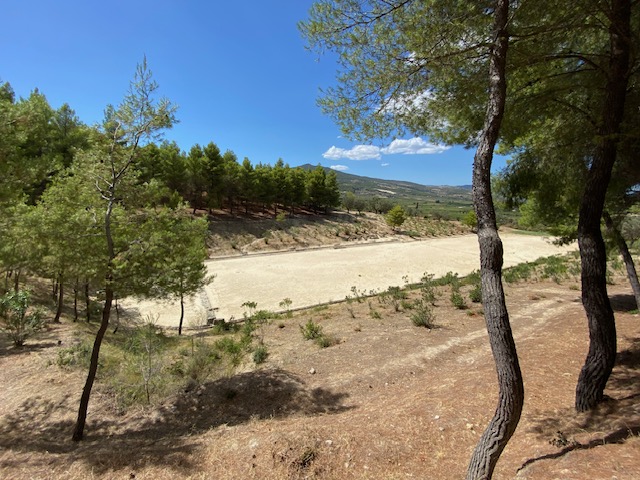
Nemea’s stadium is smaller than Olympia’s, but it’s still substantial, as it should have been for a location of one of the four Crown Games. It could seat up to 40,000 spectators in its day on the roughly hewn stone seats and embankments.

There are some fascinating remains to be seen at Nemea’s stadium, including the starting line and its mechanism, as well as the channels that flow around the stadium, once fed by mountain springs, so that athletes and spectators could drink and stay hydrated during the competitions.

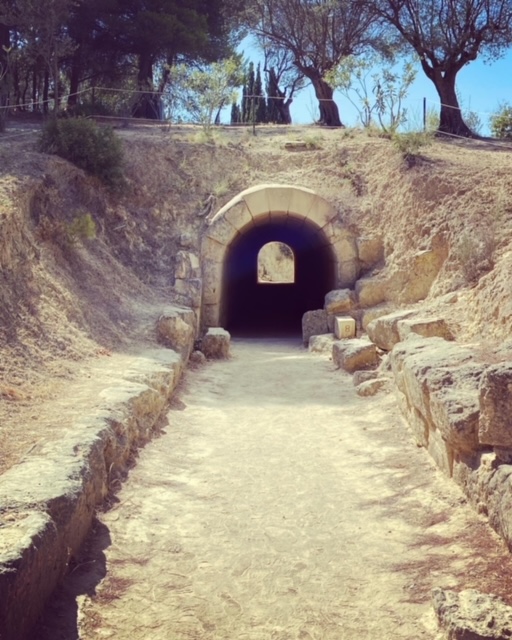
The apodyterion, or ‘locker room’ where athletes prepared

Perhaps the most fascinating parts of the stadium, however, are the remains of the apodyterion, or ‘locker room’, and the barrel-vaulted tunnel which led from there to the stadium. One can still see the graffiti carved by waiting athletes on the stone walls of the tunnel.

When you visit this site, you can walk everywhere at will, including on the stadium floor, and then on a path high on the treed embankments for a magnificent view of the stadium and surrounding countryside.

Even more so than the massive stadium at Ancient Olympia, the stadium at Nemea really does give one a sense of the competitions and sacred games that took place here. And for those of you who want to deepen your experience of the Nemean Games, you can participate for yourselves in the modern, revived Nemean Games which are actually taking place in the summer of 2024! CLICK HERE for more information!

Once again, we visited this amazing archaeological site with our video camera in hand. You can take a full virtual tour of the stadium in Nemea – A Tour of the Ancient Stadium

I firmly believe that it is well worth revisiting sites such as Ancient Nemea, for as the years go by, as we experience more of this life, as we learn more, our new perspectives allow us to see such places in a different light.

For me, Ancient Nemea is one such place.

If you ever get the chance to visit, I highly recommend it. 

Who would have thought that so much could come out of the death of a small child? Then again, tragedy and glory are interwoven in the myths and places of Ancient Greece.

Thank you for reading.

If you are interested in visiting Ancient Nemea for yourself, be sure to check out the deals that are available from Eagles and Dragons Publishing’s subsidiary, Ancient World Travel here: https://www.ancientworldtravel.net/travel-resources-1

Check out our specially-curated deals on visits, tours and tickets to Ancient Nemea, and Nemean Wine Tours at the following link:

  https://viator.tp.st/V9XO4E5D   

Also, read the review of La Petite Planète in the nearby village of Mycenae which is a great place to spend the night: 

https://www.ancientworldtravel.net/post/hotel-review-la-petite-planète-a-warm-welcome-in-the-shadow-of-ancient-mycenae 

Facebooktwitterpinterest

Victory for Heart of Fire!

Eagles and Dragons Publishing has some big news to share today!

As many of you know, 2024 is an Olympic year, and so it is fitting that today we share some wonderful news about Heart of Fire: A Novel of the Ancient Olympics.

First of all, The Historical Fiction Company (HFC) recently awarded Heart of Fire Five Stars and the ‘Highly Recommended’ Award of Excellence.

As the HFC one of the premier reviewers of historical fiction in the world, this is indeed an honour that we are all proud of.

In addition to the award, the HFC’s editorial review of Heart of Fire rendered us speechless with extremely high praise for the story, for Adam’s knowledge and storytelling abilities, and for our amazing editor at Beautiful Ink Editing whose work is “top-notch, making for a smooth reading experience.”

Below are some excerpts from The Historical Fiction Company’s review of Heart of Fire

“…Haviaras grabs the reader’s interest right away with an engaging and evocative opening. The first sentence immediately immerses the reader in antiquity and establishes the epic tale’s setting. This intriguing hook reveals the author’s skill in drawing readers in from the beginning of the narrative. 

In Heart of Fire, Adam Alexander Haviaras transports us to the vibrant heart of ancient Greece through a story that is both a realistic recreation of the ancient Olympic Games and a voyage of personal salvation. Haviaras is an engrossing, poignant story that is full of the essence of human struggle and victory through the perspective of Kyniska, a Spartan princess with dreams of Olympic glory, and Stefanos, an Argive mercenary with a turbulent background. 

Heart of Fire brings the most famous athletic event in ancient history to serve as the backdrop for a brilliant fusion of romance, mythology, and history. The plot is intriguing, drawing us in with a blend of deep personal stakes and wider historical ramifications. Haviaras explores what it means to pursue glory and redemption in a civilization constrained by strict conventions and long-standing rivalries via the weaving of a tale of love, honor, and ambition…

… The next strong suit of the book is the character development. It’s very well done and we’re able to relate to Stefanos and Kyniska’s challenges and goals because of the nuanced and intricate writing. Stefanos has a fascinating and complex path from a violent existence to one filled with honor and purpose. Kyniska defies the norms of her era and epitomizes strength and resolve. Their growth throughout the book is evidence of Haviaras’ talent for developing believable and incredibly inspirational characters. 

The plot keeps up a smooth flow, with each chapter adding to the story’s increasing energy. Haviaras skillfully strikes a balance between the personal and historical aspects, allowing the story to flow naturally toward its conclusion. Heart of Fire’s continuity is a crucial component that keeps you interested and ready to find out what happens to the characters.”

Green olive wreath on white. Top view

“Another positive of this book is the uniqueness. Heart of Fire is notable for how differently it portrays the historical Olympic Games. Haviaras provides a novel viewpoint on a well-known historical era by contrasting the grandeur of the Olympics with the intimate tales of its protagonists. The novel’s examination of concepts like love, competition, and atonement via the prisms of athletics and combat brings a noteworthy level of uniqueness…

Heart of Fire‘s narrative arc is expertly written, following a precise path that heightens suspense and expectation. The story moves along at a good clip, striking a pleasing mix of action and emotional nuance from Stefanos’ early search for atonement to the pivotal events of the Olympic Games. The storyline comes to a dramatic climax that not only settles the main problems but also has a long- lasting effect on the reader. 

With vivid descriptions and real dialogue, Haviaras’ writing eloquently and precisely captures the spirit of Ancient Greece. The author’s skill in fusing vivid storytelling with historical detail is astounding, resulting in an engaging and educational story. Heart of Fire is an excellent example of Haviaras’ storytelling ability and his in-depth knowledge of antiquity. 

Heart of Fire ends in a way that is both thought-provoking and satisfying. The conclusion, which will not give away any plot points, sums up the themes of sacrifice and triumph and leaves readers with a strong impression of the characters’ travels. For anyone who has ever dared to dream large, it is a fitting conclusion to the novel’s examination of reaching greatness despite all circumstances. 

In summary, Adam Alexander Haviaras’ Heart of Fire: A Novel of the Ancient Olympics is a magnificent story that vividly and emotionally captures the world of ancient Greece. Haviaras explores the ageless human search for greatness and significance via the connected destiny of Kyniska and Stefanos, as well as the spirit of the ancient Olympics. For those who enjoy historical fiction as well as those who are enthralled with Ancient Greece and its lasting influence, this book is a must-read.”

We’re thrilled by this wonderful award and the amazing review which The Historical Fiction Company has bestowed on Adam and Heart of Fire.

To read the full review on The Historical Fiction Company’s website, CLICK HERE.

If you are looking for an exciting summer read in this year of the Olympiad, then look no further than Heart of Fire: A Novel of the Ancient Olympics!

Heart of Fire is available in e-book, paperback and special edition hardcover from all major online retailers, independent bookstores, brick and mortar chains, and your local public library.

CLICK HERE to buy a copy or get ISBN# information for the edition of your choice.

Remember… There can be no victory without sacrifice.

Facebooktwitterpinterest

The Tombs of Mycenae

Greetings History and Mythology-Lovers!

We are heading back to Mycenae in this post to explore the domiciles of the Dead outside the walls of the ancient citadel, that is, the great tombs of Mycenae.

In our previous post, we walked through the entire fortress of Mycenae, discussed what it was like and how it felt to return to that ancient and, some would say, menacing, fortress after twenty years.

To read the previous post, Return to Mycenae, CLICK HERE.

Likewise, to go on a full tour of the archaeological site, check out our video Mycenae: A Tour of the Ancient Citadel, HERE.

Grave Circle ‘A’ within the walls of Mycenae’s citadel.

In our tour of the fortress, and the video, we explored what is known as ‘Grave Circle A’ which is located within the walls of Mycenae and was the location of the royal cemetery. It was here that graves pre-dating the Trojan War were located, and where many of the magnificent finds of Mycenae were discovered, including the golden death mask Heinrich Schliemann mistakenly took to be the ‘Face of Agamemnon’.

In this post, we are going outside the fortress walls of Mycenae to explore four of the most astonishing tombs of the Greek Bronze Age: the Lion Tomb, the Tomb of Aegisthus, the Tomb of Klytemnestra, and of course, the Treasury of Atreus.

But first, let us take a brief look at the types of tombs these represented.

Parts of a Mycenaean chamber tomb, drawn up by Piet de Jong in 1920–1923

The graves located within ‘Grave Circle A’ are what are known as ‘shaft graves’ and, within the citadel, these were used to bury royalty with their astounding grave goods.

The tombs which we are looking at here are known as ‘chamber tombs’, of which there are many in the hills about Mycenae. These consisted of rock-cut chambers underground which were achieved by way of a passage called the dromos, which means ‘road’.

These chamber tombs could vary in size and shape, but when it came to the royal chamber tombs, or ‘beehive tombs’, they were meant to impress!

Artist representation of a Mycenaean tholos or ‘beehive’ tomb

The royal beehive tombs outside the walls of Mycenae were built into the hillsides and approached each by a long dromos, the largest being thirty-seven meters in length!

They had elaborate doorways and entranceways known as the stomion, beyond which are the vast, round burial chambers. These beehive tombs were roofed by a stone vault of horizontal rings which diminished in diameter until the roof closed at the top. They were true feats of engineering at the time. They were also referred to as tholos tombs because of their round shape. In some cases, such as the Lion Tomb, rectangular cists were cut into the floors of these tombs to accommodate bodies and valuable grave goods.

At Mycenae, there are approximately nine tholos or ‘beehive’ tombs that are known to date, dating from roughly around 1550 B.C.E to the end of the 13th century B.C.E.

Unfortunately, the grave robbers had cleaned all of them out, but the tombs themselves remained largely intact, and we are going to explore four of them today.

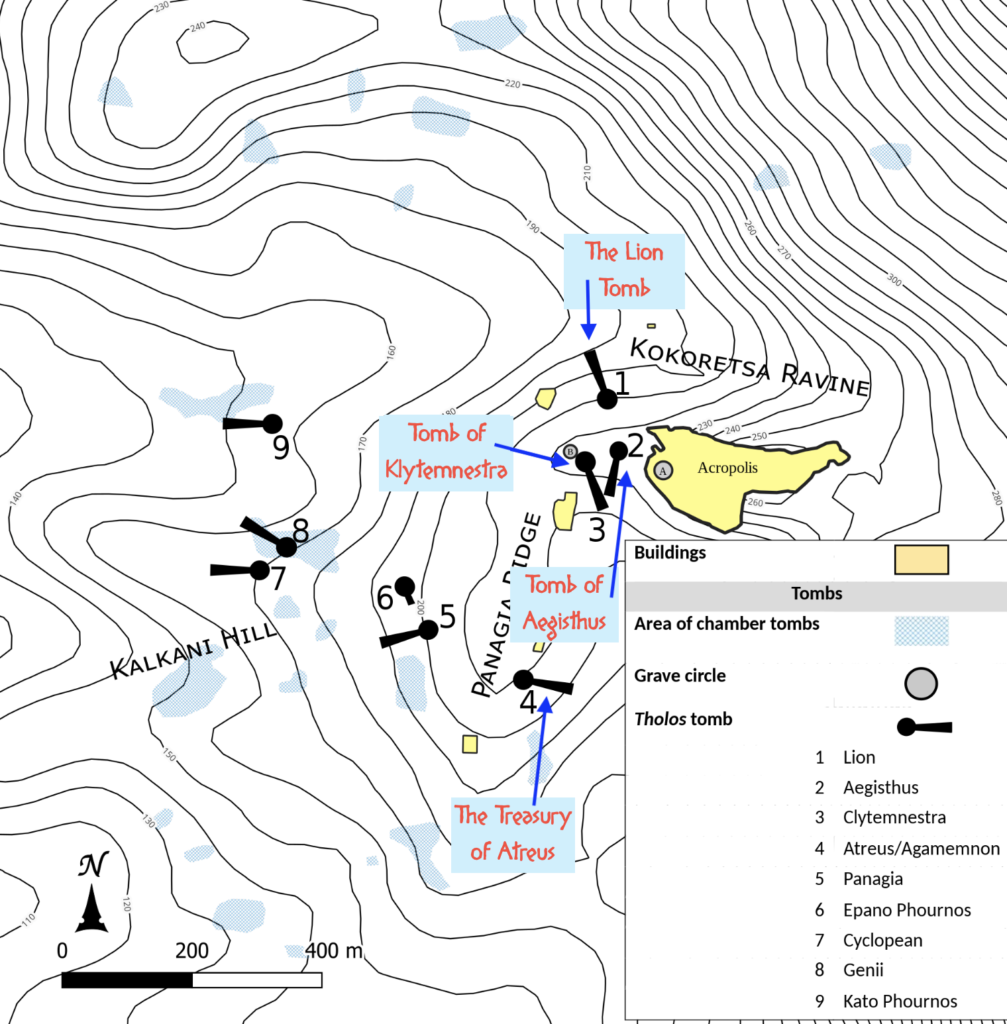
Map of Tombs at Mycenae

There is the grave of Atreus, along with the graves of such as returned with Agamemnon from Troy, and were murdered by Aegisthus after he had given them a banquet… Klytemnestra and Aegisthus were buried at some little distance from the wall. They were thought unworthy of a place within it, where lay Agamemnon himself and those who were murdered with him.

(Pausanias, Description of Greece, 2.16)

In his ‘Description of Greece’, the second century C.E. traveller and historian, Pausanias, makes mention of the tombs outside of the fortress walls, and three of them were on our list to visit after we finished our long, hot journey through the ruins of the fortress that dominated the area.

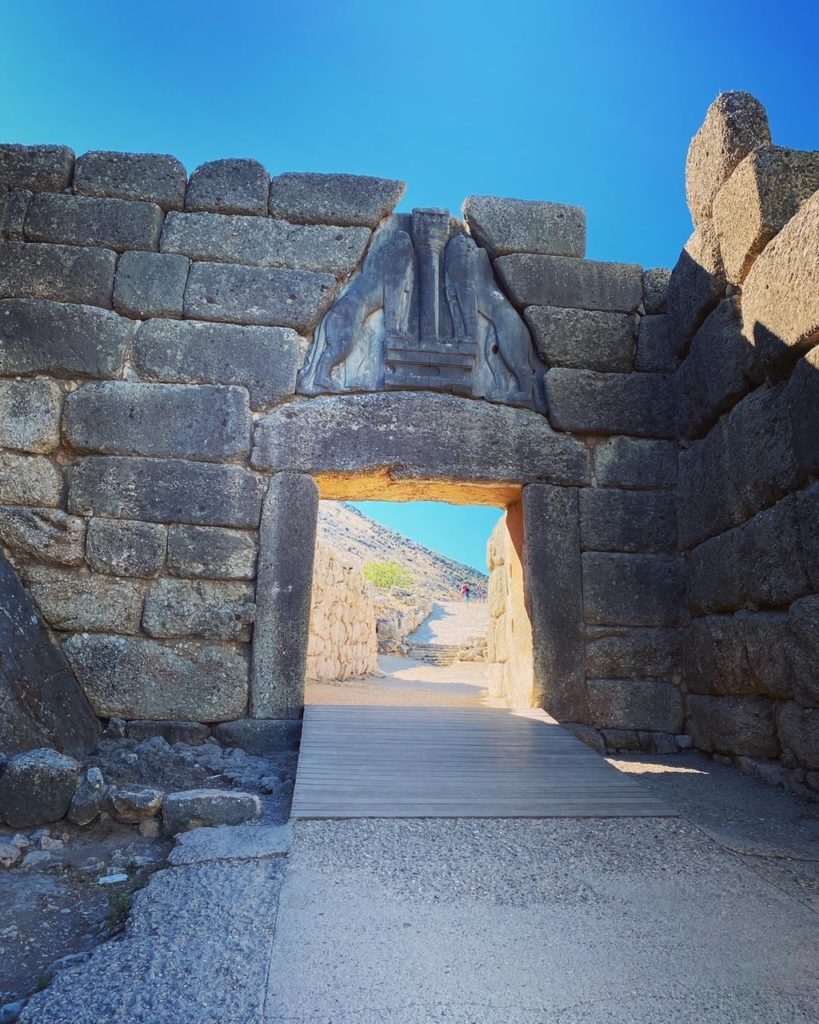
When we came out of the Lion Gate of Mycenae, cutting our way through the army of invading tourists, we turned left immediately and followed the dirt path down to where we knew there were two of the tombs we wanted to see.

Over twenty years ago, when we were last in Mycenae, these had been closed to the public because of their state of disrepair and the risk of stone falling upon one’s head. However, this time, we were thrilled to discover that these first two tombs, the tombs of Aegisthus and of Klytemnestra, were open!

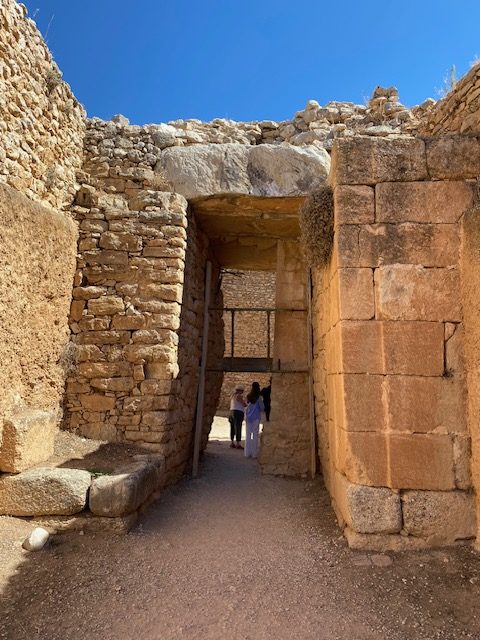
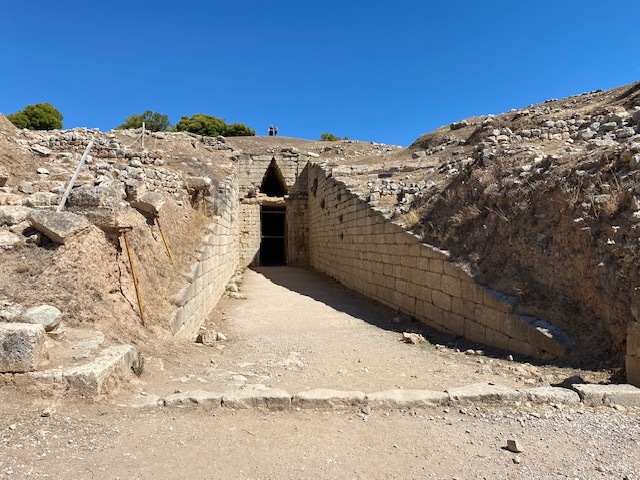
Entrance to the ‘Tomb of Aegisthus’

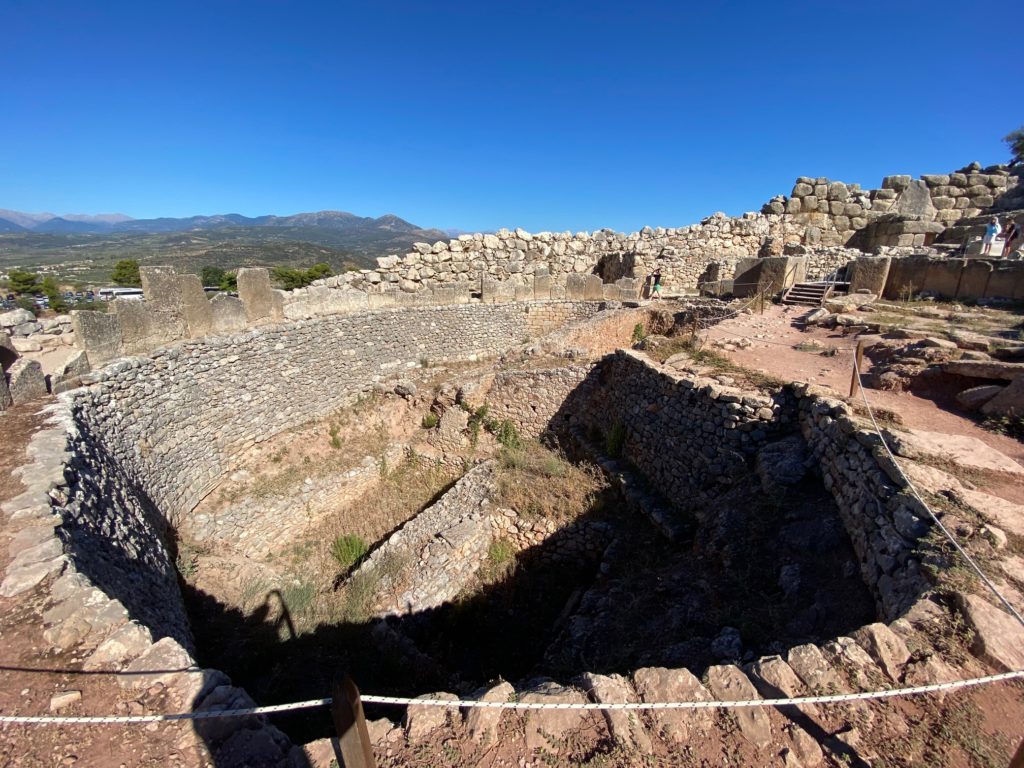
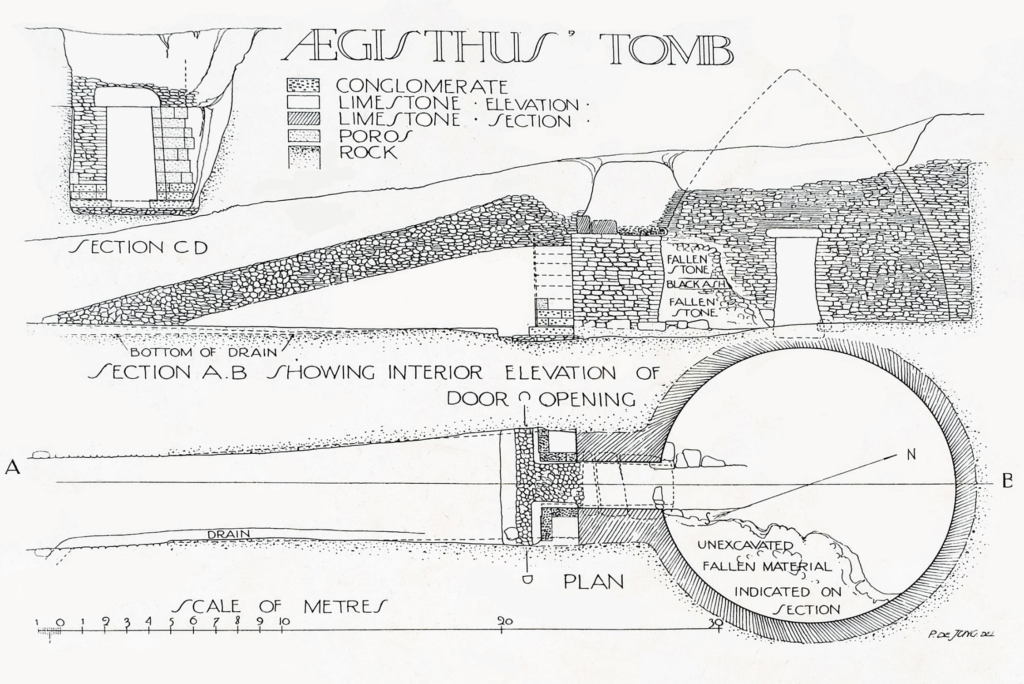
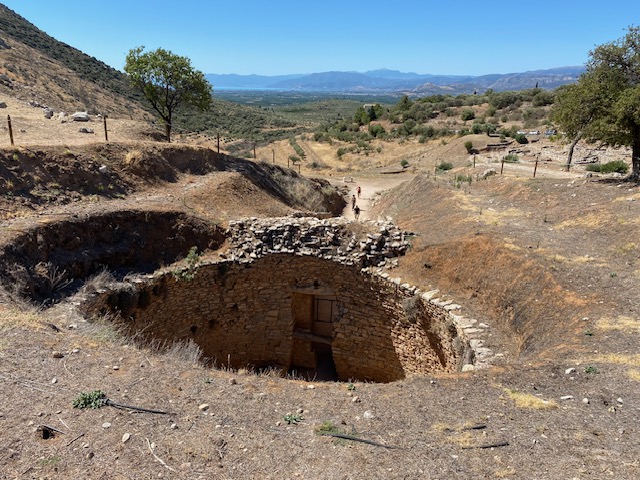
The Tomb of Aegisthus was the first into which we ventured. It is the smaller tomb, and seemed to have born the brunt of time as much of the beehive roof was missing, leaving its golden sandstone walls open to sky. The chamber of this is still an impressive thirteen meters wide and the dromos is twenty-two meters long and five meters wide.

What struck me about this tomb – aside from the fact that this grand house of the dead may have been built for the murderer of Agamemnon – was the size of the lintel above the deep entrance.

There was a scaffold beneath this, supporting the entrance, which forced us to look carefully as we walked beneath and into the sun-drenched inner chamber.

The interior of the ‘Tomb of Aegisthus’ viewed from above with the plain of Argos in the distance.
When we emerged from the Tomb of Aegisthus, we turned right and went a short distance downhill to the site of the Tomb of Klytemnestra, King Agamemnon’s queen, and the mother of Electra and Orestes.

I would be lying if I didn’t note that I felt strange approaching the supposed tomb of this legendary character of Greek legend. Yes, Klytemnestra was said to be an adulterer with Aegisthus, but she was also daughter of King Tyndareus of Sparta, the older half-sister of the famed Helen, a jilted wife, and a tragically vengeful mother whose daughter was sacrificed by her husband.

I felt for the tragic, yet powerful spirit of Klytemnestra as I approached her final resting place.

The ‘Tomb of Klytemnestra’

The Tomb of Klytemnestra is thought to be the latest in date at Mycenae, constructed around 1220 B.C.E. The dromos of the tomb is thirty-seven meters long and six meters wide, and is lined with massive rectangular blocks.

The triangle over the lintel and the rest of the entrance would have been faced with marble slabs that were covered with elaborate carvings of spirals, rosettes and more, and the stromion seems to have contained a great wooden door about midway through its depth.

When we entered the Tomb of Klytemnestra, it was dark and sad, a feeling that was no doubt added to by what looked like a dead body at a glance, but which turned out to be a sad stray dog come to cool itself from the 45+ Celsius degree day.

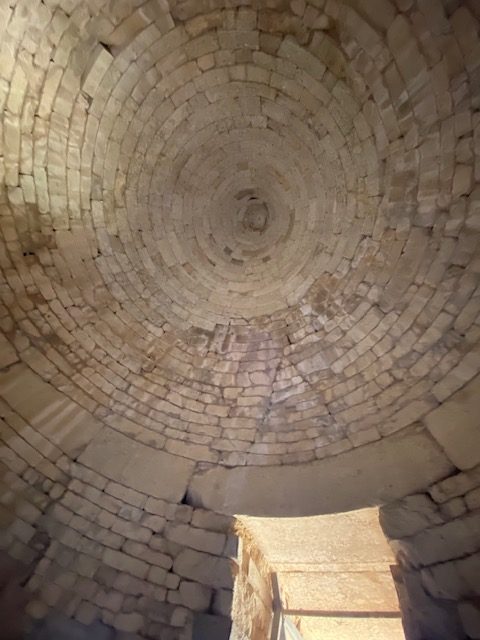
The chamber of this tomb is only slightly larger that that of Aegisthus’ at thirteen and a half meters, but the beehive vault is fully intact and disappears into the darkness thirteen meters overhead.

This truly is an impressive monument and well-worth the visit if you have the strength after visiting the citadel. To be able to see even more, consider bringing a good flashlight the better to view the stonework inside.

Interior of the ‘Tomb of Klytemnestra’

After the Tomb of Klytemnestra, we climbed back up the hill toward the Lion Gate and then down toward the site museum.

To our surprise, there was yet another tholos tomb to the left of the museum. Without delay, we went down the rocky slope to its dromos, delighted to find that no one else was there.

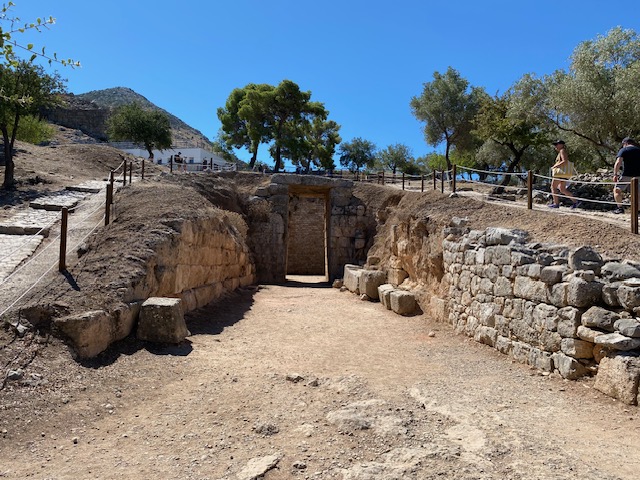
Entrance to ‘The Lion Tomb’ of Mycenae

The ‘Lion Tomb’ is thus named because of its proximity to the famed  ‘Lion Gate’ of Mycenae’s citadel. This is believed to have been constructed some time in the middle of the fourteenth century B.C.E. and has a dromos that is twenty-two meters long and almost five-and-a-half meters wide.

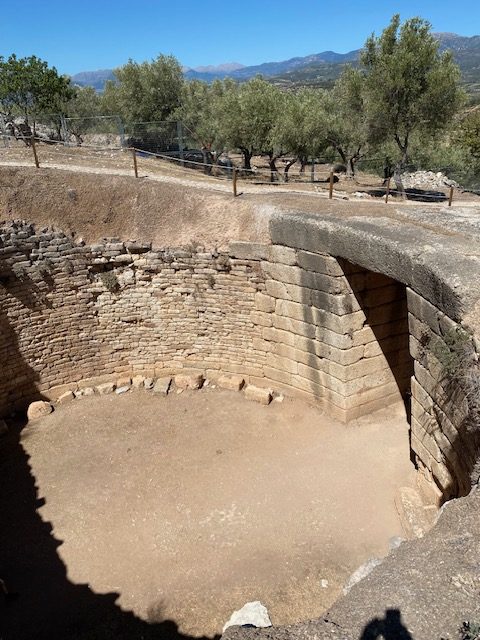
Sadly, the roof of this tomb is no longer intact, but it is estimated that its dome soared to a height of fifteen meters. It is still an impressive work, the chamber of which is fourteen meters wide and contained three pit graves which were found to be empty upon its discovery.

We stood in the middle of this chamber, our voices carrying around the bright, poros stone, and marvelled at its beauty, wondered who had been buried here. Had they been warriors of Mycenae, or members of the royal family who were not fit to be buried within the citadel, as Pausanias points out was the case for Klytemnestra and Aegisthus?

We will never know, but it certainly felt like a gift to be there with no one else around.

Interior of ‘The Lion Tomb’

From the Lion Tomb, we made our way to the museum to view many of the wonderful artifacts discovered at Mycenae. It is worth a visit, if anything to cool off from the Greek summer heat. The most important finds from Mycenae, including the golden death masks and bronze daggers, can be seen at the National Archaeological Museum in Athens, which everyone should visit.

After a refreshing, and overpriced, cup of freshly squeezed Argive orange juice in the parking lot, we got in our car and bid farewell to Mycenae’s walls. 

But not before one final stop.

A short distance down the road to the modern village of Mykines, you will find on the right the entrance to the great ‘Treasury of Atreus’, or, as the locals have called it in the past, the ‘Tomb of Agamemnon’.

The Treasury of Atreus is accessed by way of a separate entrance to the main archaeological site, but it is no less impressive.

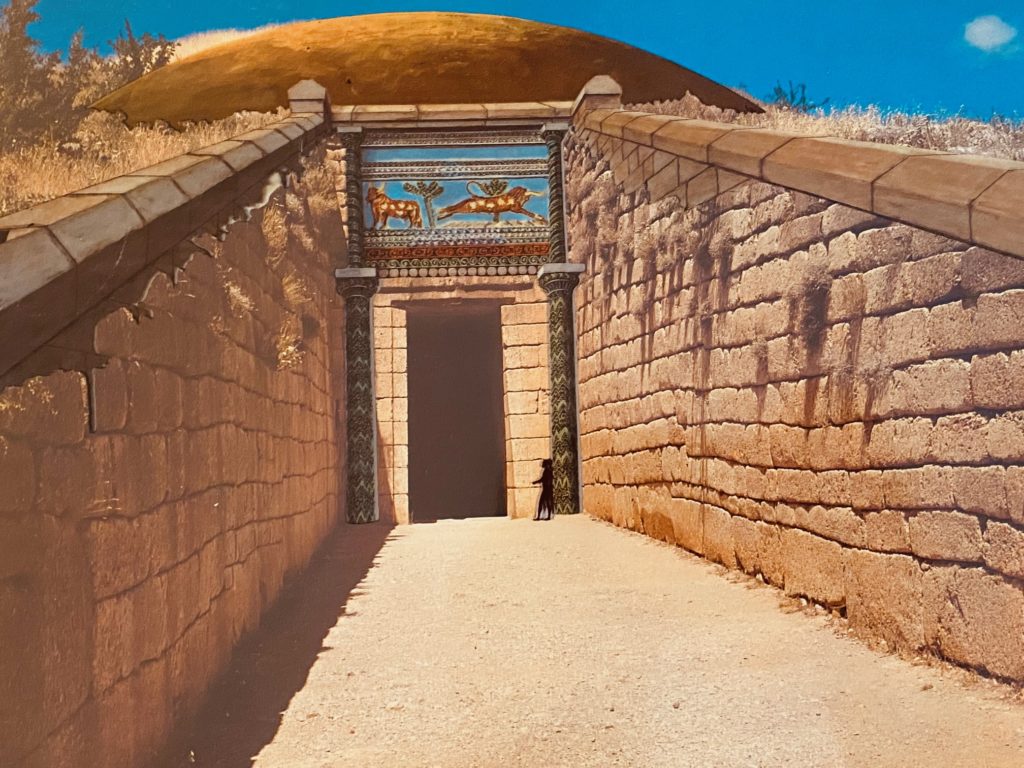
Artist impression of the ‘Treasury of Atreus’

The Treasury of Atreus – named for the legendary son of Pelops and Hippodameia, and father of King Agamemnon, and King Menelaus of Sparta – is one of the most impressive monuments of the Mycenaean Age. It is completely preserved with only the decoration of the facade and interior missing.

Approaching the tomb, one is filled with a sense of awe and wonder. Who was truly buried here, and why did their people believe they deserved such a monument? What was the burial ceremony like, and what magnificent grave goods were interred with the dead, only to be stolen by grave robbers to disappear for all time?

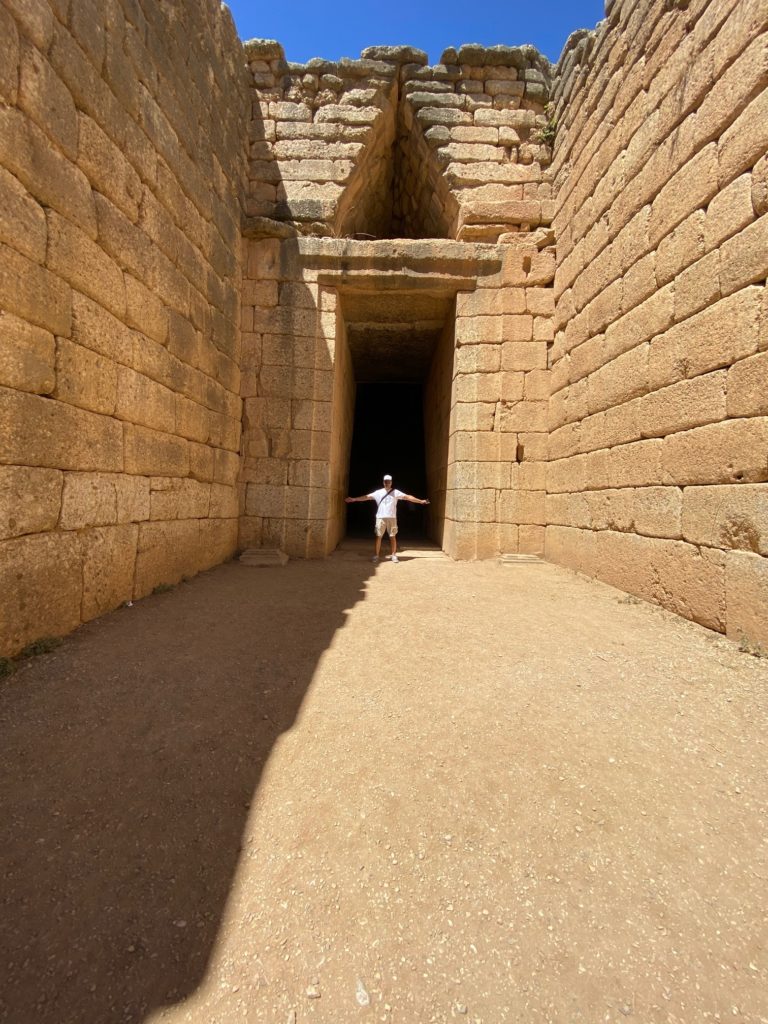
Standing in front of the Treasury of Atreus

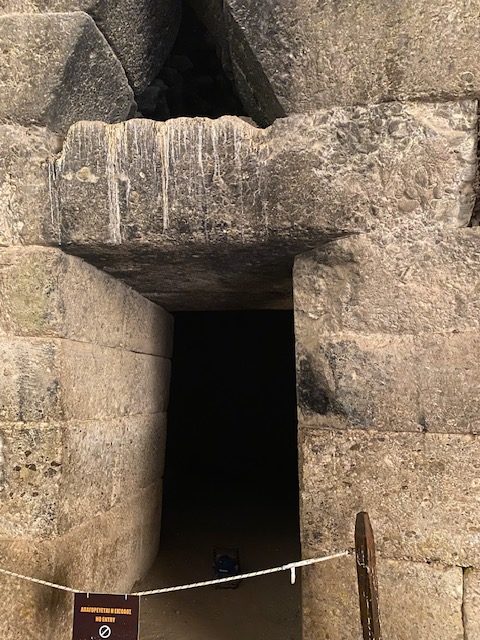
The dromos leading to the tomb is cut into the rock of the hillside and is lined with massive rectangular blocks. It is thirty-six meters long and six meters wide, and the height of the entrance to the tomb is a stunning ten and a half meters high. The actually doorway measures just under five-and-a-half meters high and nearly three meters wide.

Passing beneath the lintel and the gaping triangle that would have been faced with ornate columns of green stone and a fresco or sculpture is an eerie experience. Remains of these can be seen in the National Archaeological Museum in Athens.

As we walked from the blistering heat and sunlight into the cool darkness of the tomb, it was indeed like stepping into another world, a world of the Dead.

Though there were many tourists by the time we reached the Treasury of Atreus, their presence seemed to be swallowed up by the tomb’s darkness, allowing us to observe our surroundings in relative peace.

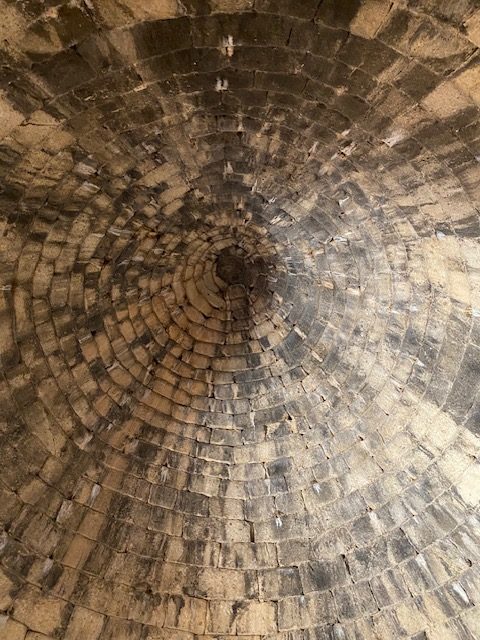
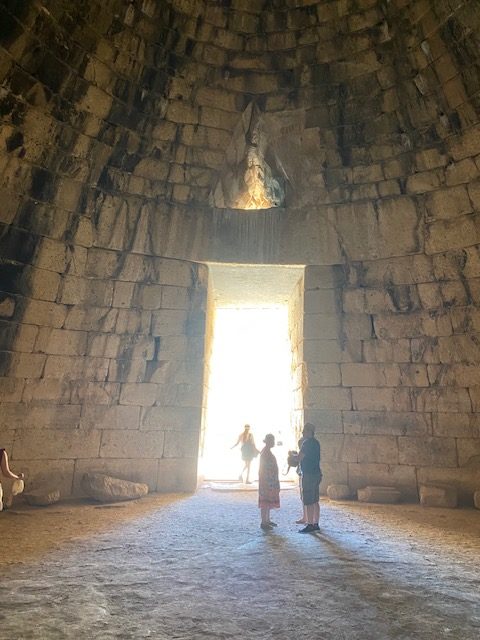
Ceiling of the ‘Treasury of Atreus’

The main chamber of the tomb measures just over fourteen-and-a-half meters in diameter. It is a broad space one steps into upon entering the tomb, but the first thing that really draws the eye is the soaring ceiling of the tomb’s mesmerizing beehive construction.

The ceiling reached to a height of about thirteen-and-a-half meters high with thirty-three courses, or ‘rings’, of perfectly joined stones making up the construction. It is a true feat of engineering, that much is obvious, but it was also ornate, a home fit for kings in the Afterlife, though the ornamentation that would have decorated the circular walls is all gone, stolen since long before the visit of Pausanias in the second century C.E.

It is not only incredible to think that this tomb may have held the remains for such legendary figures as Atreus or Agamemnon but also, perhaps more so, it is stunning that it is still intact. The construction of this tomb has survived since the thirteenth century B.C.E.

The ante-chamber within the ‘Treasury of Atreus’

One feature that sets this particular Mycenaean chamber tomb apart from the others is the addition of an ante-chamber within the tomb. This large room is located to the right as one enters the treasury and was another burial chamber, in addition to the main chamber. The ante-chamber is blocked off and is deep and dark, but if you have a flashlight handy you can just make out the interior.

Once we finished explored the tomb, the air growing somewhat heavy within, we bid farewell to the shades of Atreus and Agamemnon, and made our way to the doorway and the light outside in the land of the living.

The tomb’s maw spat us out and we shielded our eyes as we walked in the sliver of shade offered by the walls of the dromos. It was time to leave Mycenae and the dead behind but, just as Orpheus could not help but turn to seek Eurydice at the gates of the Underworld, we also felt the need to turn around for one final glance at the magnificent entrance of the Treasury of Atreus.

The light outside the ‘Treasury of Atreus’

If you ever go to Mycenae, after exploring the citadel itself, be sure to leave time to visit the tombs of Mycenae, those great houses of the Dead that surround it.

They are some of the most stunning pieces of Mycenaean architecture that you will ever see, and when you emerge from them, from the deep darkness into the light, those tombs, and the shades of their inhabitants, will leave a lasting impression.

The ‘Lion Gate’ of Mycenae

If you are interested in visiting Mycenae for yourself, be sure to check out the deals that are available from Eagles and Dragons Publishing’s subsidiary, Ancient World Travel here: 

https://www.ancientworldtravel.net/travel-resources-1  

Check out our specially-curated deals on visits, tours (many from Athens) and tickets to Ancient Mycenae at the following link: 

https://viator.tp.st/4DfkV2n1 

Also, read the review of La Petite Planète, a lovely hotel (with an amazing terrace for dinner!) in the village of Mycenae where you can stay here: 

https://www.ancientworldtravel.net/post/hotel-review-la-petite-planète-a-warm-welcome-in-the-shadow-of-ancient-mycenae

Lastly, check out the new video tour, The Tombs of Mycenae, on the Eagles and Dragons Publishing YouTube and Rumble channels.

Come with us as we explore the interior of these magnificent tombs of the Mycenaean age!

Thank you for watching, and thank you for reading!


Facebooktwitterpinterest