The World of The Hearts of Heroes – Part VI – A Temple for Mary: The First Church at Glastonbury

Greetings Readers and History-Lovers!

Welcome back to The World of The Hearts of Heroes!

If you missed Part V in the this blog series about the Romans on the Isle of Anglesey, you can read that article HERE.

Today, in Part VI, we are heading through the mists of time to what was known to the ancient Britons as Ynis Wytrin, that is, today’s Glastonbury. There, we will explore the foundation of what is believed to be the very first church in Britain. Join us as we explore the history behind The Lady Chapel at Glastonbury Abbey…
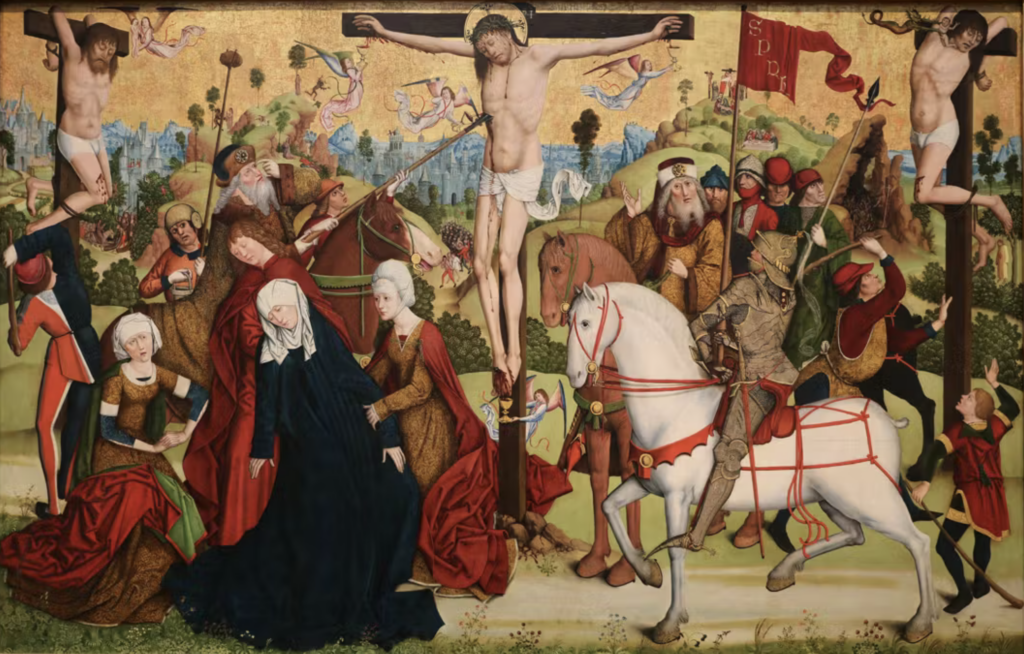
Calvary, attributed to Master of the Death of Saint Nicholas of Münster, c. 1470-1480

For in whom have all the nations believed, but in Christ? — Parthians, Medes, Elamites; the inhabitants of Mesopotamia, Armenia, Phrygia, Cappadocia; the dwellers in Pontus and Asia, and Pamphylia; tarriers in Egypt and the region of Africa beyond Cyrene; Romans and Jews; and the regions of the Britons, which were inaccessible to the Romans, but are subject to Christ.

(Tertullian of Carthage, Adversus Judaeos, VII, c. A.D. 197)

The quote above is one of the earliest recorded mentions of Christianity coming to Britain. What it does not tell us, however, is how truly important this coming of Christianity to that far-off island at the edge of Rome’s empire truly was. It is a tale that is steeped in myth and legend that has deep roots in the Matter of Britain and the foundations of the Christian faith in that ancient isle.
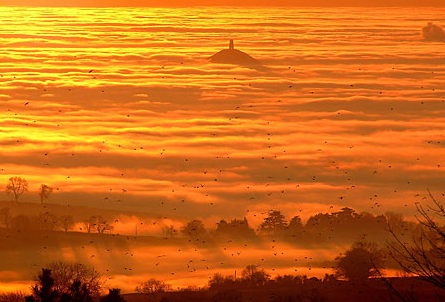
Readers of the Eagles and Dragons series will know what a central role Ynis Wytrin plays in the story. It is also a place that has played a central role in my own life and academic study of Arthuriana, for I lived and wrote there for some years, wandered the pathways beside ancient oaks and yews, climbed up the slopes of the Tor and Wearyall Hill, and sat in quiet contemplation beside the Chalice Well.

I also spent many a day on the grounds of Glastonbury Abbey, gazing up at the soaring and majestic ruins of what was once the second largest abbey in all of Britain. But Glastonbury Abbey is not just another assemblage of ruins bearing the scars of Henry VIII’s rage. It is much more than that.

Long before the great stone abbey was erected by the Normans, this was the site of the very first Christian settlement in the British Isles, and the very first Christian temple or ‘church’. It was built and dedicated by none other than Joseph of Arimathea in honour of St. Mary, the Virgin Mother of Christ.

When the even was come, there came a rich man of Arimathaea, named Joseph, who also himself was Jesus’ disciple: He went to Pilate, and begged the body of Jesus. Then Pilate commanded the body to be delivered. And when Joseph had taken the body, he wrapped it in a clean linen cloth, And laid it in his own new tomb, which he had hewn out in the rock: and he rolled a great stone to the door of the sepulchre, and departed…

(Matthew, Gospel of Matthew, 27:57-60)
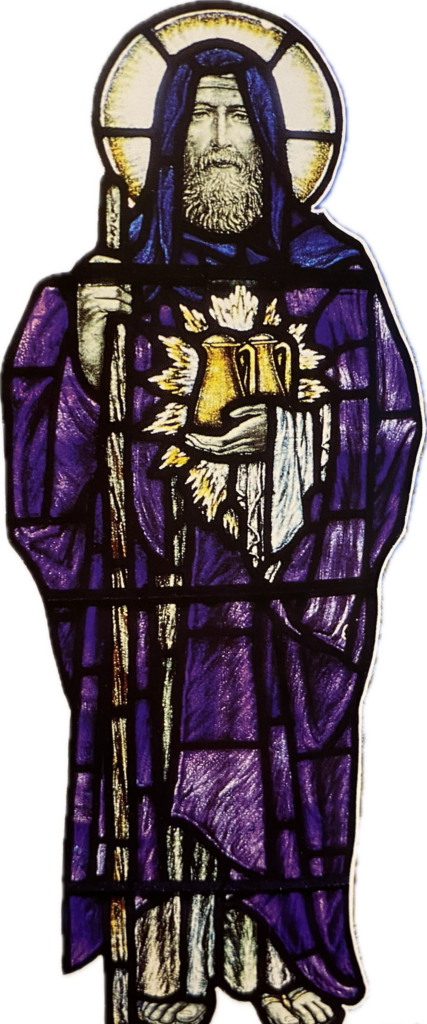
Joseph of Arimathea

Joseph of Arimathea, an older disciple of Jesus (believed by some to actually be Christ’s uncle) became, over time, central to the story of the coming of Christianity to Britain and even stories of the Holy Grail, which he is said to have brought with him. According to tradition, Joseph and twelve followers built a wattle church on the site on land he was given by the local king, Arviragus (possible ruler of South Cadbury Castle at the time) around the middle of the first century A.D., at the end of the reign of Emperor Tiberius (A.D. 14-37).

Meanwhile, to an island numb and chill with ice and far removed, as in a remote nook of the world, from the visible sun, Christ made a present of his rays (that is, his precepts), Christ the true sun, which shows its dazzling brilliance to the entire earth, not from the temporal firmament merely, but from the highest citadel of heaven, that goes beyond all time. This happened first, as we know, in the last years of emperor Tiberius, at a time when Christ’s religion was being propagated without hindrance…

(Gildas, De Excidio Britanniae, I, VIII, c. A.D. 540)
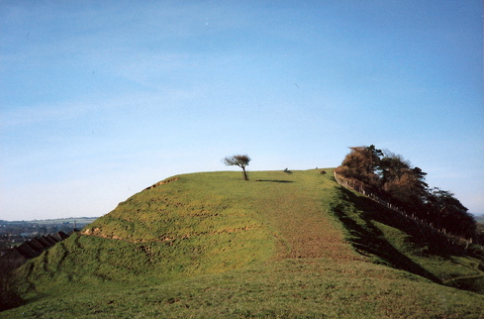
Wearyall Hill and the Holy Thorn. Joseph and his followers are said to arrived at a dock at the foot of this hill. He planted his staff into the ground and it took root, becoming the Holy Thorn.

Having been granted land by the local king, Arviragus, Joseph and his followers are believed to have built a temple dedicated to the Virgin Mary, Christ’s mother, on the site. Before the ‘Lady Chapel’, as it was later called, this sacred yet humble place of worship was known as the ‘Old Church of St. Mary’.

The first church, dedicated to St. Mary by Joseph and his followers, was a simple wattle and daub structure with a well (later named ‘St. Joseph’s Well’), and a small cemetery beside it. Here, the new Christianity lived in peace and harmony beside the pagan Britons who had already lived in and revered Ynis Wytrin for generations.
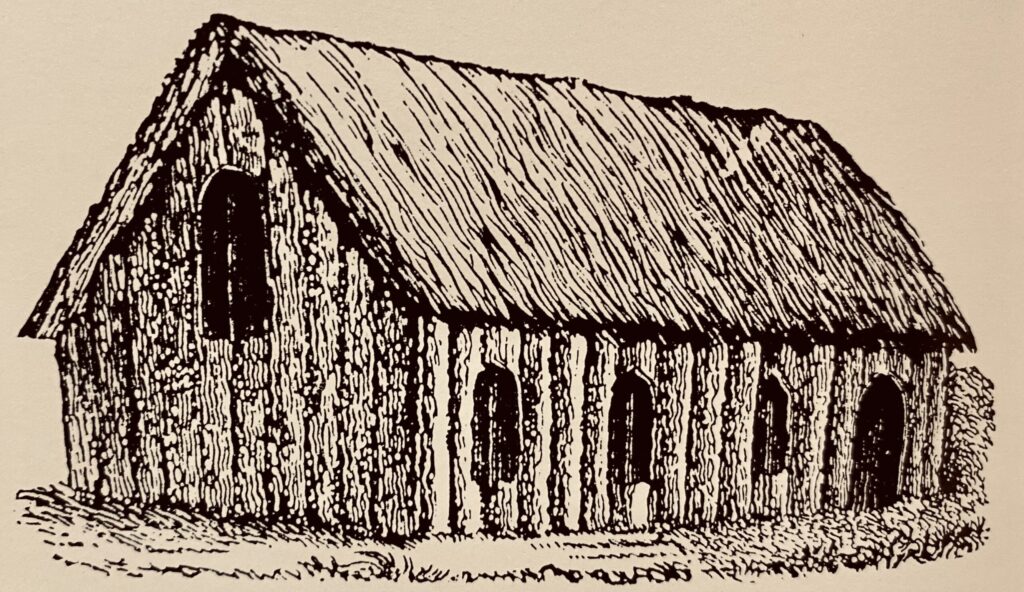
17th century artist impression of the original wattle church built by Joseph of Arimathea and his followers at Ynis Wytrin.

Then desiring that the word of Christ should be yet further spread abroad, he chose twelve of his disciples and sent them to Britain to proclaim the word of life and preach the Incarnation of Jesus Christ, and on each of them he devoutly laid his right hand; and over them he appointed, it is said, his dearest friend, Joseph of Arimathea who had buried the Lord. They arrived in Britain in the sixty-third year from the Incarnation of the Lord, and the fifteenth from the Assumption of the Blessed Mary, and preached the faith of Christ with all confidence.’

The king gave them an island on the borders of his country, surrounded by woods and thickets and marshes, called Ynis Wytrin. Two other kings in succession, though pagans, granted to each of them a portion of land: hence the Twelve Hides have their name to the present day. These saints were admonished by the archangel Gabriel to build a church in honour of the Blessed Virgin. They made it of twisted wattles, in the thirty-first year after the Lord’s Passion and the fifteenth after the Assumption of the glorious Virgin. Since it was the first in that land, the Son of God honoured it by dedicating it to His Mother.

(William of Malmesbury, On the Antiquity of Glastonbury, c. A.D. 1129)
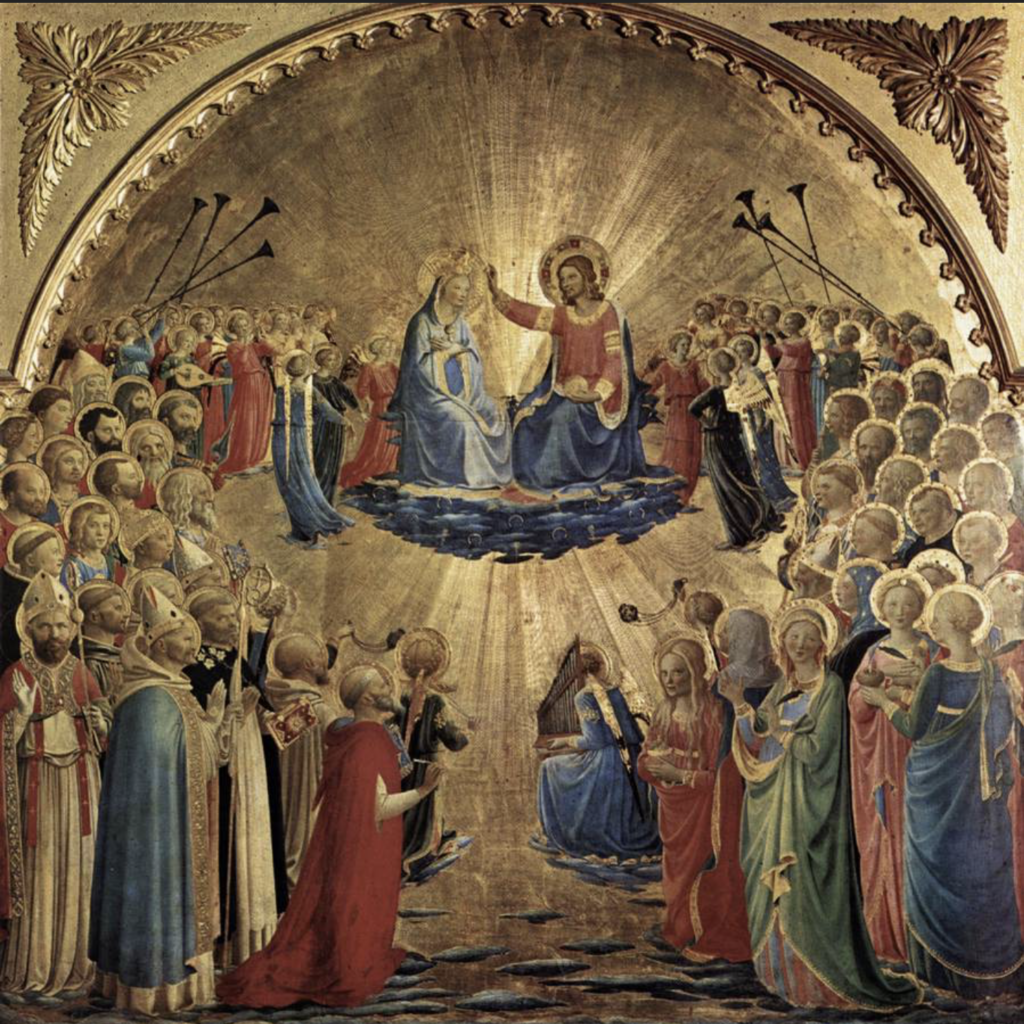
“These all continued with one accord in prayer… with Mary the mother of Jesus.”, Acts 1:14
Coronation of the Virgin, by Fra Angelico, ca. 1432

In the second century A.D. (c. A.D. 166), over one hundred years after the first wattle church had been built by Joseph of Arimathea and his followers, a new church was built by two Christian missionaries who were sent by Pope Eleutherius at the request of a British king named ‘Lucius’ (not the Lucius of the Eagles and Dragons series) who wished to be made a Christian.

The two men whom the Pope sent were named Phagan and Deruvian, and they rebuilt the original, aging wattle church, and this became what is known as the ‘Old Church of St. Mary’.
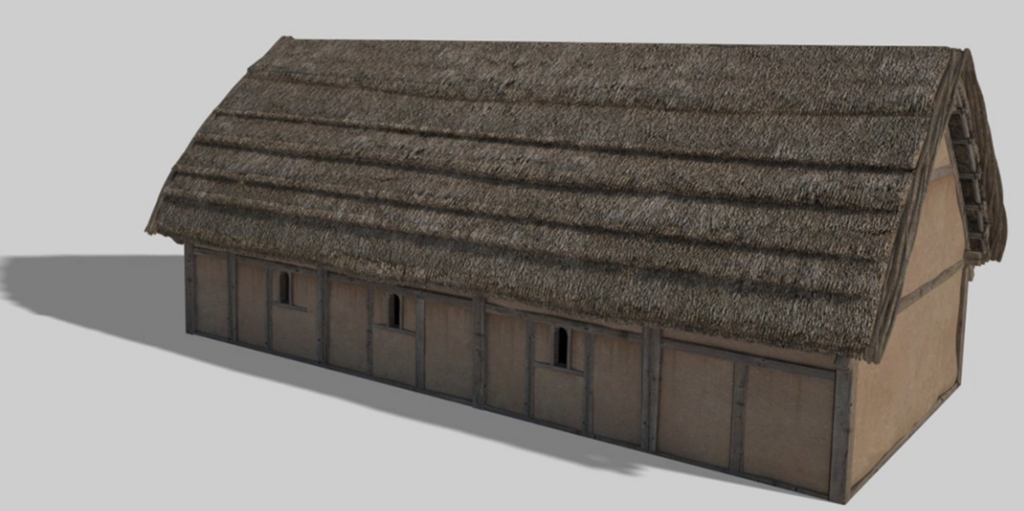
Digital reconstruction of the ‘Old Church’ (Centre for the Study of Christianity & Culture, University of York)

There came, then, these two holy men, Phagan and Deruvian, and preached the word in Britain in A.D. 166. When they came to the Isle of Avalon [Ynis Wytrin] they found the church, ‘built, as it is said, by the hands of the disciples of Christ and made ready by God for the salvation of men, which afterwards the Maker of the heavens … shewed that He had consecrated to Himself and to Mary the Holy Mother of God’. This was 103 years after the coming of the disciples of St Philip. St Phagan and St Dernvian remained here nine years. ‘They found in ancient writings the whole story, how when the Apostles were dispersed throughout the world St Philip the Apostle came with a multitude of disciples to France and sent twelve of their number to preach in Britain. And these by the guidance of an angelic vision built that chapel which afterwards the Son of God dedicated in honour of His Mother; and to these twelve three kings, though pagans, granted for their sustenance twelve portions of land.’

Accordingly St Phagan and St Deruvian chose twelve of their companions and settled them on the island. They dwelt as anchorites in the very spots where the first twelve had dwelt. ‘Yet often they assembled at the Old Church (vetusta ecclesia) for the devout performance of divine worship. And just as three pagan kings had granted the island with its appendages to the first twelve disciples of Christ in days gone by, so Phagan and Deruvian sought from King Lucius that the same should be confirmed to those their twelve companions and to others who should come after them.

(William of Malmesbury, On the Antiquity of Glastonbury, c. A.D. 1129)

It is this second church of St. Mary that is present in Ynis Wytrin in the Eagles and Dragons series in the early third century A.D.
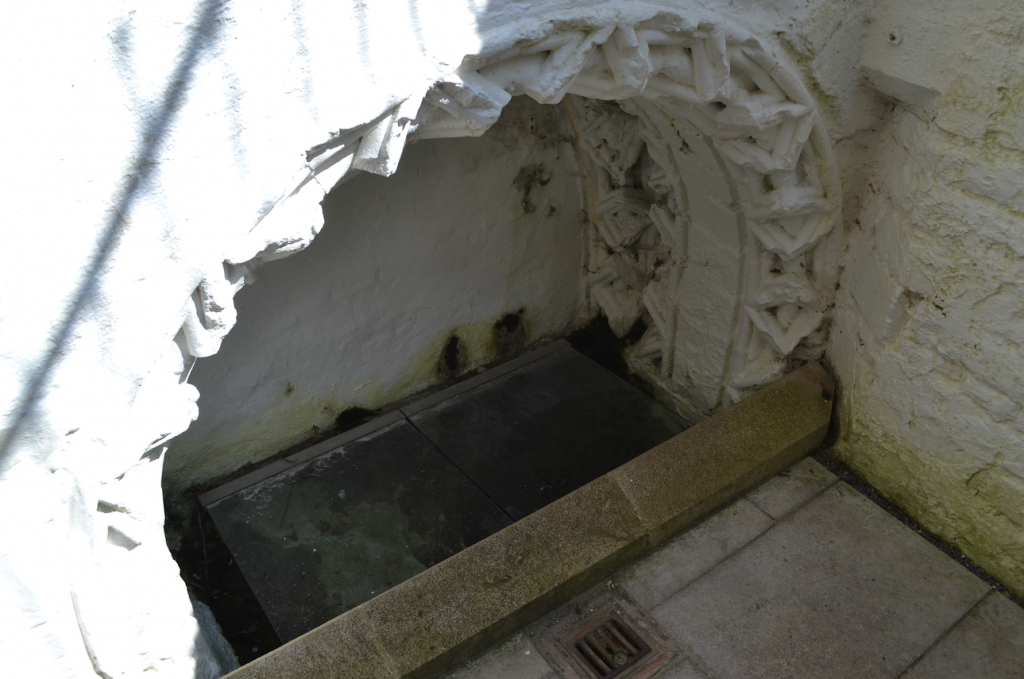
St. Joseph’s Well in the crypt of the Lady Chapel, on the site of the Old Church of St. Mary

Up until the expansion of the church in stone by the Anglo Saxons in the early 8th century, under King Ine of Wessex, it was the second church built by Phagan and Deruvian that was present throughout the 5th and 6th centuries, what is generally believed to be ‘Arthurian’ period.

In the early days of Christianity in Britain, this first chapel and the well were the predecessors of the magnificent Norman ruins of the abbey we see today. The Lady Chapel was the site of the first Marian cult in Britain, and in the words of Geoffrey Ashe “there is no rival tradition whatsoever. When all of the fantastic mists have dispersed, ‘Our Lady St. Mary of Glastonbury’ remains a time-hallowed title.”

It became a place that Christians gravitated to. Indeed, several Celtic saints are said to have come here, including St. David, St. Columba, and St. Bridget who allegedly left her ‘wallet’ and distaff there and which, after she departed, were preserved as holy relics. Most importantly, perhaps, was Ynis Wytrin’s association with St. Patrick, the Romano-British missionary who became the patron saint of Ireland, and whom some stories name as the first abbot of Glastonbury.
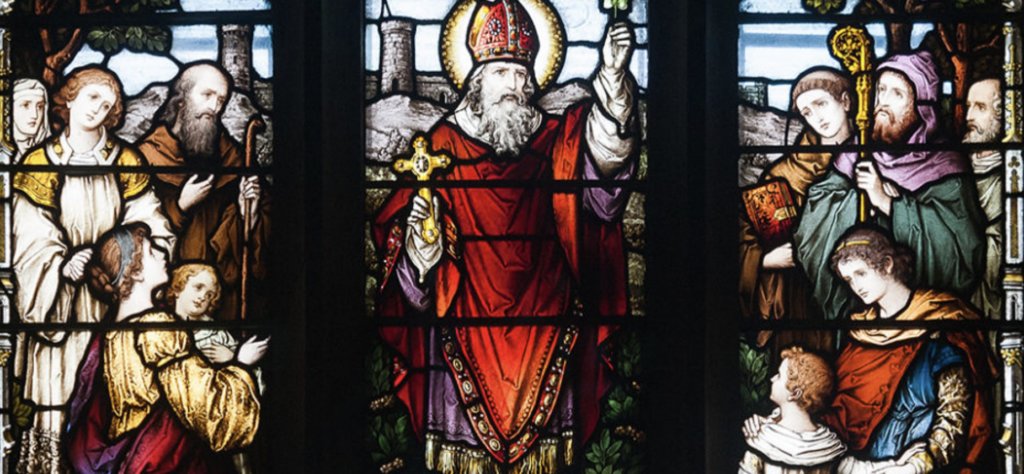
St Patrick preaching at Tara at St Patrick’s Cathedral, Armagh, Northern Ireland

St Germanus of Auxerre, having come to the aid of the Britons against English invaders and Pelagian heretics, on his return took Patrick with him. Presently he sent him, by order of Pope Celestine, to preach in Ireland. When his work was done, he came to Glastonbury. There he found twelve brethren living as anchorites: he gathered them into a community and became their abbot, ‘as the following writing, which he himself in his own day composed, manifestly declares….

‘In the name of our Lord Jesus Christ. I Patrick, the humble servant of God, in the year of His Incarnation 430, was sent into Ireland by the most holy Pope Celestine, and by God’s grace converted the Irish to the way of truth; and, when I had established them in the Catholic faith, at length I returned to Britain, and, as I believe, by the guidance of God, who is the life and the way, I chanced upon the isle of Ynis Wytrin, wherein I found a place holy and ancient, chosen and sanctified by God in honour of Mary the pure Virgin, the Mother of God: and there I found certain brethren imbued with the rudiments of the Catholic faith, and of pious conversation, who were successors of the disciples of St. Phagan and St. Deruvian, whose names for the merit of their lives I verily believe are written in heaven…’

(William of Malmesbury, On the Antiquity of Glastonbury, c. A.D. 1129; quoting The Charter of St. Patrick)

St. Patrick’s story became a part of the fabric of Glastonbury’s mythology and, after his death, his relics, and those of another saint by the name of Indracht (thought by some to be an abbot of Iona) were preserved in two ‘pyramids’ (a sort of A-framed shrine) to either side of the high altar in the church of St. Mary.
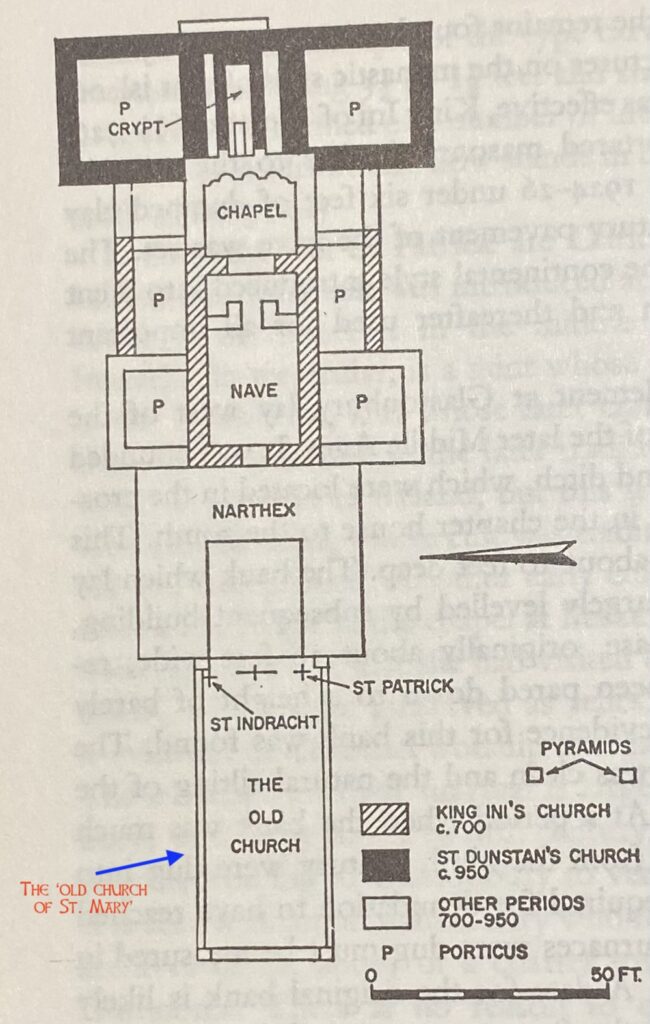
Plan of the later Saxon church which included the ‘Old Church of St. Mary’ at the bottom, then rebuilt in stone. (from The Quest for Arthur’s Britain, ed. Geoffrey Ashe)

One cannot speak about the Old Church of St. Mary without also speaking about the ancient cemetery that sat just to the south of the chapel. These were at the heart of the early monastic settlement of Ynis Wytrin and contained many stone-lined graves. At the centre of the cemetery there were, according to Ralegh Radford who excavated the site, two large ‘pyramids’ with crosses as tall as twenty-eight feet. Most importantly there were, supposedly, two mausolea at the heart of the cemetery that are believed to have held the remains of St. Patrick and St. Indracht. Some believe that St. David may also have been buried there.

Only the most important of people would have been buried near the mausolea containing the remains of those venerated saints in the cemetery beside the church build by disciples of Christ in honour of the Virgin Mary.

This church, then, of all I know in England is the most ancient: hence its name. The place is crowded with the bodies of saints. Under the pavement, above and beneath the altars, relics are everywhere. Rightly is it called the heavenly sanctuary on earth and the depository of saints. Happy are they who dwell there! Who shall fail of heaven, with patrons such as these to plead their cause? So sacrosanct is the place that none dare profane it, none swear falsely by it. The truth of this finds its support in testimonies of every age.

(William of Malmesbury, On the Antiquity of Glastonbury, c. A.D. 1129)
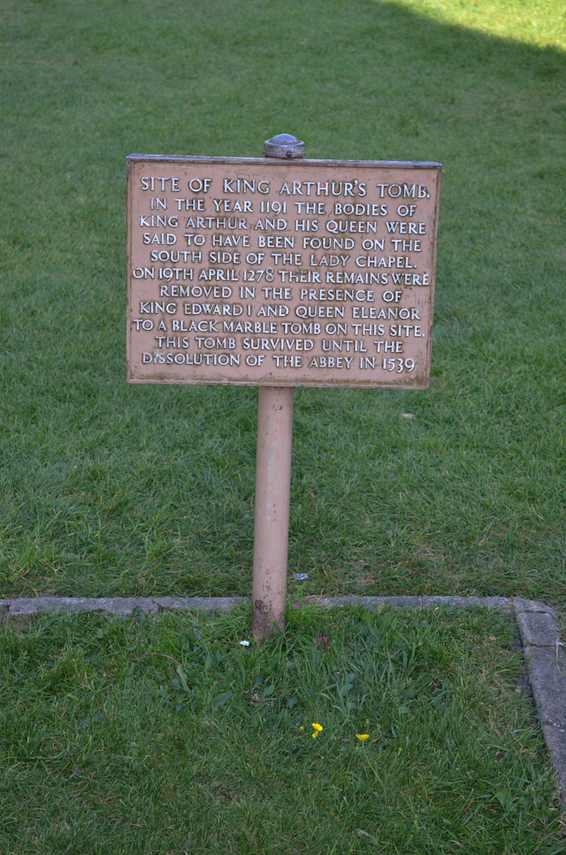
Spot where Arthur and Guinevere’s bones are said to have been discovered in the ancient cemetery south of the chapel.

And here, we come to perhaps the most famous person associated with Glastonbury: King Arthur.

Let it be certain to all that it is in the graveyard of the monastery of Glastonbury, after his mortal wound on the river Camlan, that Arthur was buried, between two crosses of stone made from the ingenuity of craftsmanship. And these were raised standing highly, with letters on them which had been to proclaim that the grave of Arthur was there. And now those letters have been worn away from age. Let it be known, however, to all, that the grave of Arthur was not of marble stone. There was no grave for Arthur, except that he was placed inside an oak after it had been hollowed out, and he was buried sixteen feet deep in the earth. The grave is two parts of length, as if the two highest thirds were separated from the [lower] third. And as if it were a border between them, the third part is separated from them by the arranged bones of Arthur, which were large and sturdy. In the skull there were sixteen wounds, and each one of them had closed and hardened except one, and that one was open and large, as though it were certain that it was from that one that he had become dead. In the third part of the grave, like the two parts of the bottom, were the bones of Gwenhwyfar his wife, as they can be recognized as smaller and more feminine…

…Besides that, it was king Arthur who was the chief founder of the monastery of Glastonbury, for before the English came to the island, he had given land and earth and other goods to that monastery, which he consecrated in honour of the Blessed Virgin Mary, whom he loved more than that all the other saints, and not without cause. And because of that, he caused her image to be put on the two shoulders of his shield on the side next to him. And as it is said, in every battle and fight which he was in, he would kiss her feet in true humility and love for her…

…And in the end, Arthur was honourably buried in the oldest and most powerful monastery in the whole kingdom, as was befitting to place a man of such great fame and honour as that.

(Gerald of Wales, De Principis Instructione and Speculum Ecclesiae, c. A.D. 1216) 
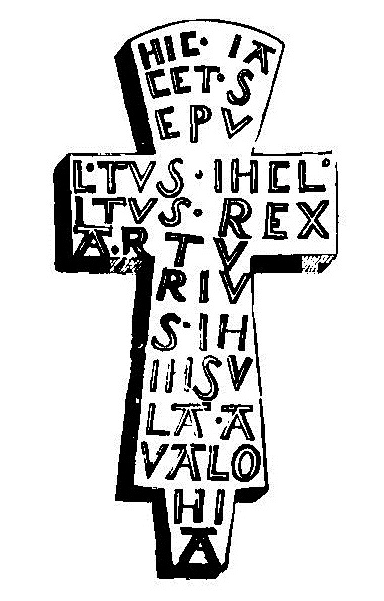
17th century engraving of the ‘Arthur Cross’ discovered in the burial beside the Lady Chapel

In A.D. 1184 a fire ravaged the abbey and the monks needed to rebuild. Around the time of the fire, a Welsh bard is supposed to have revealed to King Henry II that King Arthur himself was buried within the abbey grounds.

The king passed this information on to the Abbot of Glastonbury who later ordered excavations to be carried out. In 1191, it is said that the monks found the bones of a man and a woman in a hollowed out tree trunk who were none other than Arthur, and his queen, Guinevere.

With the remains was a lead cross with the words ‘Hic Iacet Sepultus Inclitus Rex Arturius in Insula Avalonia’ which translates as ‘Here lies buried the renowned King Arthur in the Isle of Avalon’.
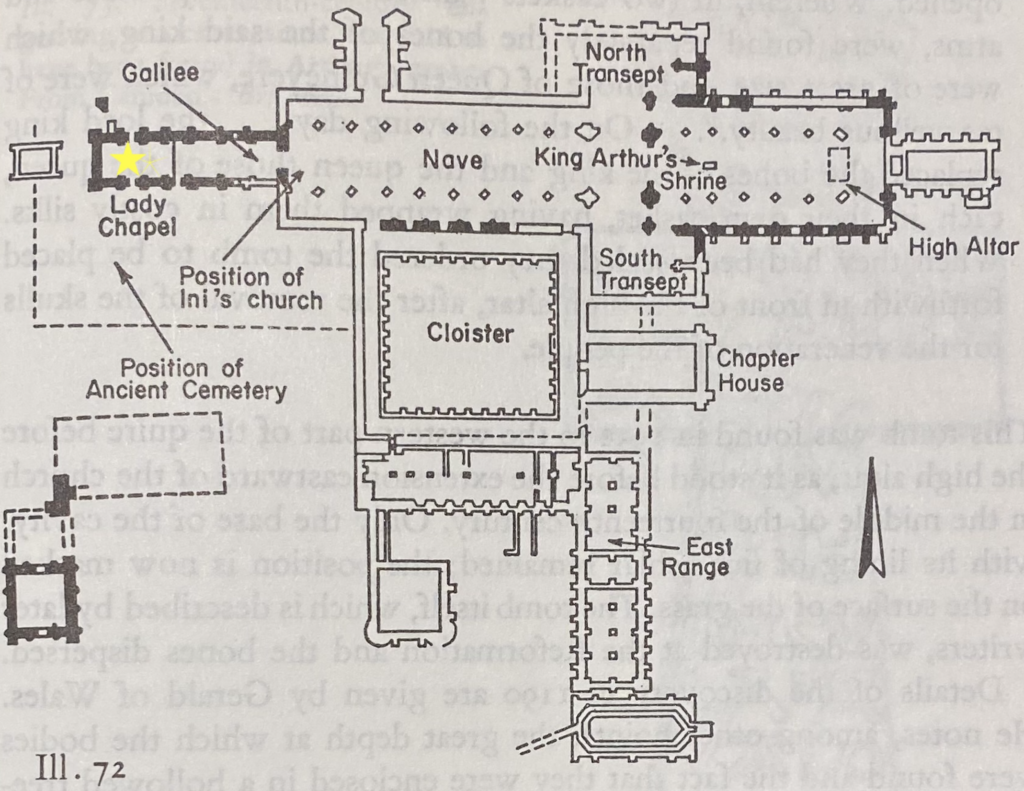
Plan of the full medieval abbey which included the ‘Lady Chapel’ built on the site of the ‘Old Church of St. Mary’ at the bottom, then rebuilt in stone. (from The Quest for Arthur’s Britain, ed. Geoffrey Ashe)

A lot of doubt has been cast on the monks’ discovery with many believing that it was a hoax created by the monks to boost tourism through pilgrimage. The remains were treated as relics and later moved within the abbey during the reign of Edward I in the early 13th century.

It is important to note that the archaeologist who excavated the abbey in the 1960s, Dr. Ralegh Radford, indicated that the monks’ story might not have been that far-fetched, and that there was indeed a person of great import from the correct period buried in the graveyard just south of the Lady Chapel. As with all things in Glastonbury, faith is always a part of the great equation.

And it is that faith that returns us to the original disciples who came with Joseph of Arimathea and who built that first temple or church to St. Mary.
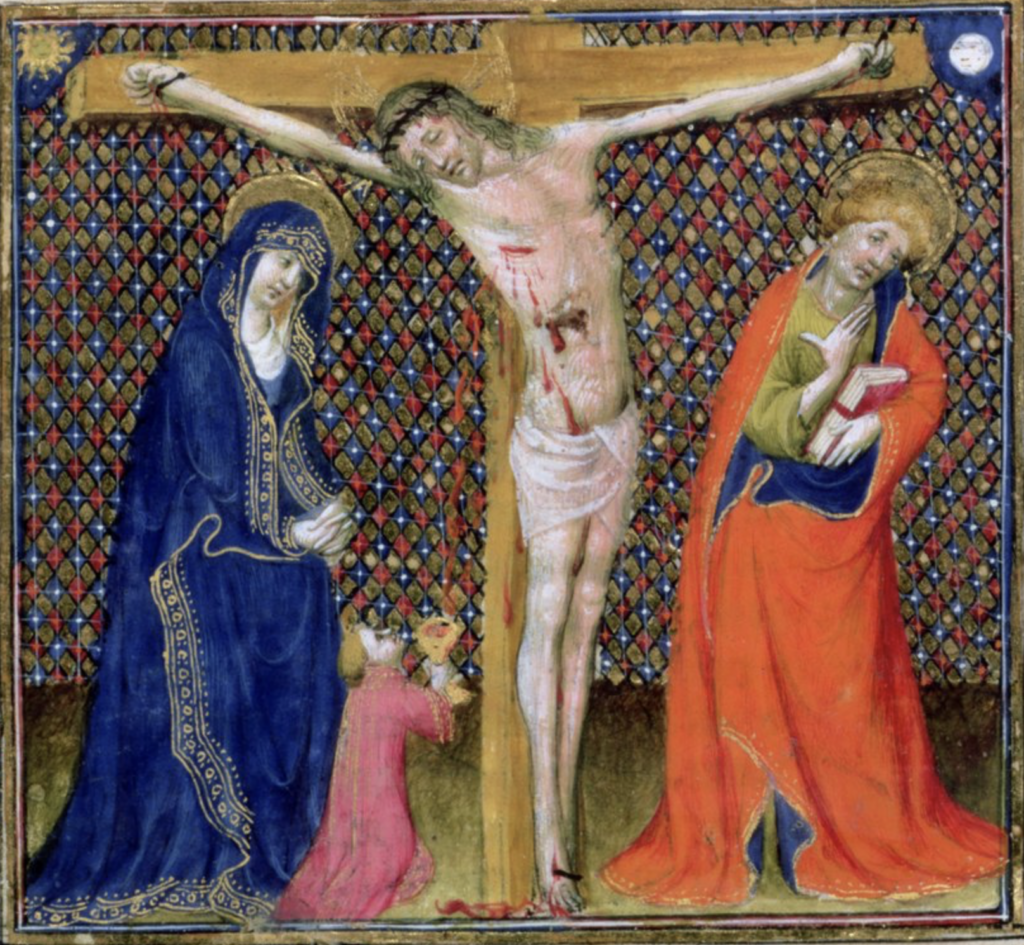
Joseph of Arimathea beside Mary, collecting the Blood of the Crucified Christ, from La Quite de Saint Graal

Joseph carried the Grail and, through his piety and that of the faithful, invoked Our Lady so that the holy vessel would be protected and glorified…

And Joseph came, weeping, to his vessel, and knelt before it and said: ‘Lord who was born of the Virgin, by your holy pity and gentleness, and to save our obedient servant; Lord, I saw you truly both alive and dead, and saw you again, in the tower where I was imprisoned, after you had suffered the agonies of death, and you bade that, whenever I needed you, I should come before this precious vessel which held your precious blood; so truly, Lord, I beg and pray you now to guide me…

(Robert de Boron, Joseph of Arimathea, c. A.D. 1190)

Over time, and in addition to sailing to Britannia with his followers, and founding the first church dedicated to St. Mary, it was also told that Joseph of Arimathea brought with him the Holy Grail.

This is one of the main themes of Medieval Arthurian romance.

Joseph of Arimathea, the veneration of the Virgin Mary, the Holy Grail, and King Arthur and his knights were all linked, shrouding history beneath a veil of myth and legend that has inspired generations ever since.
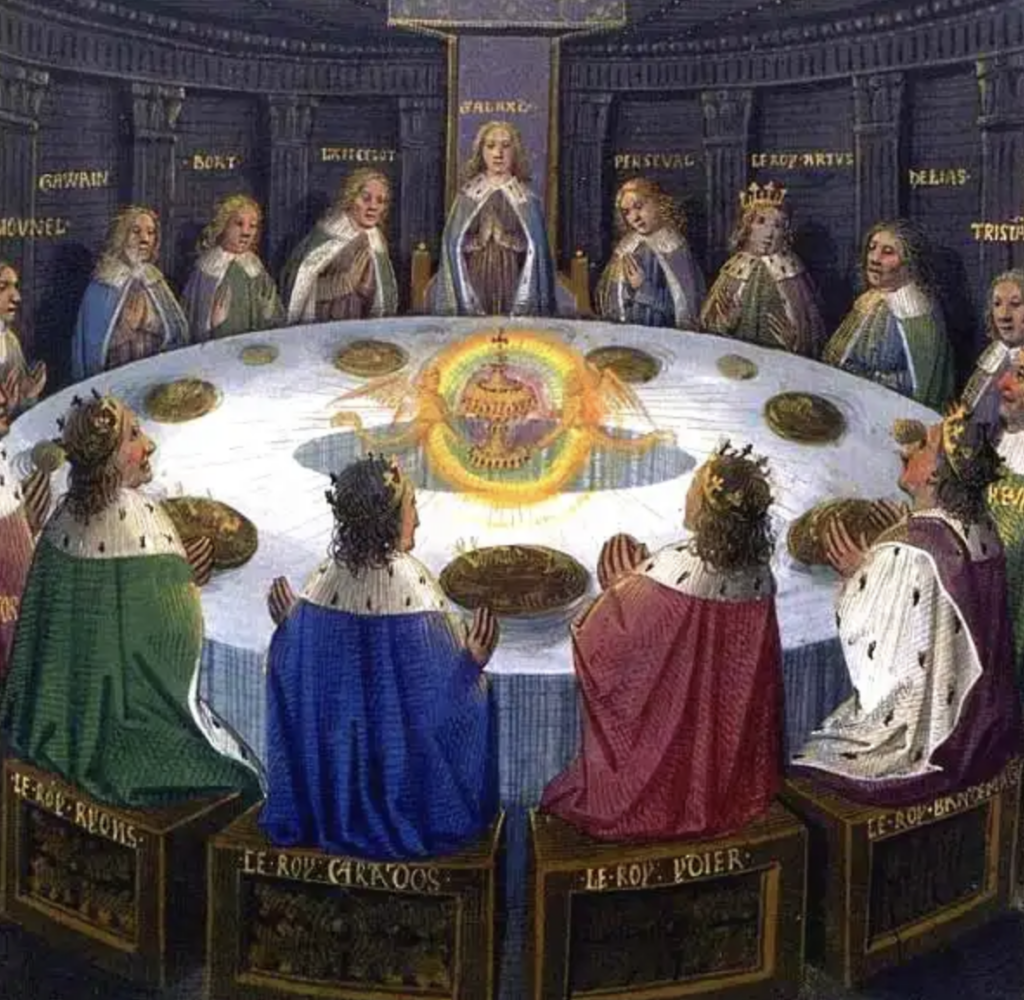
King Arthur’s knights, gathered at the Round Table to celebrate Pentecost, see a vision of the Holy Grail – 15th-century manuscript illumination.

Before the fight and the encounter at the Castle of the Grail, the knights prayed to Our Lady to obtain victory and strength…

And in the chapel, they lifted their hands and voices toward the Virgin Mary, asking for help and guidance in their quest for the Holy Grail.

(Early Vulgate Cycle, Queste del Saint Graal, c. A.D. 1215-1230)

When it comes to Glastonbury being the mythical Isle of Avalon and the resting place of the Holy Grail and of King Arthur himself, there are myriad doubters and believers.

Did Joseph of Arimathea indeed come to Britannia after the death of Christ and found the first temple or church dedicated to the Virgin Mary? Did he bring the Holy Grail with him? Was the ‘Old Church of St. Mary’ the original Grail Chapel?

We may never know for certain. At the end of the long day, however, it really is a question of faith and what one believes.

What is certain is that for almost two thousand years, both saints and sinners, warriors and poets, tourists and faith-seekers have been drawn to that magical place where early Christians first arrived in Britannia and built a humble church to honour Mary, the mother of Christ.

The king and the knights prayed to the Virgin Mary to protect them and to aid them.

(Chrétien de Troyes – Perceval, ou le Conte du Graal, c. A.D. 1180)
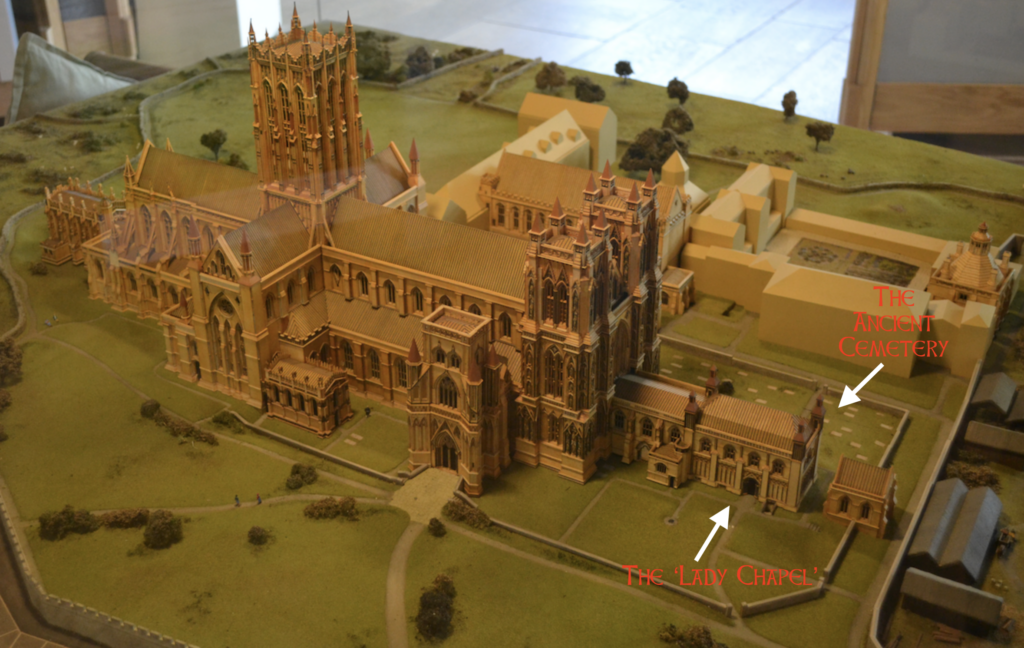
Reconstruction of the later Medieval abbey at Glastonbury with the ‘Lady Chapel’ at the western end. (Glastonbury Abbey Museum)

If you would like to learn more about the other sites associated with Joseph of Arimathea, King Arthur, the Holy Grail and more in and around Glastonbury, be sure to read our popular articles Ynis Wytrin: The Place Beyond the Mists, and The Dragon’s Domus (about South Cadbury Castle, the historical Camelot)

You can also join Adam on magical walking tours of Glastonbury to visit all of the sites mentioned, as well as South Cadbury Castle, in our two highly-acclaimed videos on the Eagles and Dragons Publishing YouTube and Rumble channels:

In Insula Avalonia: A Tour of Glastonbury and the Isle of Avalon

and

Camelot: A Tour of the Ancient Hillfort of South Cadbury Castle

Stay tuned for Part VII in The World of The Hearts of Heroes when we will be looking at the reign of Emperor Alexander Severus and the end of the Severan dynasty.

Thank you for reading.
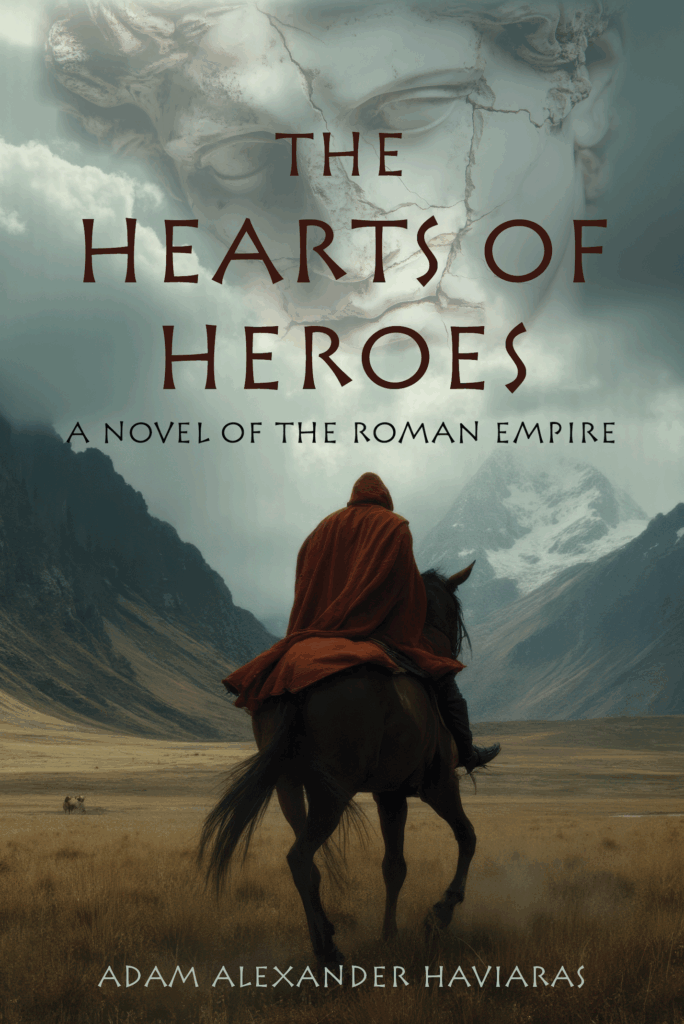
The Hearts of Heroes: A Novel of the Roman Empire is available ebook, paperback and deluxe hardcover editions from all major online retailers, independent bookstores, brick and mortar chains, and your local public library.

CLICK HERE to buy a copy and get ISBN#s for the edition of your choice.

If you are new to the Eagles and Dragons historical fantasy series, you can start your epic adventure with the award-winning, #1 bestselling prequel, A Dragon among the Eagles.

Facebooktwitterpinterest

Samhain at the Gates of Annwn

scan-12

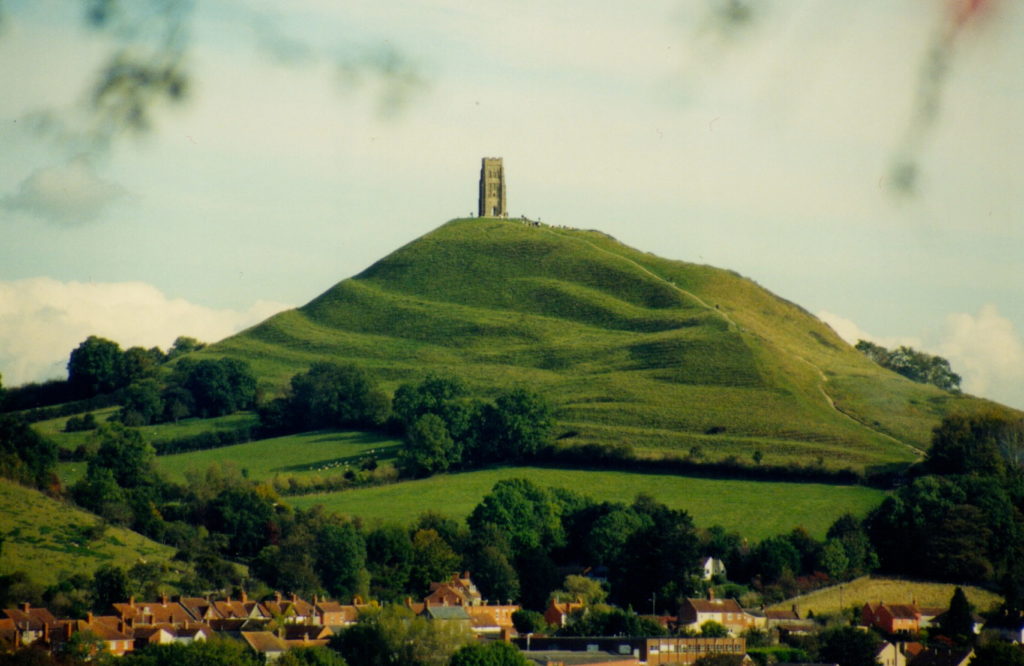
It’s the end of October, and as it is the ancient Celtic festival of Samhain I thought it would be a good idea to look a place that is both mysterious and iconic: Glastonbury Tor.

To most, the mere mention of Glastonbury will likely conjure images of wild, scantily clad or naked youths and aged hippies. You’ll think of thousands of people covered in mud as they wend their way, higher than the Hindu Kush, among the tent rows to see their favourite artists rock the Pyramid Stage.

It’s a great party, but to me that’s not the real Glastonbury.

This small town in southwest Britain is an ancient place. The real Glastonbury is a place of mystery, lore and legend. It is a place that was sacred to the Celts, pagan and Christian alike, Saxons, and Normans. For many it is the heart of Arthurian tradition, and for some it is the resting place of the Holy Grail.

Today, Glastonbury is a place where those seeking spiritual enlightenment are drawn. The New Age movement is going strong there, yet another layer of belief to cloak the place.

I lived in the countryside outside of the town for about 3 years and I never tired of walking around Glastonbury and exploring the many sites that make it truly unique.

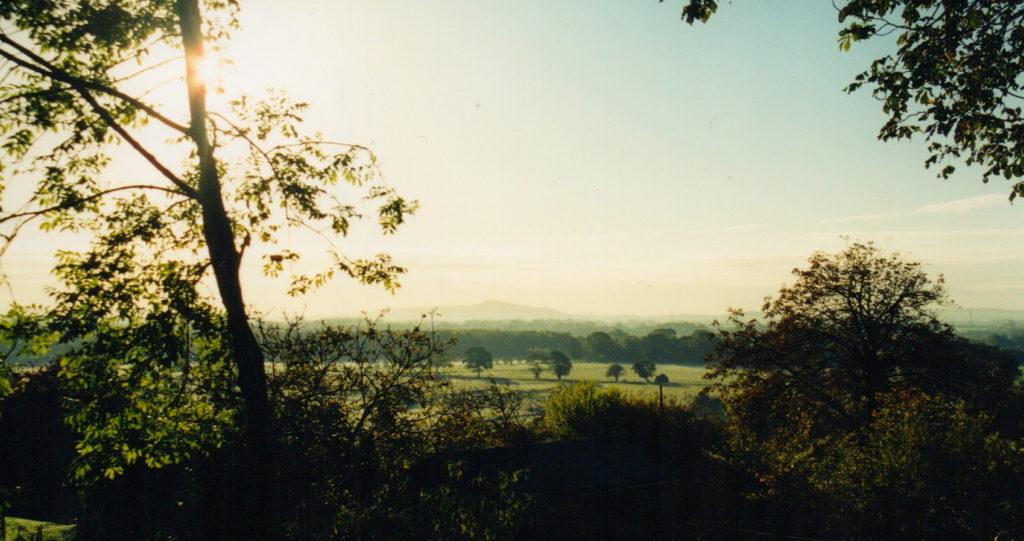
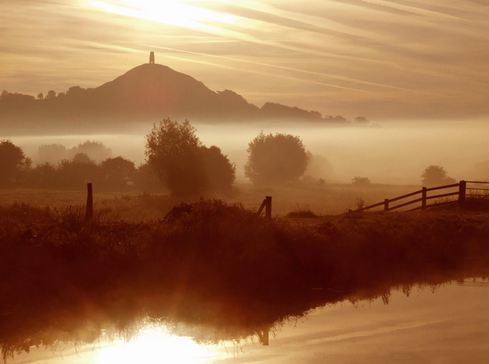
From where I lived on the other side of the peat moors, I awoke every morning to see Glastonbury’s majestic Tor shrouded in mist.

My morning view of the Tor across the Somerset levels

My morning view of the Tor across the Somerset levels

Tor is a word of Celtic origin referring to ‘belly’ in Welsh or a ‘bulging hill’ in Gaelic. Glastonbury Tor thrusts up from the Somerset levels like a beacon for miles around. Every angle is interesting. On the top is the tower of what was the church of St. Michael, a remnant of the 14th century. Before that, there was a monastery that dated to about the 9th century A.D.

However, habitation of this place goes much farther back in time with some evidence for people in the area around 3000 B.C. But it was not always a religious centre. In the Dark Ages, the Tor served a more militaristic purpose and there are remains from this period.

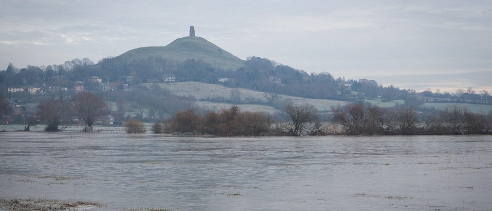
In Arthurian lore, the Isle of Avalon is a sort of mist-shrouded world that is surrounded by water and can only be reached by boat or secret path. In fact, during the Dark Ages and into later centuries, until the drainage dykes were built, the Somerset levels were prone to flooding. This flooding made Glastonbury Tor and the smaller hills around it true islands. With the early morning mist that covers the levels, this watery land would have been a relatively safe refuge for the Druids, and early Christians, Dark Age warlords and late medieval monks.

The Tor surrounded by flooded levels - Avalon!

The Tor surrounded by flooded levels – Avalon!

In Celtic myth, Glastonbury Tor is said to be the home of Gwynn ap Nudd, the Faery King and Lord of Annwn, the Celtic otherworld.

Gwynn ap Nudd is the Guardian of the Gates of Annwn. He is an Underworld god. It is at Samhain that the gates of Annwn open. This was also the place where the soul of a Celt awaited rebirth. (Quick hint: We delve into this in the upcoming Eagles and Dragons novel, Warriors of Epona!)

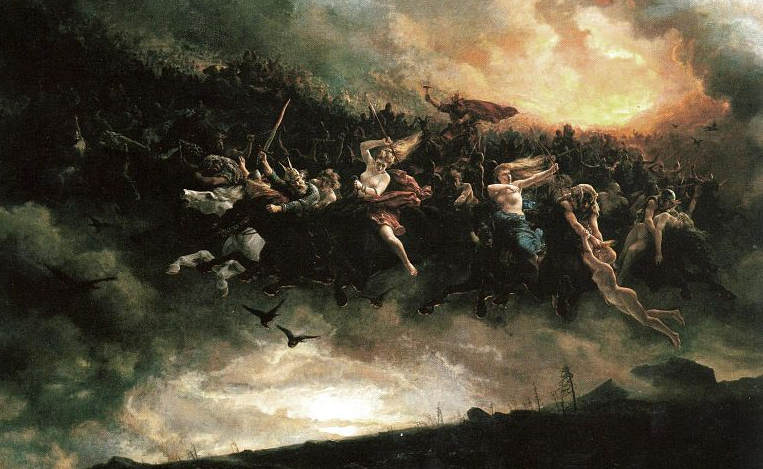
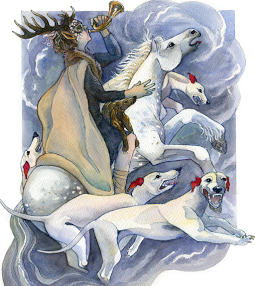
If you are on the Tor at Samhain, you may hear the sound of hounds and hunting horns as the lord of Annwn emerges for the Wild Hunt of legend.

The Wild Hunt 1872 by Peter Nicolai Arbo

The Wild Hunt 1872 by Peter Nicolai Arbo

In Arthurian romance, there is a tradition of the wicked Melwas imprisoning Guinevere on the Tor. Arthur rides to the rescue, attacks Melwas and saves Guinevere. This particular story mirrors an episode in Culhwch ac Olwen, one part of the Welsh Mabinogion, in which Gwythyr ap Greidawl attempts to save Creiddylad, daughter of Lludd, whom he is supposed to marry, from Gwynn ap Nudd himself.

Another even more fascinating Arthurian connection can be found in a pre-Christian version of the ‘Quest of the Holy Grail’, called the ‘Spoils of Annwn’ which was found in the ‘Book of Taliesin’. In this tale, Arthur and his companions enter Annwn to bring back a magical cauldron of plenty. In this, some say that ‘Corbenic Castle’ (the ‘Grail Castle’) is actually Glastonbury Tor. It isn’t just Herakles and Odysseus who journeyed to the Underworld!

Glastonbury Tor is not only associated with Celtic religion, myth and legend. It is also said by some to be a place of power or a sort of vortex in the land that lies along some of the key ley-lines, including what is called the St. Michael ley-line. The majority of sites associated with St. Michael, the slayer of Satan, along the ley-line were indeed places of power and belief of the old religion.

But this is nothing new. Christians built on top of sites sacred to the pagans they were eager to overcome. What better way to symbolize your ‘victory’ than to build right on top of a site and make it yours.

‘Gates of Annwn and Gwynn ap Nudd? Let’s build a church of St. Michael on top of it! That’ll show ‘em!’

Artist impression of Gwynn ap Nudd at the hunt

Artist impression of Gwynn ap Nudd at the hunt

But myth and legend persist through story and place, and the Tor is a prime example of how successive traditions do not overcome each other, but rather combine to make up the various aspects of that place.

If you ever get to Glastonbury, the Tor is a definite must. Walk to the top and sit awhile. Look out over the landscape and watch the crows and magpies dive in the wind around the steep slopes. Close your eyes and listen. While you’re there, you can decide whether you are sitting on a natural formation, a ceremonial labyrinth, a hill fort, a sleeping dragon, the mound where Arthur sleeps until he is needed once more, or the doorstep of the Gates of Annwn itself! The Tor is all of these things and more.

However, no matter what you believe, one thing is certain: Glastonbury Tor remains a site of extreme beauty and mystery that is well worth a visit, even if it is just to watch the sun sink in the West.

Have a safe and happy Samhain.

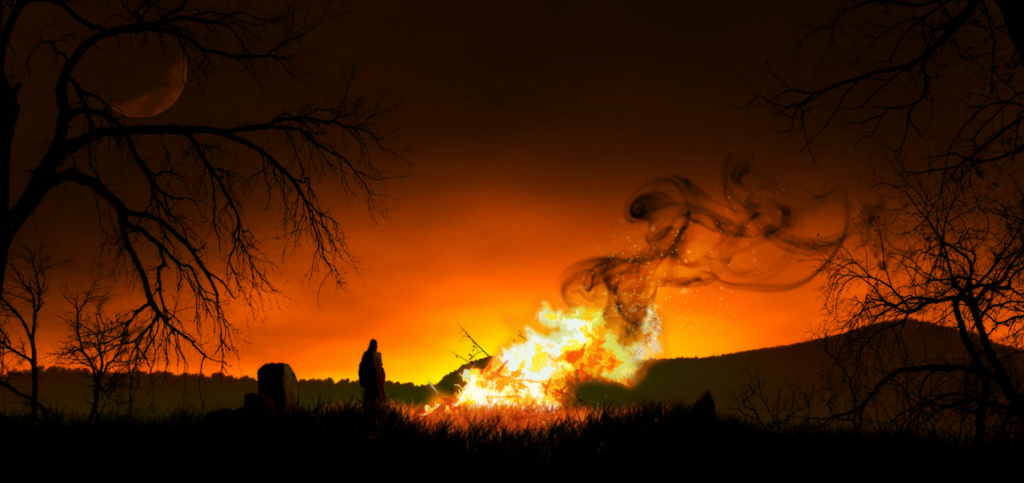
samhain-bonfire

Facebooktwitterpinterest

Harvest Time – From Eleusis to Avalon

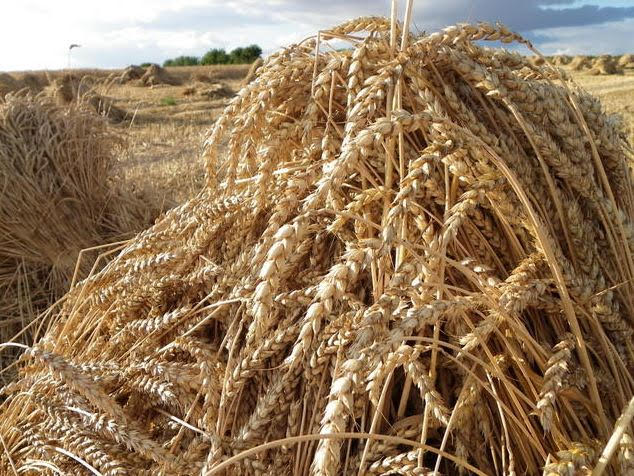
Wheat

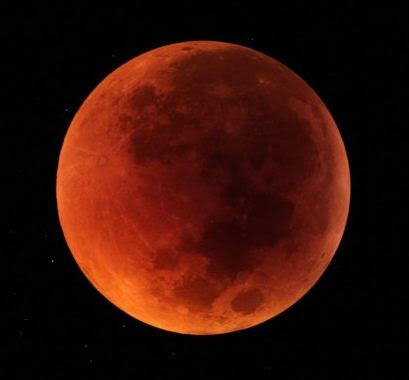
The Autumn Equinox has come and gone, and a giant ‘Blood Moon’ made its round of the earth. From the photos I’ve seen, it was spectacular.

Harvest time is here.

However, in the city, it’s a bit difficult to feel a connection to harvest, our rural roots having been eclipsed long ago by fast, urban living.

In a small effort to reconnect with the earth and our western ancestors who were bound to it, I thought I’d mention a couple of traditions around what has been, for thousands of years, an extremely sacred time of year.

Of course, this is the time of year for Thanksgiving (earlier in Canada than in the USA) when we sit around the table en-famille and stuff ourselves like the turkeys that grace our tables. And wine, oh yes, and lots of it for the oenophiles among us.
blood moon

But where does all this come from? Not the pilgrims, I can tell you that.

Apart from this being the time of year when summer gives way to fall, when the length of days is equal to that of nights, this time of year is when crops were harvested and preparations made for the coming winter.

In ancient Greece it was the month of Beodromion and the festival Apollo, and the time for one of the most sacred rites: The Eleusinian Mysteries. The Mysteries were of course, in honour of the Goddess Demeter who was associated with crops, fertility, harvest and the protection of marriage. The Mysteries also honoured Persephone, Demeter’s daughter who would go to spend half the year in the Underworld with Hades. The time of harvest is associated with the death of agriculture and Persephone’s time away from her mother, the time Demeter would weep, wintertime.
Demetra (Elefsina museum)

The Goddess Demeter – Eleusina Museum

“Queenly Demeter, bringer of seasons and giver of
good gifts, what god of heaven or what mortal man has rapt away
Persephone and pierced with sorrow your dear heart?  For I heard
her voice, yet saw not with my eyes who it was.  But I tell you
truly and shortly all I know…

(from Hesiod’s Hymn to Demeter – Hecate to Demeter)

…But grief yet more terrible and savage came into the
heart of Demeter, and thereafter she was so angered with the
dark-clouded Son of Cronos that she avoided the gathering of the
gods and high Olympus, and went to the towns and rich fields of
men, disfiguring her form a long while.”

(from Hesiod’s Hymn to Demeter)

The cult of Demeter and Persephone existed for over one thousand years and Eleusis, one of the most sacred places of ancient Greece, was where the highly secretive ceremonies would take place in September and October. Sparse details about the ceremonies include bathing in the sea, sacrificing a piglet (not a turkey!), various sacred, secret objects, and a procession from Athens to Eleusis.

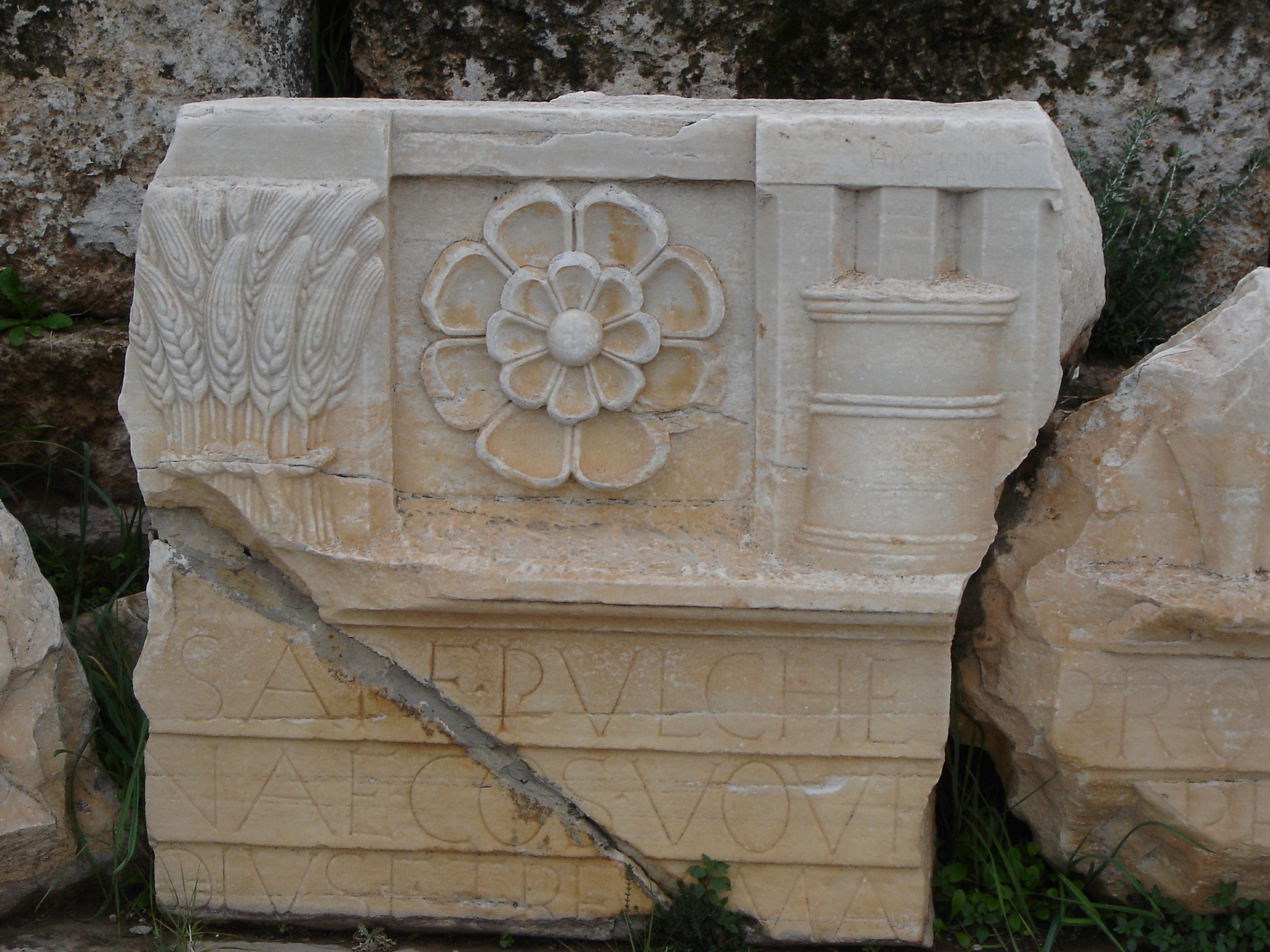
Symbols of the Harvest at Eleusis

Symbols of the Harvest at Eleusis

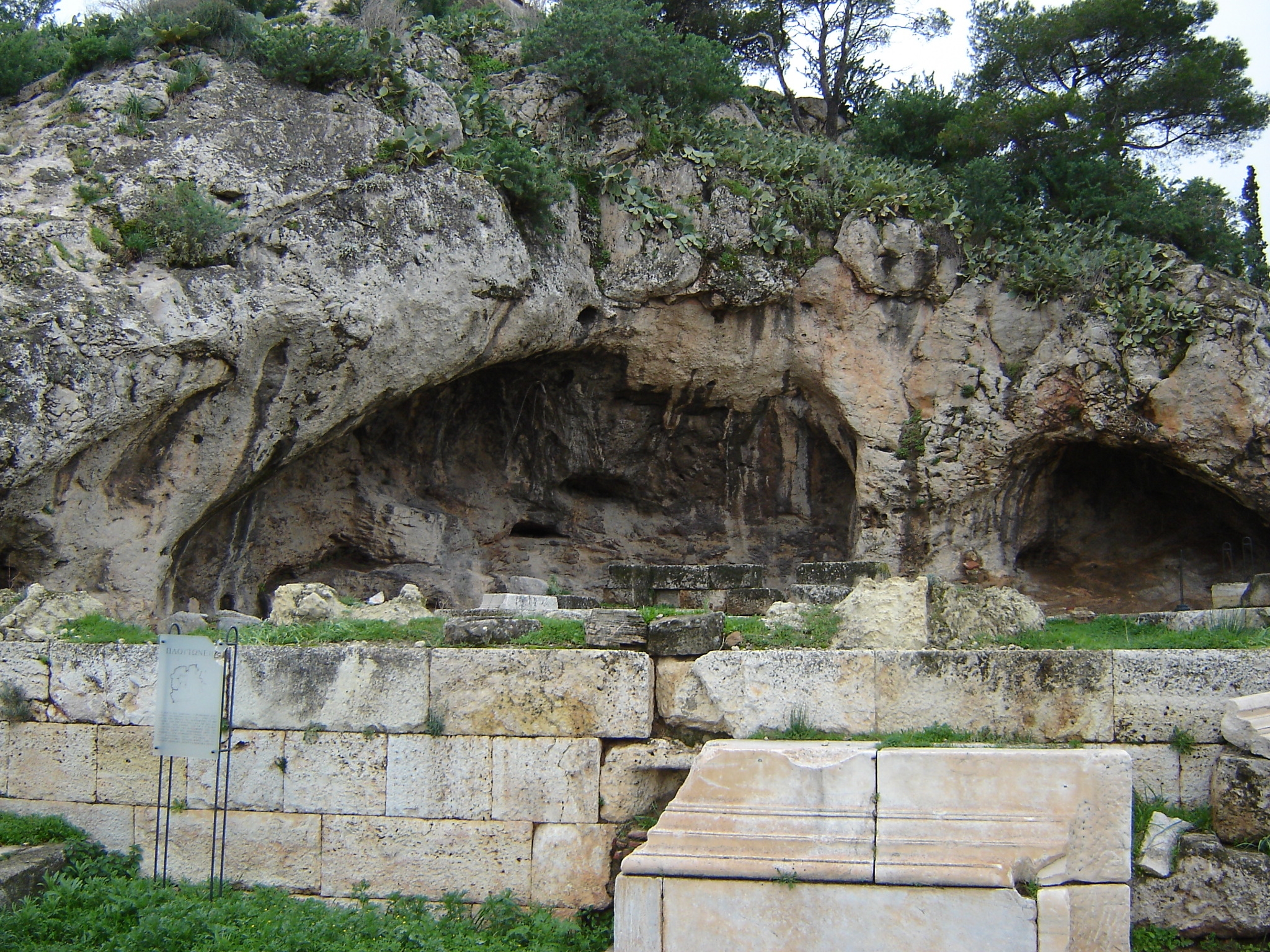
The site of Eleusis is itself an amazing archaeological site that is well worth the visit if ever you have the opportunity. Apart from the vast complex of temples, and other remains, you can see the cave where Persephone supposedly descended into the Underworld, a door to Hades’ realm. Facing the dark entrance is a well, known as the “Tears of Demeter”, thus named because of the goddess’ weeping in that spot. It’s a very moving place.

The 'Gate to Hades' at Eleusis

The ‘Gate to Hades’ at Eleusis

Let us not dwell too long in ancient Greece however, for our Celtic ancestors in Europe also revered this time of year. To the Celts, harvest time was also known as Alban Elfed (Welsh for ‘Light of Autumn’), and the Feast of Avalon (Feast of Apples) among other names.

apples

To the Celts, this was the time of year when the acorns fell from the sacred oaks and the last sheaf of wheat was cut by a young maiden. It was a time of reverence and thanks for the Earth’s bounty, a time to harvest once more, and to slaughter animals before the onset of winter. An offering of apples would often be placed on burials to symbolize rebirth, hence the Feast of Avalon, Avalon of course being the ‘land of apples’.

Harvest time, to the Celts, also preceded the sacred festival of Samhain which marked the end of the light of summer and the beginning of winter’s dark. Again, the cycle of light and dark, birth and death is an ever present arch-type, a cycle of which our ancestors were keenly aware and for which they had a deep respect.

The Isle of Avalon - Tor and flood (photo by Lynne Newton)

The Isle of Avalon – Tor and flood (photo by Lynne Newton)

So, as we sit to our laden tables this autumn, perhaps we should tip a bit of wine to the goddess who wept for her daughter’s departure into darkness, and for the end of light. When the harvest moon shines down on us in all its luminescence where we live in a world of concrete floors and steel girders, think of our forest and field-dwelling ancestors. They looked up at that same moon for ages from the dark circles of their sacred groves, and gave thanks for all they had.

Thank you for reading.


Facebooktwitterpinterest

In Insula Avalonia – Camelot: The Fortress of Arthur

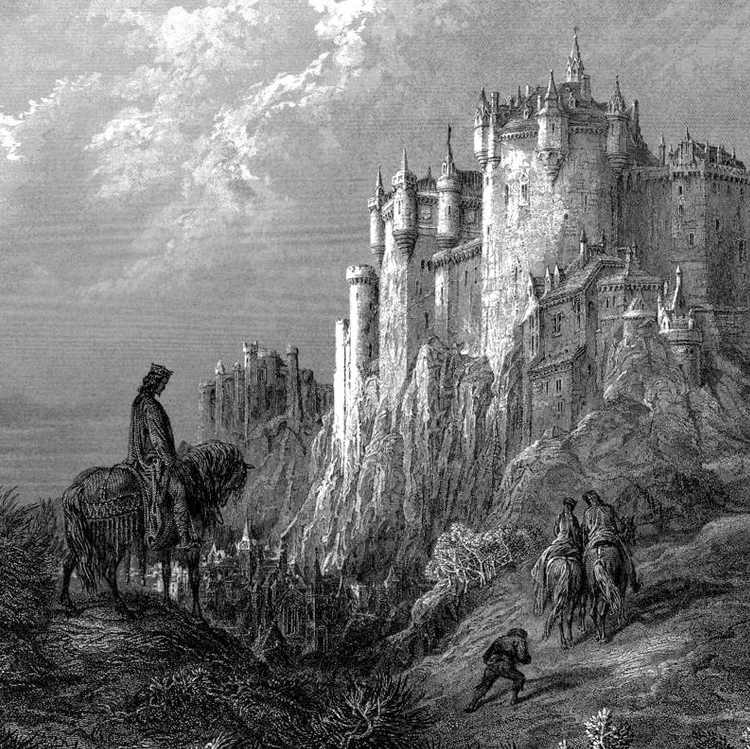
Camelot by Gustave Dore

Camelot by Gustave Dore

At the very south ende of the chirche of South-Cadbyri standith Camallate, sumtyme a famose toun or castelle… The people can tell nothing ther but that they have hard say that Arture much resorted to Camallate. (John Leland, Royal Antiquary, 1532)

Happy Holidays everyone!

Hard to believe we’re at the end of yet another year. How can so much happen in so little time? With time speeding by at such an alarming rate, History is, as ever, my anchor and touchstone.

This will likely be my last post of 2014. When I was trying to think of a suitable topic, it didn’t take me long to decide what better way to get into the holidays than a post about ‘Camelot’.

We haven’t been In Insula Avalonia since the springtime when I spoke about Glastonbury Abbey, and prior to that Gog and Magog, Wearyal Hill and the Holy Thorn, The Chalice Well, and Glastonbury Tor. If you missed those posts, you can read them on the old website. Just click on the names.

For Part VI of In Insula Avalonia, we’re going to look at a site that is just ten miles from Glastonbury itself: South Cadbury Castle.

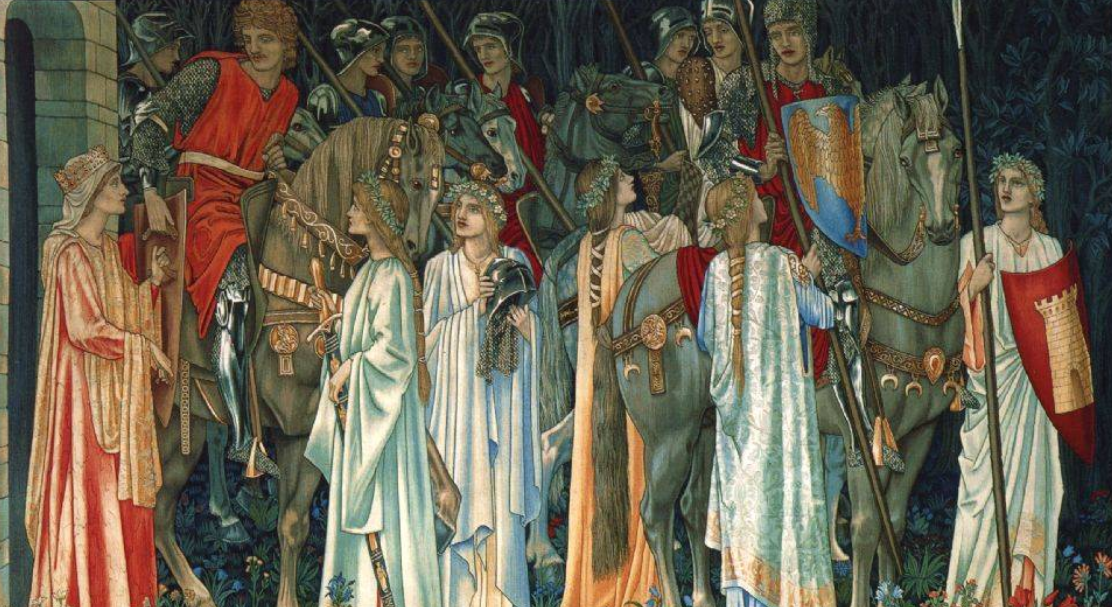
The Knights of the Round Table (Edward Burne Jones)

The Knights of the Round Table (Edward Burne Jones)

Now, South Cadbury Castle, like so many of the other places that we have discussed in this blog series, is a site with strong Arthurian associations. As such, its importance and role is hotly debated.

Was South Cadbury Castle the power centre of the historical Romano-British warlord, or dux bellorum, we know as ‘King Arthur’? Was this the actual site of what has come to be known in the popular imagination as ‘Camelot’?

I’ve always been a strong proponent of the theory that there was in fact, an historical ‘Arthur’ who formed the factual basis for all the legends we love and cherish. So, when I look at sites such as South Cadbury, I do so with that in mind. However, that doesn’t mean that I accept a site’s association with Arthur on faith alone.

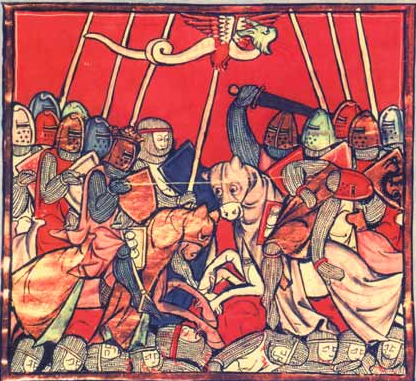
Arthur in battle beneath the Dragon banner

Arthur in battle beneath the Dragon banner

I know this site pretty well – as I studied it and wrote about it as part of my Master’s dissertation entitled Camelot: Comparing the historical, archaeological, and toponymic evidence for King Arthur’s Capital. As part of this, I looked at three of the main candidates for Camelot that had been put forward at the time – Wroxeter (Roman Viroconium), Roxburgh Castle (in the Scottish Borders), and South Cadbury. There is a copy of the dissertation hidden somewhere in the stacks at the St. Andrews University library in Scotland.

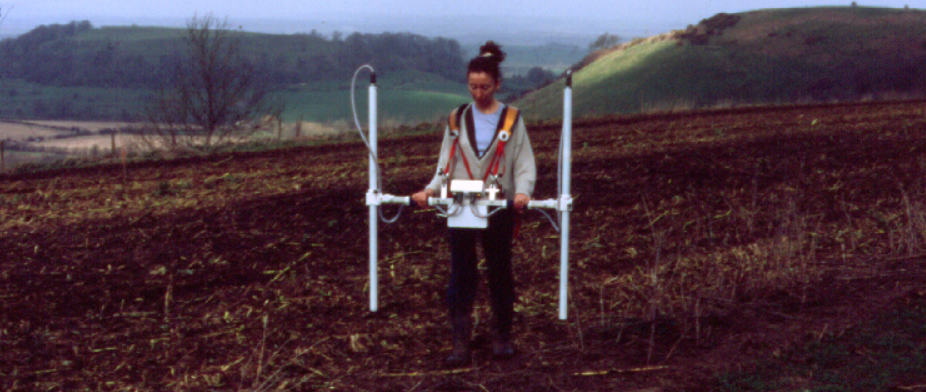
South Cadbury Castle is also where I cut my teeth as an archaeologist as part of the South Cadbury Environs Project team for a couple of seasons under the leadership of Professor Richard Tabor. This was a wonderful experience that helped me to get up close and personal with the site I had studied for so long – I dug test pits, got into bigger trenches in which curious cows came to watch what I was doing, carried out geophysical surveys with a magnetometer, and found some curious objects such as a bronze dolphin that formed the handle of a Roman drinking cup.

An archaeologist carries out geophysical survey at Sigwells with Cadbury Castle in the back left

An archaeologist carries out geophysical survey at Sigwells with Cadbury Castle in the back left

Most of all, I was given the chance to spend more time on this amazing, and yes, magical, landscape.

Before I give my thoughts on wandering the slopes of South Cadbury Castle, we should have a look at what it actually is.

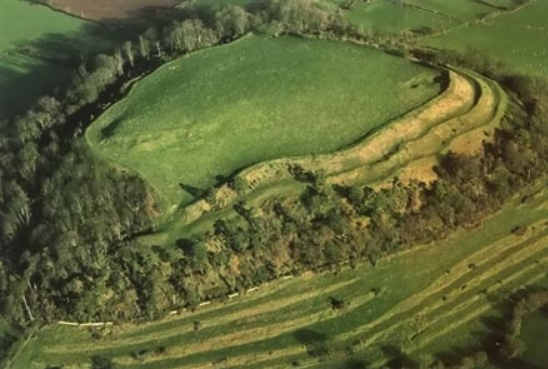
South Cadbury Castle is not the late medieval castle with banners flying from tall towers that make up our usual image of Camelot. It is a 500 foot high Iron Age hill fort located in the pre-Roman era lands of the Durotriges. Occupation of the site began in the Neolithic period and it went through various stages of occupation from the 5th century B.C. onward.

Camelot as portrayed in the movie First Knight

Camelot as portrayed in the movie First Knight

By the time of the Roman invasion of Britain, it had four massive defensive ramparts with an inner area of about 18 acres. Access to the top was by two entrances, one to the north-east and the other, larger one to the south-west. The Iron Age occupation of the site came to a violent end around A.D. 43 when Vespasian stormed the southern hill forts of Britannia.

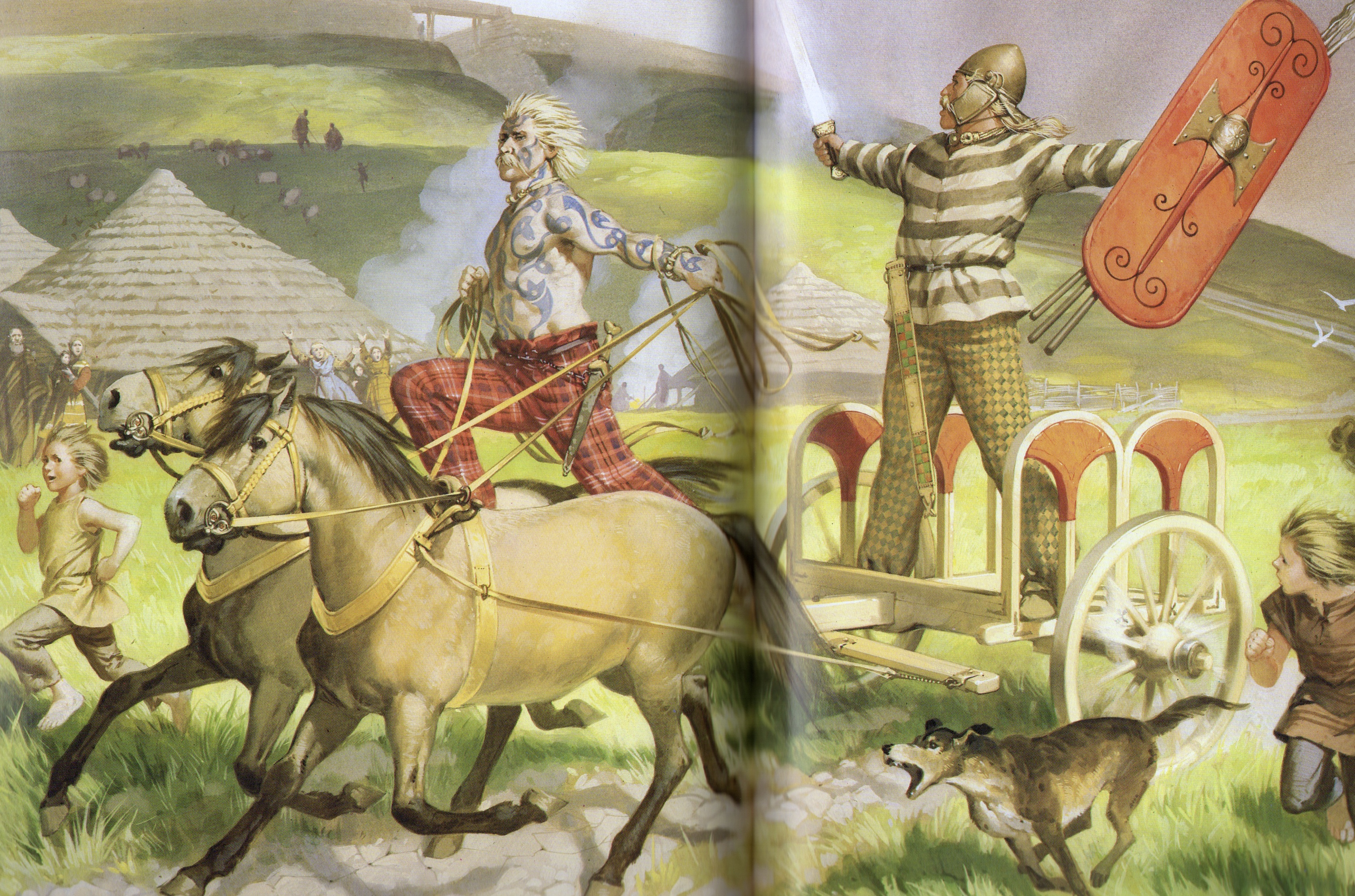
British Belgic Warriors of the Iron Age - Illustrated by Angus McBride (source - Rome's Enemies 2 - Gallic and British Celts)

British Belgic Warriors of the Iron Age – Illustrated by Angus McBride (source – Rome’s Enemies 2 – Gallic and British Celts)

The Romans made little use of the site, though there have been some theories that it was used as a Roman supply station.

In the 3rd and 4th centuries, there was renewed activity with visits being made to a Romano-Celtic temple that was built on the site. During excavations, a bronze letter ‘A’ was found that some believe belonged to this temple, which was perhaps dedicated to Mars, or some other deity.

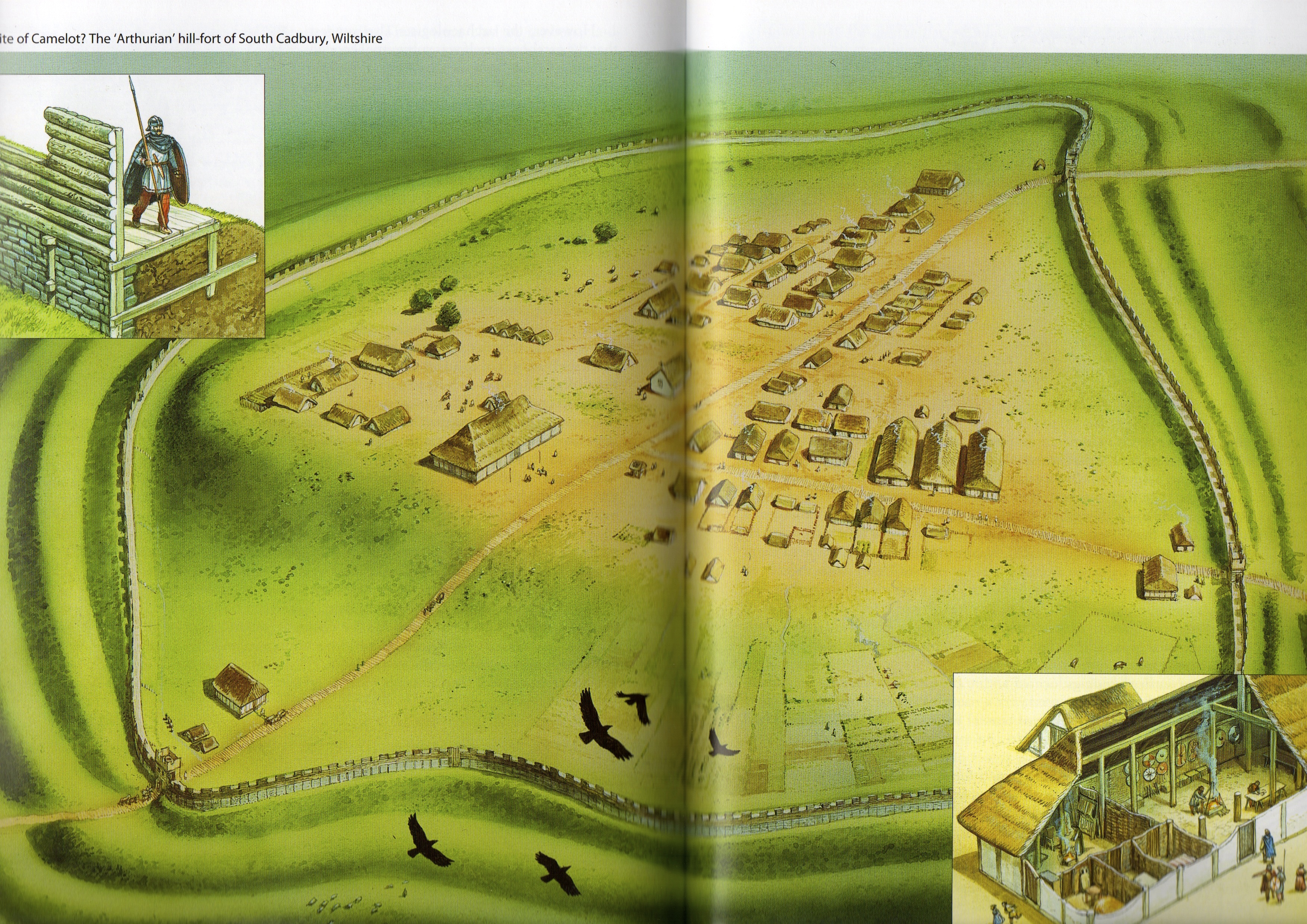
However, when it comes to South Cadbury Castle, the period that I am concerned with is the 5th and 6th centuries A.D. This period is known as the ‘Arthurian’ period, and it is at this time, after Rome’s legions have left the island, that the archaeology shows a massive refortification of the hill fort.

Artist Reconstruction of South Cadbury Hill Fort - Illustrated by Peter Dennis (Source- British Forts in the Age of Arthur)

Artist Reconstruction of South Cadbury Hill Fort – Illustrated by Peter Dennis (Source- British Forts in the Age of Arthur)

Though it is much debated, South Cadbury’s association with the Arthurian period stems not just from hearsay and folklore. It has the archaeological evidence to back it up.

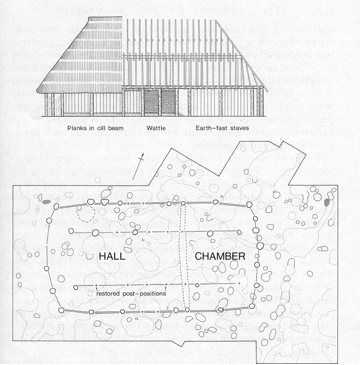
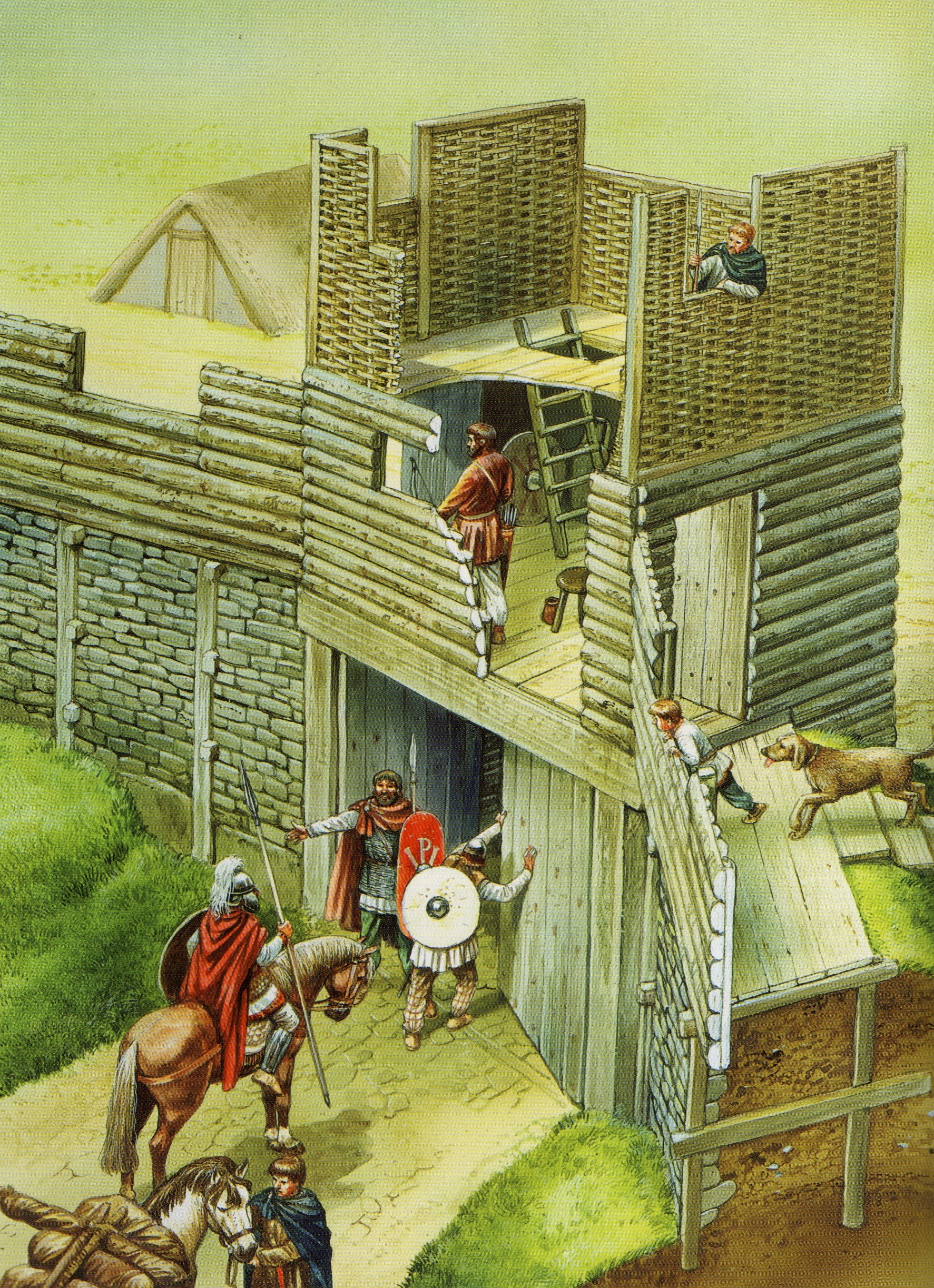
There have been a few big excavations of the hill fort over the years, but the biggest of all took place in the late 1960s and was headed by Professor Leslie Alcock. Professor Alcock and his team discovered evidence for a large scale occupation and refortification of the hill fort, during the Arthurian period, which showed repaired defences, including a strong gatehouse at the south-west entrance, and most importantly, several buildings, including a kitchen and a large timber hall on the fort’s high plateau.

South Cadbury Timber Hall

South Cadbury Timber Hall

The discovery of post holes reveals a finely-built timber hall that was on a large scale, measuring about 63×34 feet. This hall would not have been the great castle hall of late medieval romance, but rather something like the timber drinking halls of the period, more like to the Golden Hall of Meduseld, the seat of King Theoden in Lord of the Rings.

Another very telling discovery at Cadbury Castle was the large quantity of Mediterranean pottery that dates to the Arthurian period of occupation. This is the same pottery type that was discovered at Tintagel Castle in Cornwall, a site that also has strong Arthurian associations. One might think that shards of pottery from wine, olives and olive oil might be pretty mundane, but they anchor the sites strongly in the period, and also show that someone of importance was associated with the site. Not everyone could afford to import such things through trade.

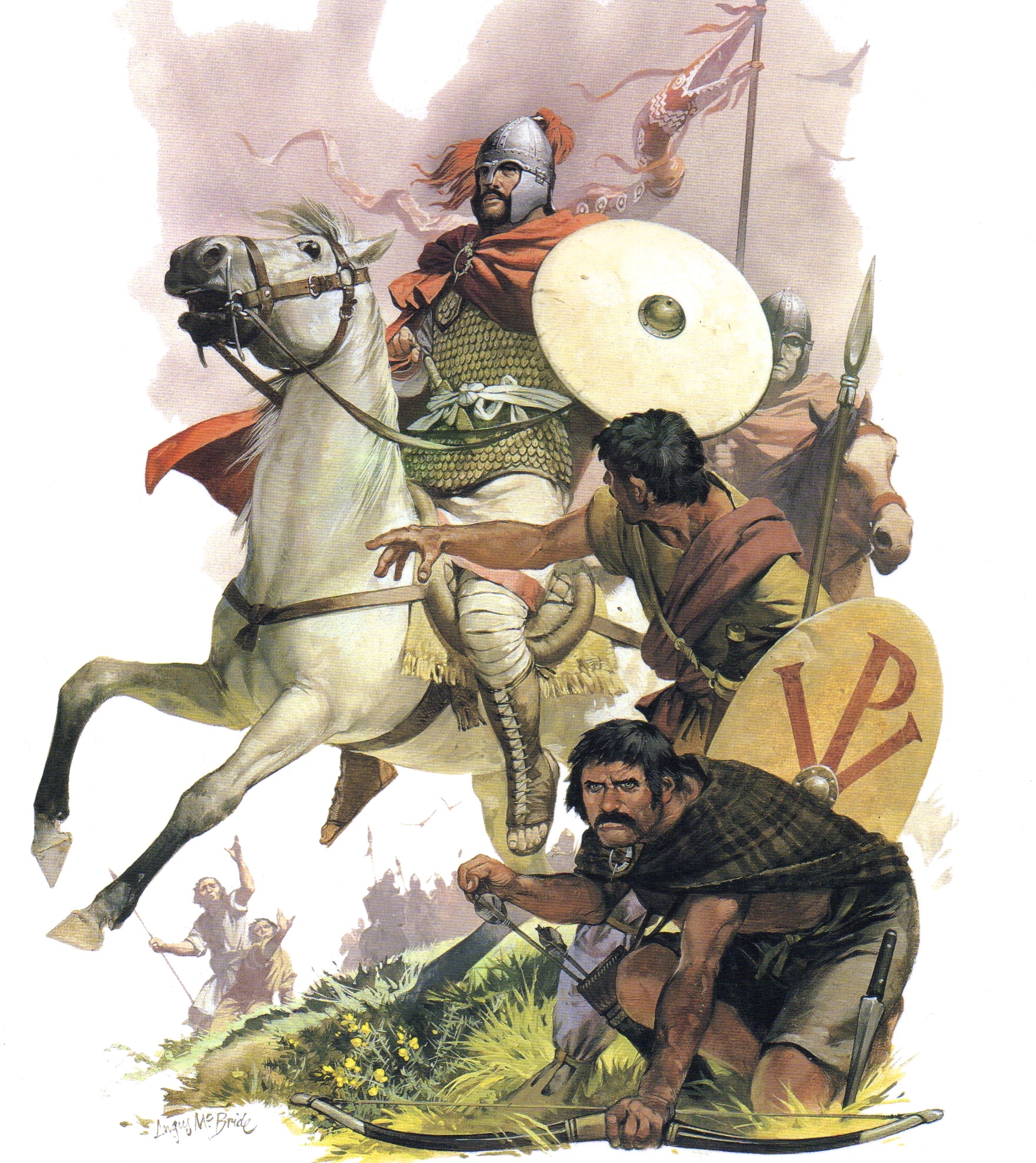
6th Century British Warriors - Illustrated by Agnus McBride (source - Arthur and the Anglo-Saxon Wars)

6th Century British Warriors – Illustrated by Agnus McBride (source – Arthur and the Anglo-Saxon Wars)

The refortification of the hill fort during the Arthurian period was on a massive scale, and would have required many resources and men to hold it. South Cadbury castle was, in a way, on the front lines of the British struggle against the invading Saxons, and would have been well-placed to meet the Saxons as they advanced westward.

Based on the refortification, and evidence of the gatehouse that linked the ramparts running over the cobbled road at the south-west corner, this place was likely the base for an army that was large by the standards of the period. It may way have been the site of the court of the dux bellorum, or the historical Arthur.

Artist Reconstruction of the South-west gate - Illustrated by Peter Dennis (Source - British Forts in the Age of Arthur)

Artist Reconstruction of the South-west gate – Illustrated by Peter Dennis (Source – British Forts in the Age of Arthur)

I am only scratching the surface here, as far as the archaeological finds. At a later date, I will do a more ‘academic’ post on the archaeology of South Cadbury Castle. It truly is a fascinating site that was finally abandoned in the early 11th century when it was being used as a royal mint during the reign of the Saxon king, Aethelred.

Today, South Cadbury Castle is a quiet hill in the midst of the Somerset countryside where it lies just south of the A303 motorway. The levels of its steep ring fortifications are now overgrown with trees and scrub, and cows roam the fields surrounding it.

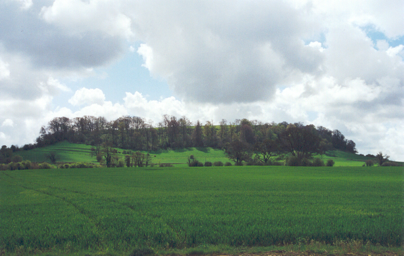
South Cadbury from the North

South Cadbury from the North

When you visit, you pull your car into the small car park at the south end of the village of South Cadbury, just east of the hill fort. From the lane, you can’t really tell what you’re looking at. It seems like a steep, forested hill with a path leading up.

This path leads up to the north-east gate of the hill fort, and for me, it was always the gateway to another time, another realm.

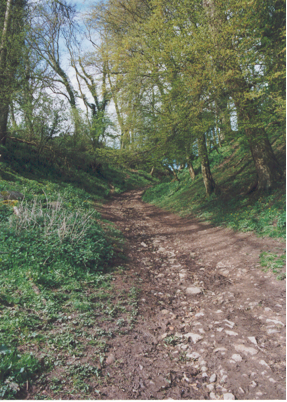
Path Leading to the North East Gate

Path Leading to the North East Gate

It’s difficult to approach this site and reconcile the archaeologist/historian side of me with the romantic. Arthurian lore runs deep in my veins, it has a hold on my psyche since I was very young. The first time I visited the site, I could almost hear the call of clear trumpets and the thumping of horses’ hooves upon the ground as knights returned home from their adventures, their horses brightly caparisoned, their armour shining brightly in the light of the Summer Country.

Of course, I know that is not how it was during the Arthurian period, but this is a place and story that fires the imagination. Cadbury Castle’s associations with Arthur include a hollow hill where he sleeps until he is needed again, the site of ‘Arthur’s Well’, a lane on the slopes where his horse drank when he led the Wild Hunt, and of course the location of Camelot.

To me, however, the idea of South Cadbury as the main fortress of a Romano-British warlord leading a group of skilled cavalry in a last stand against the invading Saxons is no less romantic.

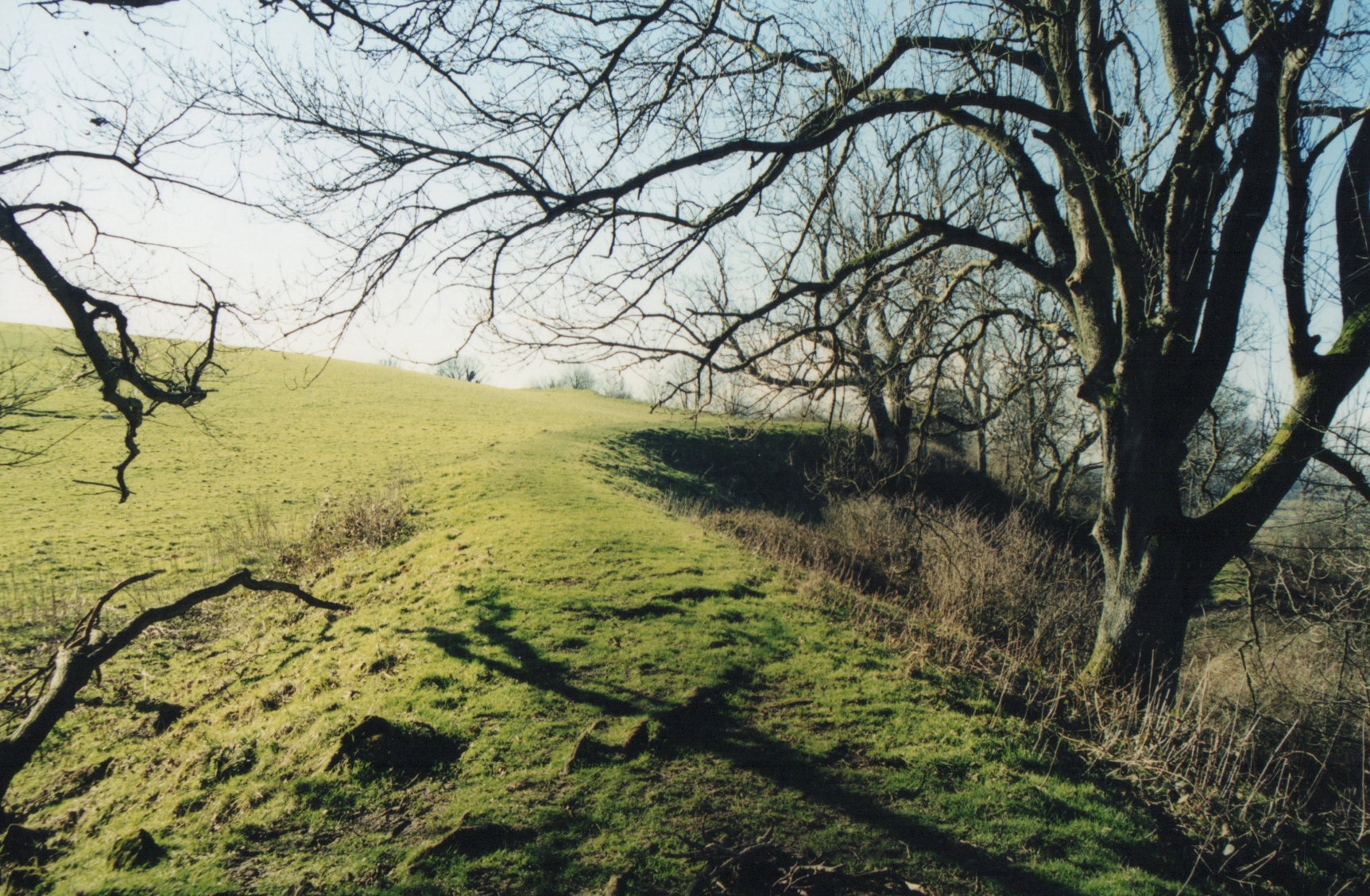
Northern Rampart of South Cadbury Castle

Northern Rampart of South Cadbury Castle

During my subsequent visits, I would ascend the dirt and rock path leading up to the north-east gate and pause with reverence for the history of the place. I would imagine looking ahead, up the slope to the central plateau of the hill fort to the great wooden hall where smoke from the hearth of Arthur’s hall wafted into the sky as he and his warriors discussed the fight for their lives and their Romano-British heritage.

The warriors that manned the ramparts of South Cadbury, who dined in the hall, and who rode out to meet the Saxons have been wrapped in the fabric of myth, as much as the Isle of Avalon not ten miles distant. But they certainly left a mark on the place, on history and folklore.

As I walk the grass-covered ramparts of South Cadbury, watching the crows dive in the winds above the steep slopes, I can’t help but wonder if Arthur, Gawain, Bors, Tristan, Bedwyr, Cai and others walked that same path, a wary eye out for a sign of the enemy that would shatter the peace they had fought so hard for at Mons Badonicus.

Rarely have I felt so at peace and nostalgic as I have when walking around this hill fort. I can still smell the damp grass and fell the sun on my face. In my mind, I still watch the puffs of white cloud blowing over the Somerset landscape as I pause to gaze to the north-west and see Glastonbury Tor rising out of the earth.

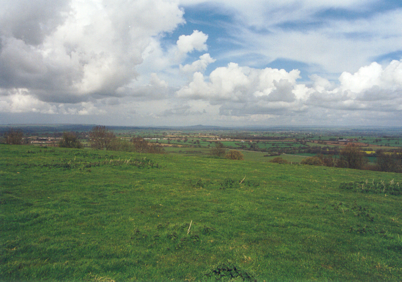
Glastonbury Tor from South Cadbury

Glastonbury Tor from South Cadbury

In ages past, when the levels flooded, the distance between Cadbury Castle and Glastonbury might have been crossed by boat if you knew the way and which rivers to take. Indeed, one of the discoveries found around the hill fort was a boat.

South Cadbury Castle is, in some ways, closely tied to Avalon, and you can feel that as you look from the top of one to the other.

After making a round of the ramparts, and standing on the roadway of the south-west gate, I would always spend a good amount of time on the plateau, watching the sky and letting my imagination take hold.

Plateau of South Cadbury where the timber hall was located

Plateau of South Cadbury where the timber hall was located

The beauty of visiting a site, rather than looking at in a book or online, is that direct connection with the past, with the history of the place.

Yes, many of the stories we know and love about Arthur and the Knights of the Round Table are medieval fabrications. But I do believe that every legend has its base in fact, and so it’s a comfort to know that the layers of myth and legend are veined with elements of truth and history.

Many people will disagree, and that’s ok. When it comes to Arthur we will never reach a consensus.

However, considering the archaeological evidence at South Cadbury Castle, along with its location and the apparent activity during the Arthurian period, it seems quite possible that if there was an historical Arthur, he would undoubtedly have been familiar with this magnificent hill fort.

Me (Adam) standing at the location of the south western gate house

Me (Adam) standing at the location of the south western gate house

Was this just another strong point in the British defensive network? Or was it the Arthurian power centre that has come to be known as Camelot?

Whatever the answer is, it is surely fascinating, and perhaps unattainable. But then, that is what makes these historical mysteries so intriguing.

If you ever manage to roam the lands In Insula Avalonia, just be sure to make your way to South Cadbury Castle. Walk up the steep slopes, and through the gate, and know that you may just be walking in the footsteps of Arthur.

Thank you for reading and have a wonderful, safe Holiday Season.

See you in 2015!

arial view of Cadbury Castle

Arial view of South Cadbury Castle from the South

Facebooktwitterpinterest